Remnantology

Dedicated to the examination of the remnants. Phil Levy's words in reference to history, archaeology, Judaism, academe, music, outdoorsing…

Dragons’ Den, UK….

Not being a big TV watcher I miss a lot. In many British comedies of my liking there are bits making fun of a sort of real life venture capital game show called Dragon’s Den. I got the gist from the likes of The IT Crowd and Harry and Paul, but I thought it might be interesting to check it out lui meme. Many if not all the eps are on Youtube so it was easy to find. There also are Canadian and American versions, but more on that later. The setting is a spare dark warehouse with a line of chairs inhabited by the posteriors of some “self made” business people. The first five mins of each ep is a paean to egos of these people narrated by a rather odd choice for a TV host. Then, once we are assured that only the shrewdest business minds would sit in a warehouse on TV, we are ready to meet the potential entrepreneurs who troop into the room one after the other for short-cut interviews or longer focus pieces. The idea is that each person or persons present their business idea in the best light possible and then after a grilling by each of the “dragons” (is that a real term or one they made up for the show?) the potential investors choose to invest or not. On one level, the show is a love letter to the market. But, over time something very different struck me. I could only make it through a few moments of the American one, but that was because that show opted for glitz and a quick cut separately produced promo piece on each entrepreneur before we saw the actual pitch. It was so painful, I could not make it through. But there is something raw and unplanned about the British one. What was really interesting though was how much it was actually a critique of the market masquerading as a love letter. The Dragons rarely pony up any money at all. More often, the hapless shmoes looking for backing skulk back to the stairs (or an elevator in later seasons) empty handed, dreams kicked to the ground. The message is very odd. Rather than being a tale of people following dreams to success, the take away really is “your idea is stupid and you are a moron for thinking of it and the wealthy investors who gate keep the market hate you for wasting their time, now leave! I’m out!” Is this good?

http://www.youtube.com/watch?v=4IGKAG-oo6k

Recalling the Jews of Falmouth

Early on Erev Yom Kippur, aided by sections of Keith Pearce’s and Helen Fry’s book The Lost Jews of Cornwall I took a break to explore the Old Jewish Cemetery in Falmouth, Cornwall. The University of Southampton’s  Mark Levene clued me into the fact that it happens to be right on my walk between Penryn and Falmouth across the road from the Sainsbury’s. The eternal and the fleeting cheek by jowl.

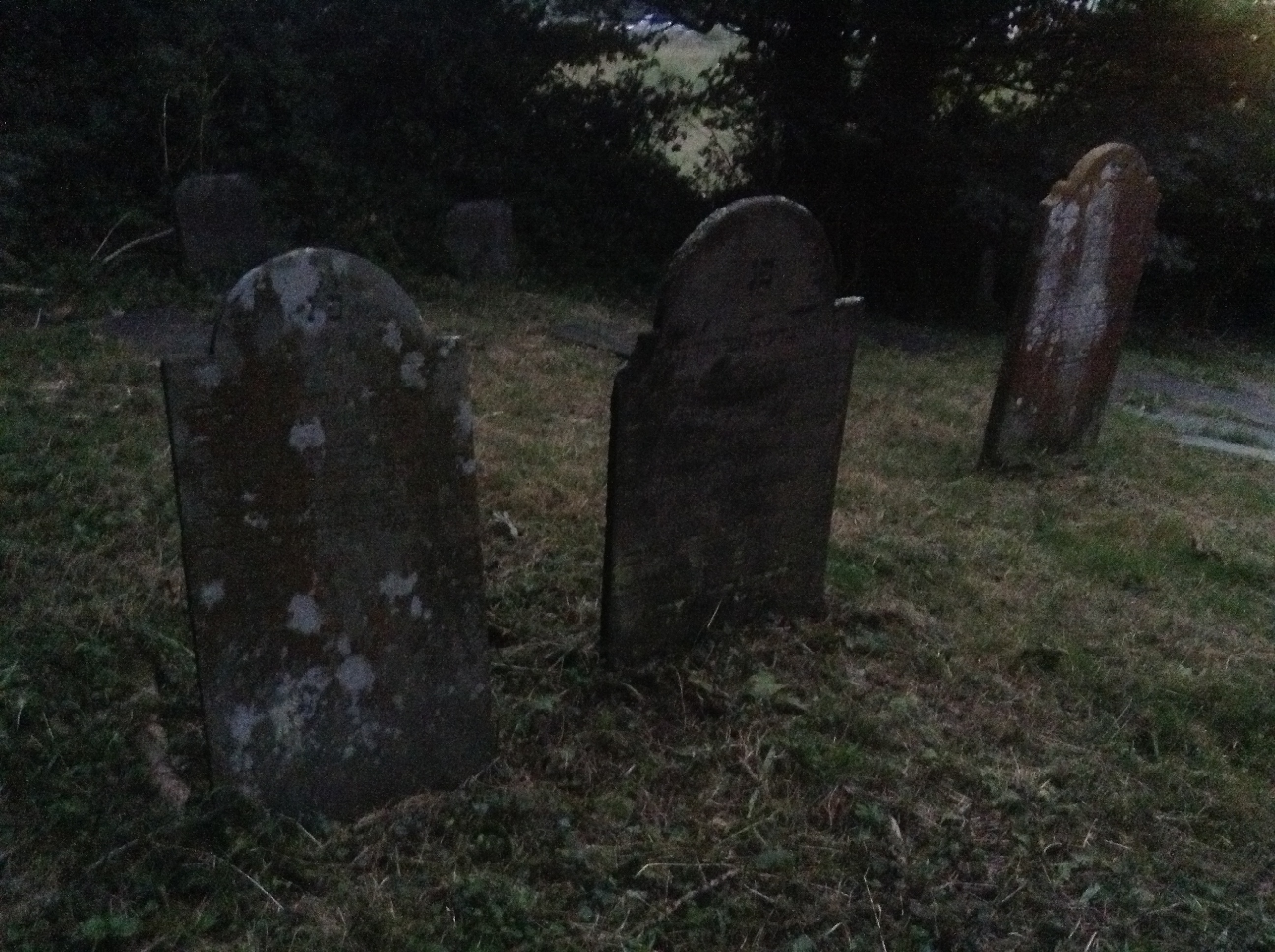
I pushed through the overgrowth and crested collapsing stonewalls to find the three-dozen some odd headstones that make up the remains of what was once a strong but small Jewish community. As that celebrated English drizzle fell, I sang Tehilim (psalms) for my bothers and sisters there interred and wished an elevation for each and every one of their souls.

Stones in the Falmouth Jewish Cemetery on the A39.

Stones in the Falmouth Jewish Cemetery on the A39.

The stones were mossy and many were toppled and broken, but many were still readable (but Pearce’s and Fry’s work was there to fill in the gaps). Some inscriptions were quite plain providing little more than a name and a wish for external life. Some hinted at family tragedies like the fact that Yissachar ben Yoel HaLevi and his son Levi both passed away in 1791. What a loss for the family as well as for this then quite small band of Jews. An undated stone marked the grave of Yoseph, infant son of Lyon Yoseph and his wife Yehudit. Moshe ben Yisrael who died in 1798 was recalled only as being an unmarried man— the first time Moshe wore a tallit was to be buried. How are we to understand that subtle but nevertheless heavily freighted lament from within a community that had to cling tightly together to survive?

Many of the stones hinted at the process of adaptation that Jews have undergone wherever we have settled. Names—some written in English and some in Hebrew—revealed the workings of that familiar process whereby we have our real names—the ones that function within the community, the names called out in synagogue, first ours and then our father’s (“ben” meaning “son of”) when we are honored or when we are ill and the congregation negotiates with God to heal us (and, as the wonderfully contractual prayer also says “and for all Israel as well, amen”), the names we are given soon after our births and the names that in the end, the stone carver will chisel on our tombstones. This naming game is a brilliant one—intended or not. Their simple familiarity erases time. There is no fashion in these names—nothing to make people seem quaint or antique, nothing to make them seem at all of a different time. No Pheobes or Alonzos, no Winifreds, Theodores, or Gouevenors to make one think, “hmm, don’t see that name much anymore.” Likewise, there are no Ambers, Tiffanys, or Tylers to seem so of the moment. Instead, we use the same names over and over so that people, dead these two centuries, bear names no different that those around us now.

Jacob Jacob of Falmouth painted around the time Darwin was in town.

Jacob Jacob of Falmouth painted around the time Darwin was in town.

Yitzhak ben Yoseph (a reversal of my own father’s name), Yishaya ben Moshe, Uri ben Zvi, Yakov Eliahu ben Naftali, Yehuda ben Yehoshua and so on—nothing in these names hints at epoch—they are no different than we hear week after week in synagogues all over the Jewish world. Time and space vanish thanks to a simple paring of a son’s and a father’s name.

But Jews have long lived amidst people with whom we did not share our real names, or frequently people whose naming styles we took up and made real in a new way. The Falmouth stones show us this process at work. Yissachar Behr ben Yoel haLevi conducted his daily affairs in Falmouth as Barnett Levy while Yakov ben Moshe was known to his English neighbors of the early nineteenth century as Jacob Jacob of Falmouth.

The stones also hinted at ethnic and gender differences as well. Whereas the men mostly had biblical names, many of their wives were recalled with altogether less formal Yiddish names. Yetle, Feigele, Gitteleh, and Beila show unmistakable family roots on the continent. But at the same time, names like Saavil on one stone and the de Pass family from South Africa (a Sephardic family noted by Pearce and Fry) show diversity even in this singularly Ashkenazi community.

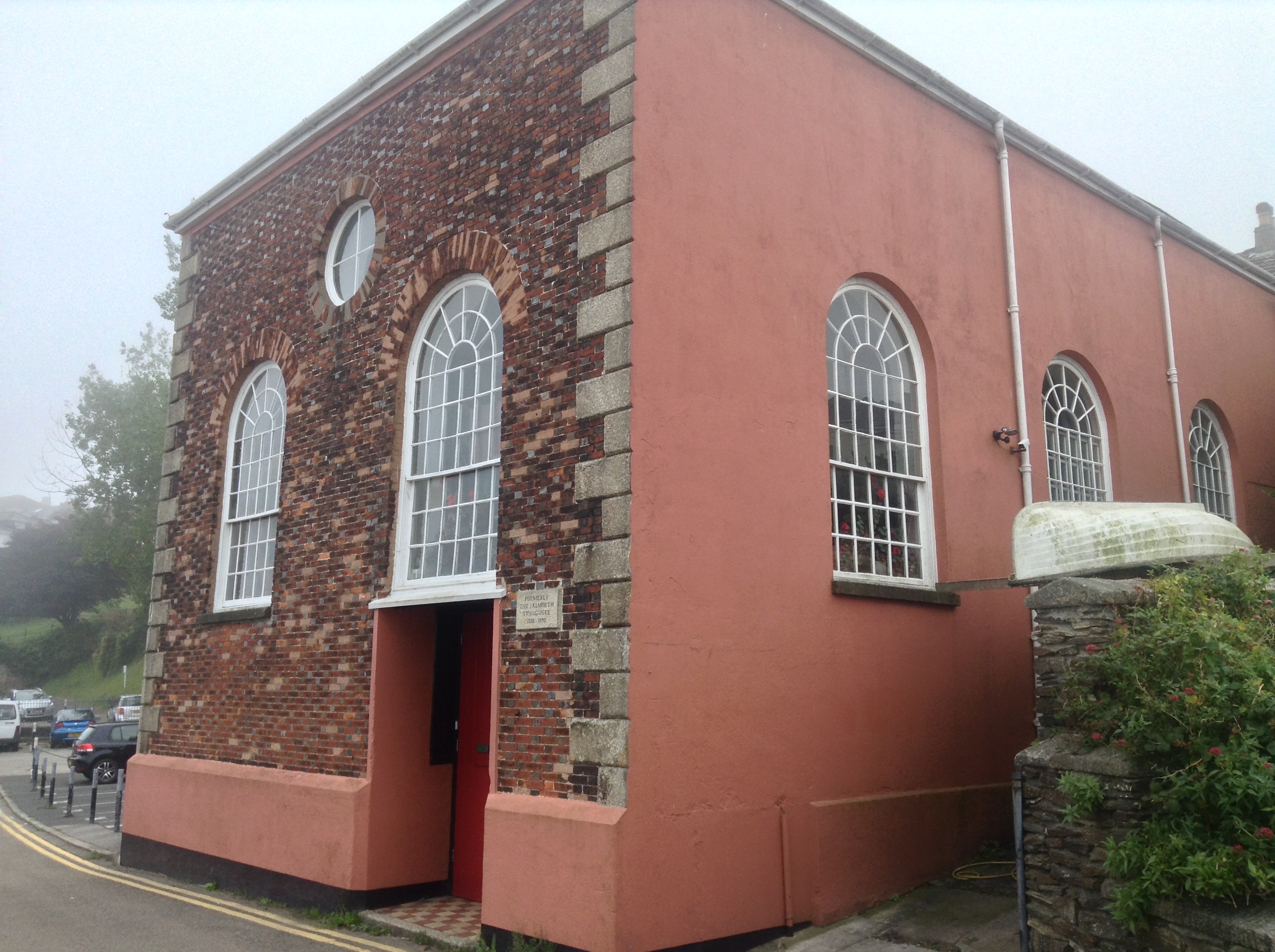
A few days later I found the old synagogue the community built about 1800 and which Britain’s Chief Rabbi ordered sold off once the community had faded away in 1888. It was a simple but distinctively German style shul with red brick and local stone coynes along the front corners. Its tall windows offer just enough of a glimpse inside to make one wonder what else survives therein.

The Old Falmouth Synangogue, 1808 - 1888.

The Old Falmouth Synangogue, 1808 – 1888.

The shul has a commanding view of the harbor below. It sits at the top of a street called Fish Strand Hill. At the base of this hill there is a plaque that says that Charles Darwin boarded an overland stagecoach at this spot on Sunday October 2nd, 1836 after the Beagle had laid anchor in the harbor. That day was also the 21st of Tishrae 5597—Hoshanah Rabbah (tomorrow), in the last days of Sukkot. At that time Falmouth’s Jewish community was in full flower and would have been in shul carrying lulavim and parading around the bimah. I consider this because I am here writing this during the same week in Tishrae passing Sukkot in Falmouth amid the ghosts of a lost community and their still living names.

“Ask A Slave” and Unintended Meanings

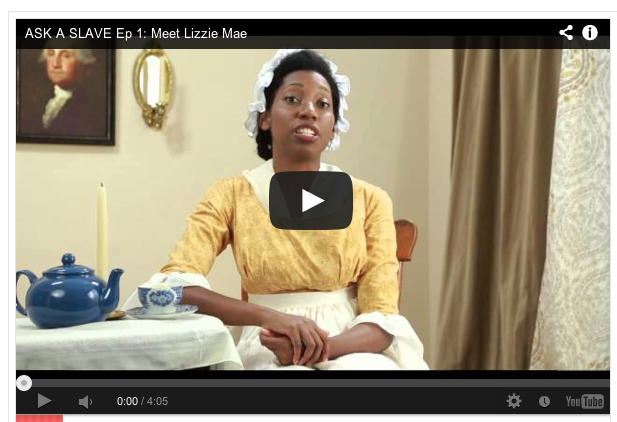
http://www.gofundme.com/AskASlave

http://www.gofundme.com/AskASlave

These videos have been making the rounds and I wanted to comment on this all. Yes, they are clever — even very clever. Yes, Dungey is talented and this is an imaginative way to promote herself as an actress and hit some social consciousness bells along the way. I respect her and her project and look forward to seeing how students react. But at the same time, it made me squirm on so many levels and raised some red flags.

The Stupid-Visitor-Question-Story genre is a staple of museum culture– and as Handler and Gable amongst others have pointed out, that is not always a good thing for either visitors or museum staff. Interpreter-visitor encounters are usually imagined as being a charming educational moment. But often these are in realty tense tug-o-wars with smugness on both sides and a high degree of trying to embarrass as well. At least visitors have the option to ask intentionally stupid questions to make their friends laugh–I suspect that that is in fact what is behind many if not most of these stories–visitors intentionally screwing around with staff. In that way, visitors get a double bang: make friends laugh in the moment and have the more incredulous repeat the feat over and over. Hey presto, a manner of immortality.

On the other hand, for interpreters, encounters are full of risk. Staff may suspect that they are being screwed with, but face employer retaliation if they get too snarky. Interpreters have to treat every question as real and have to be engaging in responding – their continued employment depends on it. Thus, the Stupid-Visitor-Question-Story genre becomes a sort of spiritual haven for people who are paid poorly, work their asses off in often harsh conditions (being in a blacksmith shop or a recreated eighteenth-century kitchen all day sucks now as it did then) and also will never be granted much intellectual respect or credibility from academe. These folks often see themselves (rightly or wrongly) as permanent second-class citizens in historyland. Most lack the kinds of schooling and publishing records academe cherishes, but do have often very detailed fine- grained knowledge of their fields. On top of that, they often have an intuitive knowledge that comes from experience—-something that is immensely valuable to museums and visitors, but always just a bit suspect to “book learning” historians. Buy an experienced interpreter a drink and they will tell you how irritating visitors are. But buy them a second drink and they will tell you what arrogant exclusive jerks historians can be.

What worries me about these film clips is the stupid visitor story being too public a performance. I see it as only encouraging visitors to play at this even more. But worse still, I worry for how museums (read employers) will see this. They are famous for retaliation and are always deeply concerned about public image. I don’t imagine that Mount Vernon is at all happy about this sort of “unmasking” and I wonder what HR policies may ensue not just there, but elsewhere as well. It is fun to laugh—and Dungey is good at making us do that. But, museums are workplaces and interpreters are staff, often very vulnerable staff at that. These clips viewed that way are so very full of issues of domination and resistance. The very title “Ask a Slave” is far more meaningful than most gleeful watchers might know.

Reenactor Divisions

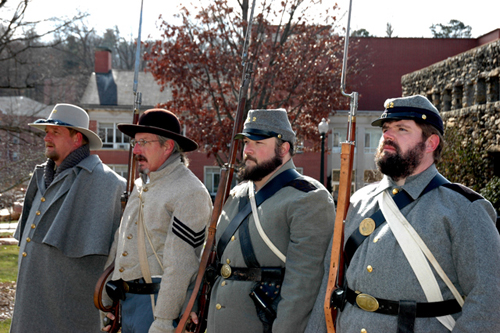
Tony Horowitz made famous a certain divide within the Civil War reenactor community–the dived between so called ‘hard cores’ and the rest. In reality though divides were always more complicated and nuanced. This essay from Jesse Marx on Salon.com highlights the divides made more pronounced by the rise and decline in popularity of the hobby–the same sort of issue I wrote about a few posts ago. I was with this group for one event many many years ago, although the membership has no doubt changed three times over. Particularistic units like this face a unique problem that marginalizes them from some reenactor visions. Uniquely uniformed groups help make an embarrassing patchwork that emphasizes the eccentric in place of the common. An event will never have more than a handful of these uniquely uniformed men, and that can never look like a company or regiment as they would have been in the field. So instead you get a surrealistic mix that undermines the attempt at uniformity (within limits) one would have seen on the field. People are attracted to these singular uniforms, but often for simple peacocking reasons and nothing more. Men wearing their best ordinary issued uniforms have a flexible generic quality that better represents what the armies in the field looked like.

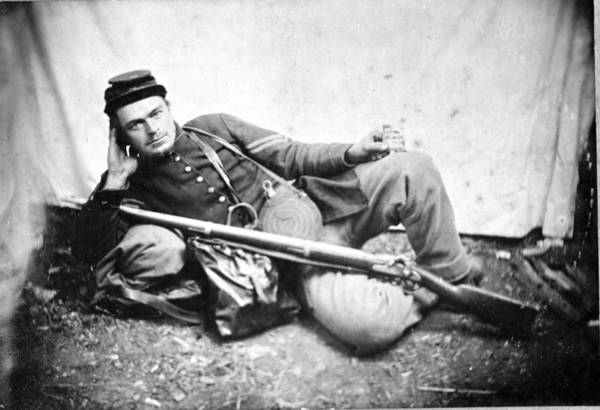
Crpl Ignatz Gresser: Hard Core model and man of style.

For that reason, so-called ‘hard cores’ long ago adopted a “commonest is best’ approach for most events while sewing specialized kits for rare appearances. Back in my day (the beginning of the ‘hard core’ movement), we used to invoke one man–a Pennsylvanian named Ignatz Gresser–as the model to look to. Apart from his obvious force of character, Gresser was as ordinary as a man could be. Everything he had was plain issue–probably mostly Schuylkill Arsenal–and he is clean and tidy, not shaggy and silly. It was the habit of many Pennsylvania non-commisioned officers to adopt the dress frock coat since regulations allowed only for stripes on these coats, and not on flannel fatigue “sack” coats. No “baseball”  rounded brim, Gresser shows ideal hat posture for a cap made as they were then (and usually not now) and notice the hardtack flare. He is simply dreamy!

The advantage of this approach is flexibility and good representation. A patchwork army of every colorful oddity that may (or may not) have one time appeared on a battlefield was always something we derided. Nevertheless, even through the 14th Brooklyn is an odd place to land for Marx’s discussion, his is a very good one.

Painting Perspective / Teaching Paintings

Travels happened me by two major Civil War sites this summer. Of course I had visited both Gettysburg and Antietam many times before, but I thought that the detours were well worth the extra miles and gas so that I could see these places in the midst of the 150th celebration. I am working up a week’s readings on the 150th for my seminar this fall and was also fishing for assignable tidbits. I wanted to see both of these sites because of the special role they have played in Civil War landscape memory. Both are gems—beautifully maintained acres, shaped vistas, and of course amazing collections of monuments. Proximity to Northern railheads made these places the most commemorated battle sites and that century-old legacy has made Gettysburg, at least, a massive tourist site.

Both sites have well placed museums that work well with the site’s story and the flow of visitation.

Antietam on a perhaps digitally enhanced beautiful day.

Antietam’s museum is the older of the two, although it is very proud of its new introductory film—a reenactor-heavy narrative of the campaign peppered with talking heads like James McPherson. Gettysburg has a newly-built state of the art visitor center reflecting current museum trends and is a magnificent shrine to all things Civil War. Its equally new film, though, is a Gilder Lehrman Center product, and as a consequence is very current and comfortable with the political context of the battle and the war—something usually less evident in this genre. Visitors receive a sophisticated lesson in the politics of slavery and the war itself.

Both museums, much to their credit, devoted space to discussing landscape memory and the creation of these places as battlefield parks. Unsurprisingly, though, most visitors passed through these areas somewhat quickly—perhaps too quickly. But in both museums what caught my eye was a lamentable example of Civil War myopia—that familiar inability of some enthusiasts to imagine a past outside of 1861 (or maybe 1859), to 1865. In this case, it was connected to paintings both museums display.

Both Gettysburg and Antietam display breathtaking works of nineteenth-century art even though neither treats them as the masterpieces they manifestly are. These are paintings of battles scenes, Gettysburg’s is the work of a master and his crew, while Antietam’s are more vernacular in approach. Both sets of canvases are well known—so I am making no claim to a discovery here.

A small section of the Cyclorama.

The Gettysburg “Cyclorama” was the core of its own much-visited auditorium long before it was incorporated into the new NPS visitors’ center. The five Antietam battle scenes may be a bit more obscure, but they were included in Time Life’s much-read Civil War series, giving them a wide audience. My point, or rather what struck me on seeing them on this visit, was not their well known existence, but rather, the way their “artness” is all but ignored—subordinated—to the battle narrative at the center of the museums’ battle stories.

In both cases there is good and compelling reason to talk about these paintings as art, and not just as simple imaginary windows into the battle as they are currently viewed. At Gettysburg, visitors see an admirable Gilder Lehrman film and then walk upstairs to have a guide use lights and recordings to awaken the climactic moment of Pickett’s Charge on the third day of the battle. The vehicle for that experience is a vast painting (or set of paintings, really) that make up a huge 360 degree panorama augmented by wonderfully evocative landscaping that begins where the canvas ends at the floor. As lights come on and off , recorded explosions and dramatic “glinting bayonets” language create a “you are there” feel, and people love it. But what they are loving is a late nineteenth-century form of popular entertainment. Indeed, there were several of these immersive environments that patrons could see from Coney Island to the various expositions as well as all over Western Europe. This is the same art form that one can still enjoy in a more “naturalistic” setting in cases at the Smithsonian Museum of Natural history or at New York’s version, to name just two. Realistic, grand, and employing a brilliant level of craftsmanship, what makes the Gettysburg Cyclorama so gripping is all—all—the brushwork of master craftsmen.

In this case the artist was Frenchman Paul Philippoteaux and a team of selected workmen.

Philippoteaux at work

Nearly 20 years after the battle, he studied the area, commissioned detailed photographs, and spoke with survivors and then set in to create a true masterwork. But despite his research, the painting is oddly French. The soldiers wear uniforms that are clearly French in cut and markings–well beyond the French influence common in American uniforms of the time–and much of the equipment is French in form as well. The main house in the image is not made of the stone it was in real life, but is instead plastered brick in a French style, and most tellingly, large conical French haystacks dot the Pennsylvania fields. The result is an American moment filtered through French artistic eyes—one wonders if what we are seeing is Gettysburg, or some sort of Franco-Prussian War parable. These are wonderful jumping-off points for discussion. Yet, during our visit, the guide never even mentioned Philippoteaux (even though the paintings’ first showings boasted the painter’s name as loudly as the word “Gettysburg”).

The old Cyclorama

Visitors’ questions afterwards focused only on “who was where,” and no one felt any need to inquire about the art they were loving so—and no official papers or voices on hand even suggested that they might want to. Julia King has written about how museums’ uses of seventeenth-century Dutch paintings to describe uses of found artifacts work to superimpose antique discussions of class and gentility, and naturalize the effects of those hundreds-of-years-old texts.[1] We see the same thing here. These paintings were meant to teach, commemorate, and entertain—with an emphasis on the latter two, especially considering that still-living veterans were a major visitor constituency. Indeed, the paintings still serve these goals, except in that now the notion of teaching seems to have outstripped the other two missions—this art is a surrogate vantage point, a means of time travel, and an unquestioned authority for visitors. All of this grants a unique validity to a very singular artistic vision while rendering invisible the artist(s) and the process and logic of the paintings’ creation. That is a shame really.

A similar thing happens at Antietam. There, five huge battle scene canvases portray crucial moments of that messy and poorly executed fight.

James Hope’s painting entitled “Artillery Hell.”

The paintings were the work of James Hope—a painter and Union veteran who painted these remarkable canvases in his Watkins Glen, New York workshop around 1892. In time the paintings ended up in a church and in 1979 became NPS property. The NPS does a good job of telling a small version of their story online, and the exhibit gives a wonderful description of the effort to save one of the damaged canvases. But, there is almost no effort in the display to talk about Hope, how and why he made these masterpieces, or even the larger context of survivor art. Again, the result is that the paintings are simply teaching aids—a role that misses an huge opportunity and sells these works short.

Both settings have the physical space to discuss these paintings as art. I suppose what is missing is the interpretive space. I hope that  can change and that visitors can see this moving remarkable art as art.


[1] Julia King, “Still Life with Tobacco,” Historical Archaeology 41:1 (2007), 6-22.

Nat Turner’s Long Silence

Several years ago I began visiting the sites of the Nat Turner slave revolt in Southampton County, Virginia. My interest began after teaching an early American slavery class and spending some time with the work the revolt, particularly Steven Oates’s The Fires of Jubilee: Nat Turner’s Fierce Rebellion and Kenneth

southampton

Greenburg’s Nat Turner: A Slave Rebellion in History and Memory.[1] I was particularly spurred on by Irving Tragle’s older but still quite useful source book The Southampton Slave Revolt of 1831: A Compilation of Source Material, Including the Full Text of The Confessions of Nat Turner.[2] My goal was to locate what I could find of what survived of the old landscape and see what there was to see.

I brought a team of archaeology students there for the first time in 2003 (as memory serves) and we drove around guided by Tragle’s 1960s photos of then-still-surviving homes as well as some of his hand-drawn maps. I matched those up as best as possible with a county map and off we set to see what we could see. My reasoning was simple. If a building was still standing in the 1960s, there was at least a chance that it was still standing in 2003. We whirled up and down the region’s dusty roads stopping here and there and looking over the land.  We even knocked on doors to see what local people knew. It was fascinating to hear how they spoke of the events and their landscape. This was particularly valuable to me as I had made a conscious choice to avoid the official arbiters of the landscape and its stories—a strategy I always employ and highly recommend. Learn a place first using your own resources and then only later turn to the “officials.”

After much valuable trial and error I was able to locate four buildings still on their sites—including the ruined Whitehead, Porter, and Edwards houses.

The Peter Edwards House in 2006. Now gone having been dismantled the following year by salvagers for its framing members sold to developers in northern Virginia.

The Peter Edwards House in 2006. Now gone having been dismantled the following year by salvagers for its framing members sold to developers in northern Virginia.

Since then, subsequent annual trips have allowed me to see the loss of the Edward’s house and watch the ongoing decay of the Whitehead house. One benefit has been getting to know one local farmer and his wife. The family owns much of the land and some of the most important sites, but, as is so often the case, is not on good terms with the local official history folks. But, my farmer friend has been more than willing to grant me access to the site, share his collection of found objects and his and his family’s own life stories. He showed me the site where the former owner disposed of the old Whitehead family grave stones to gain more plowing space and is even willing to allow me to excavate some day perhaps. He invited Colonial Williamsburg architectural historian Matt Webster and I to do a sustained “crawl through” of the Whitehead House ruins–a considerable risk since the ruin could collapse at any moment. I also located the cellar hole of the Francis House, and a trip into the woods on the advice of another aged neighbor showed me the plywood-covered remains of the home which had been moved in the 1980s. Two other buildings survive, one restored and occupied by a Norfolk lawyer and the other, the Rebecca Vaughn House, was long ago moved to a park in Courtland and all but abandoned.

Over the years I have brought a few dozen students around the land, toured friends and professional colleagues, and even drove the Smithsonian’s Museum of African

The decaying remains of the Whitehead House. Hidden away far from the modern road system and on private land.

The decaying remains of the Whitehead House. Hidden away far from the modern road system and on private land.

American history’s director Lonnie Bunch over hill and dale to see what might fit the museum’s needs (as far as I know, nothing much came of that adventure) But, I have not written about it. Why have I not done that? Like the nation, I have helped Turner continue his long imposed silence.

That question bugs me. The easy reason is that Ferry Farm and George Washington have kept me pretty busy. Another problem is that this might need to be a first person essay and that is a tricky thing. Mostly though it has been hard to see the hook, but I am getting close though, and this entry is part of getting those ducks in a row. Here is what I learned in preliminary form. For one thing, I am pretty sure that the ruins of the Porter House and the now lost Edwards House probably post-dated the revolt even though local stories set events there. For another thing, there is no real possibility of doing any meaningful historical preservation on this landscape. It is in fact virtually forgotten and entirely un-commemorated. Race and divisive local politics play a huge role in this fact, but there is as many have noted, a larger national lack of willingness to come to terms with Turner. Local memory is a carefully guarded commodity making treacherous political shoals. What it comes down to is that no one really wants to talk about Turner, and thus no one does, or at least when they do it all within a carefully constructed framework.

Nevertheless, what matters about this landscape still is its emotional power. I have seen people’s reactions and there are something. There is something amazing about standing by the ruins of the Whitehead House. Although it underwent some changes, study of its collapsing subfloor framing showed that at least that part dated to the late eighteenth century—this was indeed the house that Turner and his men visited. With some work and careful crawling I have made my way to the spot where Turner’s ally Hark cut off Katherine Whitehead’s head at her doorstep. We have seen what is said to be the chimney corner where Margaret Whitehead hid before Turner caught her and killed her a short ways away (this was the relationship William Styron’s novel made so problematic). If we believe the Thomas Gray account (which we currently do) then this is the only killing by the most famous slave rebel in American history. I have brought students to a very good guess about where that place is based on old road cuts and fence lines.

The front door of the Whitehead house. If a few good suppositions line up, this was a killing spot--perhaps the only one of which we can be sure.

The front door of the Whitehead house. If a few good suppositions line up, this was a killing spot–perhaps the only one we can be sure of.

There is a rise just before the old house and it was on this hump that locals laid out the bloody remains of the Whitehead family after the revolt so that arriving militia men from other counties could get fired up before going off to exact revenge on what survived of the enslaved and free black population. A meaningful place, and people can still feel something there.

This sort of connection is the essence of historical landscapes. Feeling the past is what motivates most people to visit sites all over the nation. But not all sites are the same. Some are too troublesome (to borrow the word) to warrant attention. A century of neglect has done a good job in erasing what survived of an event most wanted to forget. For a while the Navy considered moving its airfields away from Norfolk to the more in-land Southampton. The move would have enclosed much of the Turner lands and made them unapproachable to the public. The plan was sidelined, for now. Gradually though, the last vestiges of this event are fading away.

Turner spoke so loudly that permanent silencing was his punishment.

[1] Steven Oates, The Fires of Jubilee: Nat Turner’s Fierce Rebellion (New York: Harper Perennial, 1990); Kenneth Greenburg, ed., Nat Turner: A Slave Rebellion in History and Memory (New York: Oxford University Press, 2008).

[2] Irving Tragle, ed.,The Southampton Slave Revolt of 1831: A Compilation of Source Material, Including the Full Text of The Confessions of Nat Turner (New York: Vintage Books 1973).

Tramp Tramp Tramp Redux.

In the past two weeks two stories emerged about the 150th Civil War anniversary. One was a radio interview with local National Park Service (NPS) officials not being totally thrilled with the outcome of the Fredericksburg festivities this last winter. The other was this piece describing how Spotsylvania County lost money on the events it had sponsored. It would seem that the anniversary theme is not working as well as many had hope. This requires some reflection.CivilWarLogolarger

The whole 150th idea frankly leaves me a bit on the fence. I have nothing against commemoration, I certainly want the NPS to thrive, I support idea of historical education at this sort of mass scale. But there is something sort of made up about a 150th anniversary, something contrived (if that is not too harsh) or at least inorganic about it.  It feels as if there was a desire for an event, and so the event was located within a calendric logic and declared. Let’s be clear—a 150th anniversary of a wedding would be a remarkable thing—especially if the couple were there to cut the cake anew. But a war? Centennials are more traditional.

The 1990s saw the more clearly contrived 125 anniversary of the war fueled as it was by the energy and enthusiasm created by Ken Burns’s much beloved The Civil War—an influential historical text as ever there was. That half-decade saw the resurgence of war reenacting—a commemorative pass time that began its modern iteration amidst the 1960s centennial. But the growth of the hobby in the 1990s was without precedent. Clinton-era prosperity put lots of surplus income in enthusiasts’ pockets, and a thriving industry of producers coalesced to meet the desire for specialized goods that ranged from the highest quality museum replicas to mass produced crap. In either case, there were goods for all levels of historical sentiment or purses from the most detail-conscious devotee like those made famous in Tony Horowitz’s Confederates in the Attic, to members of the common heard eager to eat some hardtack, sneak a cigarette, and shoot some blank shots on a budget.
tumblr_l31d2vfE7K1qbslza

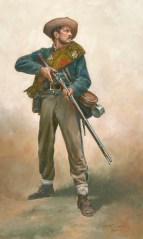
Don Troiani shows his debt to the great French military artists of the late ninetieth century and builds on an excellent understanding of the era’s clothes and equipment.

Civil War reenacting became the largest outdoor historical hobby with countless local fraternal groups all over the nation—and even overseas. This all breathed new life into older more formal groups like the Sons of Confederate Veterans who adopted the pose and style of reenactment companies. Likewise, the number of Civil War roundtables grew as did preservation supporters all of whom has reenactors and new enthusiasts in their ranks. These groups erected new monuments and even worked to preserve more obscure corners of battlefields. A subgenre of art began to grace walls as historian/collector/painters like Don Troiani and Keith Rocco brought Edouard Detaile-style to Civil War themes. They were followed by a far larger number of lesser lights but nevertheless commercially-savvy artists like Dale Gallon and Mort Kunstler who relied on reenactors as they looked on battle weekend for models, thus  painting a chubbier, older, and oddly attired present into the past.

mort2

Mort Kunstler’s art sets reenactors against imagined backgrounds but really represents reenactor portraits as opposed to others’ more informed historical art.

On top of that, there was an overall increase in military reenacting in general as Revolutionary War, the War of 1812, WWI, WWII, and even odder choices like Viet Nam or the Wars of the Spanish Conquest all competed with a busy reenactor’s schedule. All the while though the Civil War was a unifying force—its events were the largest and a great portion of the language and overall culture of historical reeneactments took form in the ranks of weekender Billy Yanks and Johnny Rebs—many of whom fought other fights in their spare spare time.

Battlefield Historian

Ed Bears doing that for which he is most beloved.

But that is where the problem for the 150th anniversary begins. Not only did a whole new consumer Civil War hobby develop, but with it evolved a whole set of characters and historically inflected consumer identities. Reeneactors gradually became a “type,” as more and more people had an uncle or a teacher who made their weekend uniform part of their lives and self identities. Hollywood began to see reeneactors as a self-costuming low-cost source of extras, and movies with themes ranging from battles to zombies employed them. Civil War tourism grew to new levels and lines of Tilley-hatted seniors in safari vests and custom-made matching roundtable golf shirts walked battle sites most every weekend of the year.

On one level, this was a wonderful thing: Americans connecting with their past, making it meaningful and relevant, and supporting with new fervor the cause of preservation. But on the other hand, the very familiarity of the identity, style, symbols, and patter of the Civil War enthusiast made the whole interest easy to marginalize, trivialize, and dismiss. Knowing exactly who liked the Civil War, made it very easy for a far larger number of Americans to not count themselves in the ranks of “those” people. All the images and symbols of the buff or devotee were owned, and indeed, and were even becoming a bit thread bare. The Civil War had become an almost exclusive possession of its fans.

And so along come 2011 and the 150th Civil War anniversary.  The NPS really was the primary agent in making this mid-century way point a date in its own right. But the battalions of private entities, roundtablers, reenactor groups, commemorative societies, museums, and clubs that make up the Civil War world, as well as counties and municipalities hoping for economic boosts all bought right in. Yet the whole thing is foundering already, and in Civil War terms, we have not even reached Gettysburg yet. Why?

Civil War interest has become a victim of its own success—especially the boost it received 25 years ago. There is a ready made audience for all things Blue and Gray, and the 150th planners counted on those people coming out in droves. Dwight Pithcaithley spoke about this at the National Council on Public History conference in 2011 right when all this was heating up. The NPS made conscious a choice here. Option One was give the devotees exactly what they most want—battles, guns, and glory—and do everything possible to offer up the best show possible. Option Two was to widen the scope, talk about politics, contemporary relevance, long-term shadows, and implications. Option One would not bring in new people, but it could force open the wallets of the hardest of the hard core by giving them what they most wanted. Option Two might bring in new people, but only at the risk of alienating a reliable and by now well-defined and mobilized constituency. Unsurprisingly perhaps, the 150th went with Option One—stick with the tried and true—give the reliable customers what they want.

The problem is that in this economic climate, the Old Guard are not rushing in as hoped and planned for. Certainly many have made these events their top priority, but perhaps just not enough of them. On top of that, the Old Guard are just that—old.
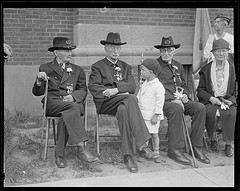
Civil War veterans Grand Army of the Republic members at the end of the nineteenth century.

Civil War veterans Grand Army of the Republic members at the end of the nineteenth century.

Today’s Civil War enthusiasts are not a young group of people—they resemble rather more the grizzled gray beard of the GAR than they do the Boys of ’61. If the 150th was intended to be a an eye catching splash that would grab the nation’s attention and reawaken the kind of weepy enthusiasm that accompanied Ken Burns’s The Civil War, then that can be said to have not happened. If the 150th intended to bring new people in or make the war seem meaningful to a new generation of Americans, well that has not happened either.

So we see now the 150th planners and backers waiting for Gettysburg later this summer or maybe the Wilderness and Spotsylvania after that in some sort of oddly reversed “it will be all over Christmas” battle cry. We’ll get ‘em next time boys.

The fact is that Americans are weary. Weary of two real ongoing wars. Weary of the language of division. Weary of the grim predictability of war commemoration. We OD’ed on it as the WWII generation passed away and as we saw, the 200th anniversary of 1812 has all but come and gone with nary a whisper and we will soon see the 100th of WWI will be the same, if not less. And most dangerously perhaps for Civil War history, the public is weary of the pose and style of the Civil War enthusiasts themselves. They have become cartoony—bikers with battle flag adorned vests on rides to the Confederate White House or too-old and too-fat reenactors puffing though yet another charge. overrated-110124These have become the stock of Seth McFarlane punch lines or worse. The brand no longer compels.

The problem with the 150th is that it came fifty years too early. Perhaps we need to forget the Civil War for a time so that a later wave of Americans can discover it anew and make it meaningful. The Boys of ’13 are just not up to the task any longer.
Photographic Now-and-Thens

Over the past few months a new manner of photographic art form has come to my attention. It involves taking old photographs and merging them with new ones. I have loved this sort of game for ages, but digital photography now brings it to our fingertips. Who cannot love the work of William Frassanito who made it his métier to locate the sites and angles of noted Civil War photographs and set “then and now” images side by side?

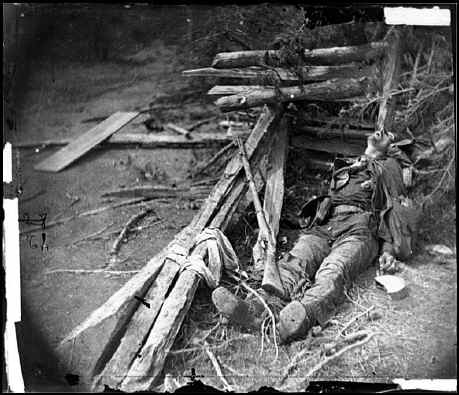
No one could not claim that Frassanito invented the approach, but few before him had used it to such great effect and historical value. His careful work charted out how photographic teams lugged corpses around battlefields from place to place to get just the right shot. That may not have changed the way military historians understood a fight, but it certainly added a deeply valuable and unique level of humanity to the aftermath of the battles. No small feat. I was one of the almost innumerable kids who grew staring in fascination and horror at the often quite beautiful images of the war’s dead. Frassanito deepened and reanimated these images for me. For example, it was moving to learn that that gaunt, prone, but yet so life-like blood-soaked Confederate boy (as he indeed was) whose life ended with a checked cloth near his hand as he hid in a small pile of fence rails near Spotsylvania Courthouse was also the dead man second from the left in another photo from the same sequence.[1] Frassanito’s work showed us that many of these men in these seemingly separate images were in fact comrades, and in all probability knew each other by name given how close to one another they died. Likewise, Frassanito’s Gettysburg work showed that the much-beloved and ballyhooed photograph of the Confederate prisoners by the fence rails shows men who in fact were not defiant heroes nor exemplars of the “elan” that Shelby Foote effused about, but were instead deserters who hid out in barns near Carlisle and thus missed the battle.[2]

Three "Johnnie Reb" Prisoners, captu...

Three “Johnnie Reb” Prisoners, captured at Gettysburg, 1863 (LOC) (Photo credit: The Library of Congress)

This Frassanito gleaned from photographer’s notes, landscape triangulation, and army records. Wonderful work.

James Deetz too used photographic “then and now” in Flowerdew Hundred when he matched up views of the James River.[3] I am not sure that he really did much more than offer a contrast, but he did use the process in aid of identifying sites—perhaps the approach’s most valuable use. I played at this game early on in the Ferry Farm work, although not with an eye toward finding sites.

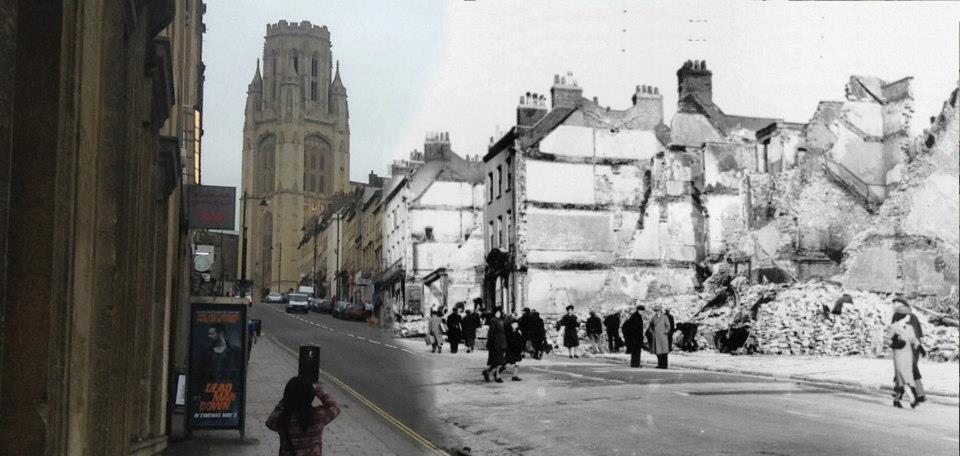
But these new Photoshop matchups (although it would be Gimp in my case) are something very different. More art than research. They have enormous capacity to invoke if nothing else–but that capacity is remarkable. The first I saw of these were mashups from Russian cities during The Great Patriotic War. They wonderfully set school children against T-34 tanks and blown out buildings and thus created deeply haunting beautiful  images.

I took my first stab at this in Bristol in the UK—a city that was extensively bombed by the Germans during WWII. I used an image of the lovely Park St. and did my best matching up.

park st

What I had not noticed at first was the contrast of the devastated buildings on the right of the image, and the fashionable cartoon violence referenced in the movie poster on the left. On Park St., one generation knew these horror all to well, whereas a later generation has turned horror into a fun afternoon. I had created art and did not even know it.

Now that I am back in Fredericksburg, I am in a setting filled with great historical images. Years of time here have let me know most of the locations for many of the best shots. So I have set in to do a few of these over the next few weeks.

PrincessAnne

I do have a question though. In a city struggling with issues of preservation I find myself wondering if this sort of imaging highlights that which is lost, or does it create the impression that more has survived? Of course that depends on the individual image to a large degree. But, I find myself wondering if this helps or hurts the larger cause of preserving past views.


[1], William Frassanito, Grant and Lee: The Virginia Campaigns, 1864-1865 (New York: Thomas Publishing, 1996).

[2] William Frassanito, Gettysburg: A Journey in Time (New York: Thomas Publishing, 1996).

[3] James Deetz, Flowerdew Hundred: The Archaeology of Virginia Plantation (Charlottesville: University of Virginia Press, 1996).

Ferry Farm in the News

Revisiting the GW Birthplace

I have a team of graduate students hard at work at the George Washington Birthplace National Shrine in Westmoreland County Va.

Memorial House at the birthplace site of Georg...

Memorial House at the birthplace site of George Washington. The foundation outline in the foreground is believed to be the actual location of Washington’s boyhood home, which burned down in 1779. George Washington Birthplace National Monument, Westmoreland County, Virginia. 30px (Photo credit: Wikipedia)

They are working under the supervision of Ranger Amy Muraca and are being funded by the NPS to make sense out of a series of excavations dating back to the 1930s. We call this sort of work Forensic Archaeology since it involves working with a problematic record we did not create. We might also call this particular project an example of Cold Case Archaeology. Our goal is to try to understand what has long been called “Building X” and is interpreted as being the home where Washington was born. The problems are legion as Joy Beasley outlined in what remains the best piece on the site.[1] To being with, the building is a sort of impossibility—architecture by M.C. Escher, if you can picture that. It seems clear that the outlines of what could be four or five rooms (all that survives are brick cellar footprints and nothing above ground) represent varied building episodes and could not have all stood together at the same time. Yet that is just how the building(s) has been understood—and sometimes quite smugly at that. Our job this summer is to untangle this mess and begin to speak from the data—perhaps for the first time in the site’s life.

Already I have been seeing some problems for the current interpretation. The layers in the cellars’ fill do not point to a single filling episode. Also, a major house fire is a crucial part of the current story and interpretation. The evidence for that fire is fading fast, just as did that of the Ferry Farm house fire. On top of that, the dates of the artifacts are not working either if they are supposed to match the current story. In short, it is a mess. But in a few weeks we will have the beginnings of a whole new and data-centered understanding for “Building X.” I will be presenting a paper on this all at the 2014 Society for Historical Archaeology Conference in Quebec, Canada, but I am also seeing that there is whole book to be done on this fascinating and confusing landscape. For now though, we just need to move slowly ahead and make out charts and spreadsheets and reserve judgment.

English: Artifacts on exhibit at Visitors' Cen...

English: Artifacts on exhibit at Visitors’ Center, George Washington Birthplace National Monument, Westmoreland County. (Photo credit: Wikipedia)

One thing that makes this very exciting, is that this is an “inside job,” that is to say that this is the park reassessing itself—we are just the labor in that task. It is great to be part of the park’s ongoing and evolving understanding of itself. It is also great for students to have such an important hands-on role in this sort of research.


[1] Joy Beasley, “The Birthplace of a Chief: Archaeology and Meaning at George Washington Birthplace National Monument” in Myth, Memory, and the Making of the American Landscape, Paul A. Shackel, ed. (Gainesville: University Press of Florida, 2001), 197-220.