Remnantology

Dedicated to the examination of the remnants. Phil Levy's words in reference to history, archaeology, Judaism, academe, music, outdoorsing…

Category Archives: Landscape

Barbados, Day Three. Slavery’s Shadow

I began today by catching up. Wireless is ok, but not great, so I was pretty glad to find that the café at the GW House has a strong connection. The house has become a sort of base of operations so finding out that the café’s digital dynamism made things even better. I talked more with Martin Miller and met Mikala Hope-Franklyn who also is part of the GW House team.

IMG_2787.JPG

A somewhat different view of the George Washington House

These folks are such great and enthusiastic young museum professionals—wonderful to talk with them. Likewise, meeting with GW Papers team as we sort of half planned and then chatting with Karl Watson the local dean of things Bajan and Historical was great.

I spent the rest of the day heading north. Nominally, St. Nicholas Abbey was my destination, but as is often the case the trip and getting lost a few times was built into the plan. There is a highway that heads north though to Americans it is really just a four lane road punctuated by roundabouts. I switched on local new radio and charged north. In several places the sea view just opens up and again you get that feeling of being on an island. I keep trying to remind myself that this place is small and remote even, but it seems pretty all encompassing when here. Only the sea—flat and empty in all directions highlights isolation, and the place is so packed and bustling that without the sea in sight, you forget.

IMG_2951.JPG

A pano view of the back of St Nicholas Abbey

I got to the home to too late for a tour so I just took some pictures and sheltered from a short rain storm. This is the oldest of the seventeenth-century homes and is managed as a museum and events all. Lots of latter additions behind it and I could hear meetings going on. There also is active sugar cultivation on site and the barns were busy.

Once I was done, I knew I wanted to head down the eastern side of the island having come up the west. What I did not know was that the road was going to slam me into what is honestly one of the best views in the western hemisphere. It comes up on suddenly. You drive along going up a hill, minding your own business, listening to the BBC talking about Syrian peace talks, then in an instant,

IMG_2955.JPG

The view from Cherry Tree Hill. I find cherry trees everywhere I go!

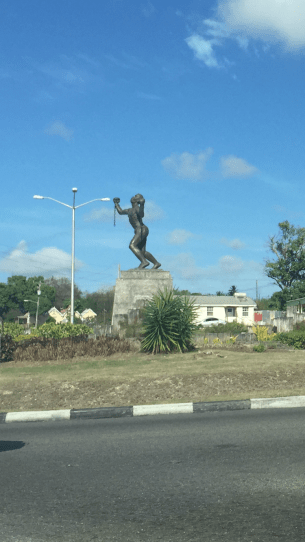
you crest a hill and the whole eastern shore of the island is hey presto spread out before you from atop a high hill. There is a little pull over and I jumped out of the car. Clearly people picnic here judging from the hundreds of chopped coconuts and the stacked push carts of the now off duty vendors. Either the rain or the lateness of the day though left me with the place to myself, so I climbed up a very steep trail to see if the view was better a bit higher and off the road. It actually wasn’t, but something about getting off the road and into the fields made me think about all the Africans, Irishmen, Indians, and others for whom this place was a living hell, a purgatory, a prison with no hope of escape. Seeing the hills, the shore, and sea in that light brings home the loneliness, sorrow, and misery that is so much a part of the history of this place and others like it. Earlier on my drive, I had seen the statue at Emancipation Circle—a bronze of a man standing up in a pose much like the old Massachusetts’s seal, but with broken chains hanging from his wrist manacles.

IMG_2952

Emancipation Circle

It is a good memorial—and seeing from this perch just how small and inescapable was this Barbados drove home what had been at stake. The emancipation statue is a remarkable thing—even though drivers whiz around it all day long presumably without remarking. We in the US are now in the midst of our own debates about statues and for the life of me I could not think of a single monument like this one. I assume that is a failing of mine, but nevertheless, I think American monument makers have made it easy for me to not recall one. We have though used considerable bronze to commemorate some aspects of, and characters from slavery’s story in almost all southern cities—but none, or at least very few, have hands with the chains broken. Curious that. I am not for the removal of Confederate monuments outright, but then again, I am a preserver and not a remover by nature and by professional inclination, so my impulse to leave them in place needs to be seen (and appropriately devalued) in light of that fact. But recontextualizing would certainly be a very good thing. What does a metal Robert E. Lee mounted a-top a metal Traveler look like if they was surrounded by castings of the emancipated? What if the base of the statue was fitted with a giant manacle or one of those pronged collars designed to make it impossible for the poor wearer to move about or lie down? It is a discussion long overdue.

The sun was setting as I drove home. The cyclist are out at the starts and ends of the days and I was so full of jealousy when I had to pass a few pace lines and group rides. These are the serious miles riders with good bikes, helmets, lycra, and lights—my people! The roads are very rough and the guy at the cycle shop said that it was an increasing problem for riders. The government here is suffering financial problems. Barbados’s economy is almost entirely tourism-based, and as the word economy slowed down, people stopped coming here. One manifestation of the problem is that there is not money to repair and maintain roads–and you can really see it everywhere you go.

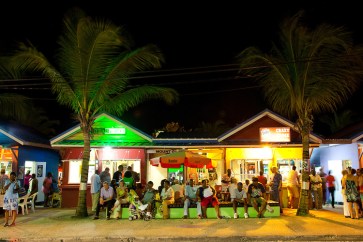
oistins-fish-fry-0058.jpg

Photoshelter.com had a better photo of the Oistins market stalls than I could take, so here it is. This is a big scene in the evenings. Lots of people chatting and eating.

At the end of the day I stopped in Oistins to sit in the market and let the night come over. I reread GW’s Barbados diary again to see what parts I might see anew in light of today’s visits. He saw the form of plantation slavery here and he had to have known that was different in some respects from what he knew at home in Virginia. He never commented on it though. I saw reminders and memories of that plantation slavery, and they were quite different than what we have back at home. When it comes to commemorating the memory, we have a lot to learn.


Chattel Houses of Barbados

One of the more notable architectural features in Barbados are the so-called Chattel Houses. These are—depending on whom you ask—a legacy of slavery or of freedom. Essentially, these are very small rectangular wooden homes designed to be light and mobile. The “Chattel” refers to, again, depending on whom you ask, the houses themselves or the people who lived in them. The real story is that they address the needs of poor landless people–tenants or sharecroppers–who often had to move from land plot to land plot. Having a small and easy take down. move, and set up again home as their own “chattel” made good sense and made this distinctive house form an early form of mobile home. They are all over the place and are the defining Bajan architectural statement.

IMG_2778.JPG

Two variations on the theme just outside Bridgetown. Note how the one on the right is really a pile of houses.

The basic design is simple and easy to move from one place to another. Many houses sit on stone foundations, some sit on pillars, others only on rocks at each corner. Eighteenth-century Virginia documents talk about dragging cabins from place to place as the planting rotation changed and workers or overseers were needed in other parts of the acreage. Rather than having multiple homes with some in use and some out, moving a home once in a while was more preferable.

The chattel houses though have stuck and taken on a vernacular life of their own. They are everywhere—often two set side by side to make a single M roofed building, or equally often with a shed on the back or some amazing sprawl of boxes and sheds all piled up together. You can see them in bright colors or not even painted and all weather-work.

IMG_2912.JPG

Some country examples near Drax Hall. Note the cinderblock columns supporting the homes.

I have seen them with new Pella windows installed and others with no glass windows at all—just a slatted closure held open at the bottom with a propped stick. Most are about 15 feet by 6 feet and and I have seen center ridge roofs set high and some with very low pitches. I have seen them with  hipped roofs and some with shed roofs. Most have  center entrances but I have seen some around Bridgetown’s outskirts that have gable entrances like shotgun shacks.

Out on the north eastern coast near the town of Coach Hill, I came across a lone chattel house in a clearing next to the road. The ground had been burned and there was some trash nearby—but the door was gone and it was clearly unoccupied. IMG_2968.JPGI pulled over and hopped out. The house was made of very small light wood—no heavy framing and all wooden strips inside (no sheetrock for example). This one had a small shed addition which contained a toilet and a sink, but no evidence of plumbing. Here was the Tiny House par-excellence and I tried to imagine what it would be like to live in one—alone or with a family, this is a very small space. Obviously, much of one’s life would be lived outdoors or elsewhere. But having loved many an AT shelter, it was easy to imagine being quite happy in one—especially with the Atlantic stretching blue to the east within sight. Of course a good wind storm would knock my little domicile around like a cardboard box. But Barbados is spared most storms as a result of being outside the actual Caribbean basin, perhaps accounting for why these houses abound.

IMG_2971.JPG

Inside my chattel house. Notice how light and far apart are the framing members. Being inside felt like being inside a cigar box.

IMG_2974.JPG

My chattel house’s rear view showing shed addition and shed roof. Notice the stuccoed cinderblock foundation. Someone cared.

Barbados, Day Two

Today began very gray but cleared up. I got up early and rushed back to town to try to recover my glasses which I had left on a wall in the cemetery. The Shul was open when I got there, so I had the pleasure of saying shacharit (albeit alone) in the beautiful old Nidhai Israel shul. It is very much like a British shul with the same type of stying and pillars holding up the women’s gallery. One difference was that the Bimah (raised reader’s table) was in the back and not in the center. I am a big fan of facing bench seating in shuls–in my mind it plays down hierarchy in favor of communalism.

IMG_2746

The Bimah in Nidhi Israel

This building dates to about 1831 when the great hurricane demolished much of older Barbados. This new shul sits on the foundations of the original which dated to the mid seventeenth century.

Some visitors came through and they must have thought that I was some sort of museum display set up for effect and authenticity. When I was done, Emerson, the tender, directed me to meet Benny Gilbert, a retired local property developer and one of the community’s elders. His wife is an Altman—one of the oldest Ashkenazi families on the island. Mr. Gilbert invited me back to his office for coffee and a chat and so we walked though the crowded Bridgetown streets having the kind of conversation one would have any where in the world after saying “shalom alechem – alechem shalom.” Mr. Gilbert had much to share about the island, its Jews, and his life as one of them. He explained that the original Spanish community was all but gone by the end of the 18c and that the Ashkenazim came in waves, many spending a few generations here and then fading away only to be replaced by new families. This was much the same as I had seen in some places in England—wandering, to paraphrase perhaps the most famous (sort of I guess) English Jew, Shylock, is the badge of all of our tribe.

IMG_2761.JPG

The shul is on the left, and the mikveh newly built is on the right.

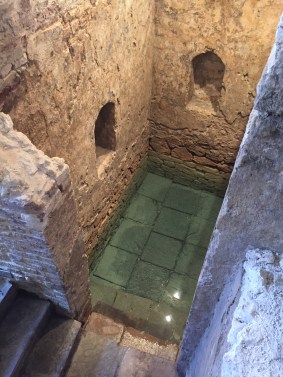
I returned to the Shul after my visit and got there in time to see that the guide had brought visitors in to see the mikveh. This 1650s bath was discovered archeologically a few years ago and once the stone rubble had been removed, the water returned. It requires no filtering—it is fresh, clear, and tapped into the water table.

IMG_2758

Newly rediscovered mikveh

They have built a very lovely building over it from the removed stone rubble and it is quite a gem. I waited and listened to the talk about how the 17c Jews here used the mikveh—a description based largely on 17c travel narratives. The mikveh is not formally open to the public (vistors can look in with the guide), but religious exceptions are made from time to time. A few weeks ago a pair visiting Chabniks went in and today it was my turn. The water was clear and cool and the stones 17c. It was a remarkable experience.

When I was done I went back to looking over the grave stones to find specific people I was curious about. In looking around, there seems to have been some surface level change though. Some nearby construction has left some holes and poked around a bit just outside the footers of the old cemetery wall.

IMG_2764.JPG

Construction and stones.

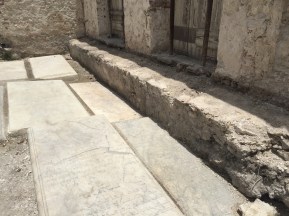
I saw at least four layers including two that appeared to be mostly pavers. The most interesting thing was that this new construction had uncovered a section of the cemetery that had been buried and had had 19c shops atop it. Those shops have been gutted and their floors removed. The result are the most amazingly well-preserved stones in the yard.

IMG_2767.JPG

Newly exposed stones. The doorways on the right are at current surface level and lead out to the street.

These are mostly of English Jews, some of whom had adopted the stone styles of their Sephardic predecessors. I am told that the development plan calls for all the graves to be reincorporated into the cemetery which will retake its original size. More on the stones later.

Much of the rest of the day was spent at the George Washington house again, this time looking over the artifacts from the 1999 and 2001 excavations. I have the reports and the artifact lists in them, but the only way serendipity can happen is when you let it. The excavations were primarily in the ravine west of the home. The collections span a large period and of course trying to find 1751 in an assemblage is not an easy task.

Once I was done, I thought it would be nice to get out into the countryside.

IMG_2914.JPG

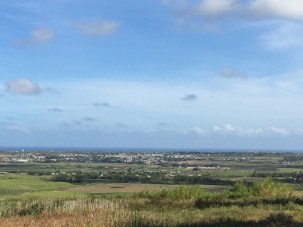
Looking south from the first major rise of land.

I was right. I drove north mostly by zigzagging the road system. The south has a large sloping plain, so that heading north means heading up as well. As Washington observed, the landscape is made so that views of the sea are to be found throughout.

IMG_2917.JPG

Drax Hall. In private hands and not open to the public, but still owned by the Drax Family in England as it was in the 17c and still producing sugar.


I wended my way up to Drax Hall—a well known 17c plantation and home just about one third up the island from the south coast. Sugar is still grown here in the hundreds of tons for shipment to European markets. Interestingly though, none of the Bajan plantations produce any molasses. That means that all the Barbados rum is made from imported molasses—not local. There is a metaphor for something in there.


Fredericksburg’s Farmers’ Bank: History vs the Tarmac Desert.

In the summer of 1862 President Lincoln visited the city of Fredericksburg. Soldiers of the United States had recently captured this hub of rail, road, and river virtually without incident and the President was in town to meet with his theatre commanders and to see the prize. Halfway between Washington and the Confederate capital of Richmond, Fredericksburg’s capture was one of the last moments when rational people could imagine that the war would be short and relatively painless.

Lincoln held meetings and visited local sites—including George Washington’s childhood home. In town, he met with General Marsena Patrick in the two-story neo-classically inflected Federal style Farmers’ Bank. The bank sat on the corner of Princess Anne and George Streets right across from St George’s Episcopal Church on its front and the town’s Presbyterian Church on its eastern side.

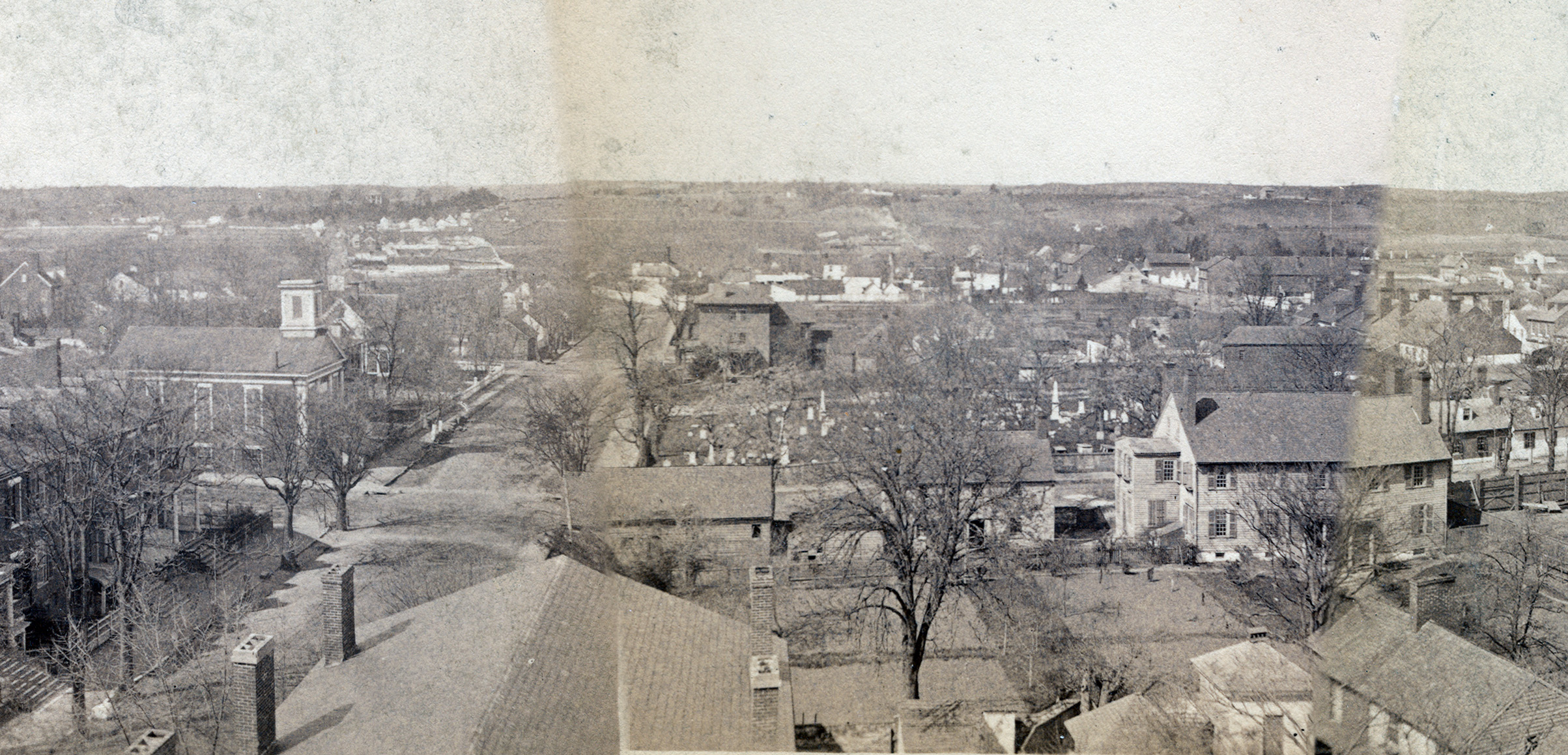
This section of the much-discussed 1888 St George Church panorama of Fredericksburg shows the roof and chimneys of the Farmers' Bank on the left foreground. Note the use of the lots that are now mostly tarmac deserts. This section of the panorama came from Fredericksburg Remembered. http://cdn.loc.gov/service/pnp/cph/3c00000/3c00000/3c00600/3c00623v.jpg

This section of the much-discussed 1888 St George Church panorama of Fredericksburg shows the roof and chimneys of the Farmers’ Bank on the left foreground. Note the use of the lots that are now mostly tarmac deserts. This section of the panorama came from Fredericksburg Remembered. http://cdn.loc.gov/service/pnp/cph/3c00000/3c00000/3c00600/3c00623v.jpg

Though lacking the adornments of ecclesiastical architecture, the Farmers’ Bank’s facade, style, and placement was nevertheless itself a statement of faith, solidity, and the American way. General Patrick’s selection of the bank as his own office—and a nerve center of the city’s occupation—enlisted the existing architecture of trust, power, and commerce for the for the cause of the Union.

The Farmers’ Bank has survived to today.

The Farmers’ Bank as it looks today. Image from Mysteries and Conundrums https://npsfrsp.wordpress.com/2011/01/17/slaves-at-fall-hill-abraham-and-hester-tuckson/

It has been a bank and office suites most of this time and is now one of Fredericksburg’s best historical buildings. Indeed, Fredericksburg NPS Battlefield Park Historian John Hennessy recently highlighted this fact for his blog readers reminding all that the bank is the only existing building we are certain Lincoln entered, walking over the bank’s worn Aquia sandstone steps and entering through the elaborate alcove entrance. The bank’s northeastern corner is especially notable for the large amount of Civil War graffiti resulting from bored soldiers carving their names and regiments into the brick (Other Civil War graffiti). In the 1930s, Historic American Building Survey architects studied the bank (then called the National Bank) and added it the list of the town’s charms. A 1990s drive through window and cash machine addition south of the bank are the only externally visible changes to the building which otherwise has maintained its historical feel capped off by a wooden Civil War era style sign.

But changes in the larger lot have left the Farmers’ Bank an isolated historical Island in a tarmac desert. Beginning at least as early as the 1950s, Fredericksburgers transformed open in-town spaces into parking lots.

Seen in order on the right, the 1990s drive through bank addition, the south wall of the Farmers' Bank, and the steeple of St George Episcopal Church.

Seen in order on the right, the 1990s drive through bank addition, the south wall of the Farmers’ Bank, and the steeple of St George Episcopal Church.

In the nineteenth century, open lots were needed as work yards, kitchen gardens, and animal residences. But in the automobile era—and particularly after the 1960s when I-95 passed just west of town—the storage of temporarily dis-used cars became a primary concern. Property owners paved open lots and, as older buildings came down, their empty lots also joined the ranks of parking lots often in the shadow of roughly constructed side walls of remaining buildings meant to be seen only from the front. The result of this was to leave town feeling cold and gap toothed and filled with unplanned areas of undesirable, mostly unused, open spaces.

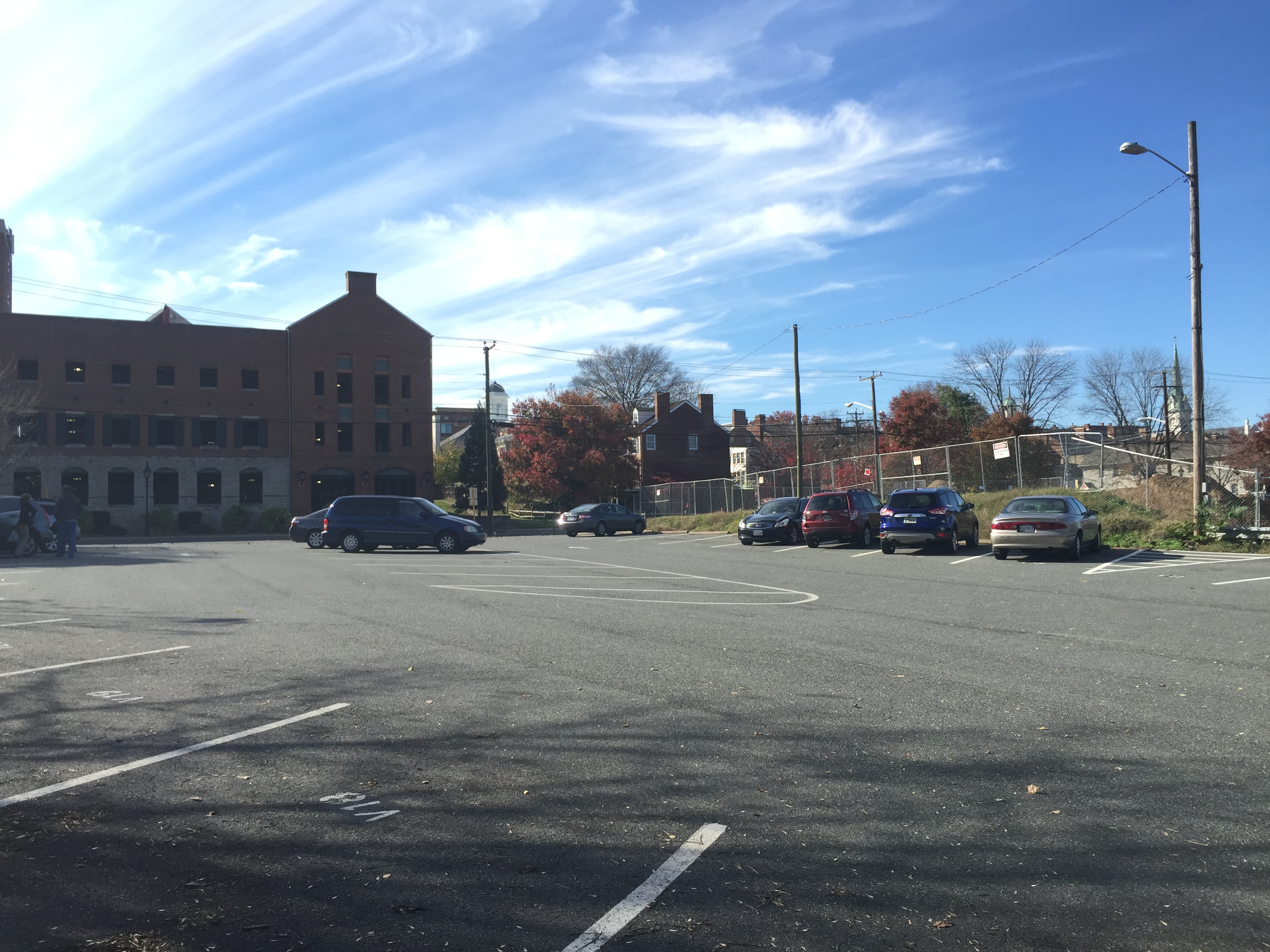
A Tarmac Desert on Sophia Street.

A Tarmac Desert on Sophia Street.

Once a lot is paved, the city or the owner are now committed to a never-ending maintenance regime as cracks have to be filled and holes patched. Paved lots also force collected rainwater to funnel into streets thus stressing removal systems, increasing flooding, and accelerating the erosion of older cobbles. The answer to this is of course more paving, so that over time, more and more of the cityscape became a tarmac desert. Whereas earthen lots absorb rainwater and produce greenery even when left alone and require no maintenance other than occasional mowing (or goat keeping), tarmac deserts produce nothing other than that distinctive smell in the heat and make corners for the collection of wind-borne trash. On top of that, the in and out flow of cars provide visible markers of when people are in a building and when they are not. The absence of cars signals a building’s emptiness to burglars while a dark lake of tar is itself an inviting terrain for all sorts of mischief. Nothing feels emptier than an vacant parking lot—and in Fredericksburg, most parking lots are empty most of the time and, being paved, can do nothing other than wait for the next car to park there. Paving a cityscape makes it an uninviting alienating tarmac desert that seems dark and dangerous most of the time.

The Farmers’ Bank sits now at the corner of just such an in-town desert. That makes the bank feel isolated and even irrelevant. This is just one of many ways whereby reliance on automobiles and that dependency has remade the landscape in ways that challenge preservation and a place’s historical feel.

The west wall of the Farmers' Bank with the drive through on the right. Note the sale sign.

The west wall of the Farmers’ Bank with the drive through on the right. Note the sale sign.

But now the bank faces a new threat—one worse perhaps than the shells and pocket knives it endured during the Civil War. When the economy bottomed out in 2008 most of Fredericksburg’s development project ground to a halt New condos near the rail tracks which once boasted signs claiming “Starting at $400,000!” soon boasted starting prices of $150,000 before being cut up into apartments. Subdivisions simply stopped with streets half fleshed out and stripped fields were left alone to regrow what grasses they could. Businesses failed and storefronts replaced displays with For Rent signs and papered-over windows. But all of that is over, and the development economy is once again booming. In a very short period of time the city saw a massive new courthouse constructed, a new downtown hotel right across the street, and many new homes fitting in between older ones. In just this last year new in-town projects have piled high-end housing into town and added eateries and even a glittering south-western styled brew pub.

Postmodern newly built townhouse filling in open spaces on the left and the stunningly out of place brew pub sitting on the corner of William and Winchester streets.

Postmodern newly built townhouse filling in open spaces on the left and the stunningly out of place brew pub sitting on the corner of William and Winchester streets.

The good news (perhaps) is that much of this new development is taking place in lots that were previously tarred over. That addresses some of the aesthetical problems posed by tarmac deserts, but none of the environmental or historical preservation ones. The bad news is that all of this is happening so quickly that thorough archaeological is very challenging—and it seems in many cases that significant finds would not be enough to slow down the pace of building or even redirect it. Speed also leaves preservation–of buildings as well as less tangible but nevertheless important things like view sheds and historical feel– left in the dust and crushed by the bulldozer’s treads. Right now the future of the Farmers’ Bank is in question. A developer had bought the lot and received initial approval to fill the desert with condos. But the plan bogged down in levels of city government and all is on hold for now.

New construction on William Street right next to 19th century rows

New construction on William Street right next to 19th century rows

At this year’s Council for North Eastern Historical Archeology conference in Fredericksburg, there was discussion about how the city, still lacking a protective archaeological ordinance, may be turning a blind eye to the destruction of the town’s material patrimony–a patrimony daily stewarded by Fredericksburg, but in reality owned by the nation. Again, the good news is that the city is on the way to hiring a preservation specialist to monitor work. Again, the bad news is that no one knows just how influential that person will be once hired and how much we may lose in the meantime.

Meanwhile though, decades’ old bad car-driven choices are still felt in a town walking the line between protecting its past and building for its future.

The C and O Canal and the Great Allegheny Passage

I want to share a report of my June 2015 trip on the C&O Canal path and the Great Alleghany Passage bike trail. Together they make for the longest stretch of car-free trail in the nation and tons of people ride the path, or parts of it, every year. I took me about a year of reading, dreaming, and planning to get everything together for a trip that ended up being close to 400 miles (all told) of riding and took 6 days. My goal here is try to answer some of the questions that I was unable to resolve in my web research before my own trip. So, I am not really going to share any info about the beauty, history, or experience of the trail—that has been covered well elsewhere. I am also assuming that you dear readers have already done some of the basic research for your trip, so I am not going to offer much of a sales pitch for the trails or bicycle touring in general. Instead, I want to focus on the sort of questions I had before I left but for which I could not really find answers, and to share useful information I learned along the way that I had not seen posted elsewhere. I hope what follows helps, and please use comments to ask any arising questions and I will try to answer them.

2015-06-24 15.55.08

My Surly LHT in happy times before the mud set in.

The first thing to cover is gear and condition. I am a daily rider doing about 10 to 15 miles a day with longer rides of up to 40 miles interspersed throughout the week. So any sense of what was physically hard or easy comes from that base vantage point. The bike was my 2009 Surly 700c wheeled, rim brake Long Haul Trucker (LHT) which I use for daily commuting (my Cannondale does the faster stuff). The LHT is more or less stock with two major changes. One was replacing the crankset with a Campignolo Veloce 52/42/30 so I could use the bike for more speed when not loaded up. The other is my fully broken in honey-colored Brooks B17. Bottoms vary, but to me, you are nuts if you try to do distances with anything other than a Brooks or a Selle Anatomica. I had troubles on the path, but not a single one of them were in anyway posterior-related.
2015-06-27 17.38.52

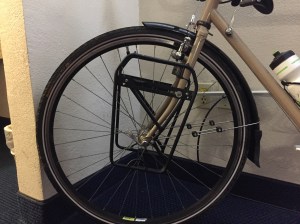
This is the angle of the Axiom Lowrider front pannier rack on the standard LHT front fork.

The rest of the bike gear was:

Continental Touring Plus Tires 700×37

2 yellow Ortlieb Back Rollers

2 yellow Ortlieb Front Rollers

1 Timbuk2 Bike Box

1 Medium Bontrager seat bag

1 set of Bontrager 35mm plastic fenders (their adjustability was a big plus)

1 Topeak Super Tourist rear rack

1 set of Axiom Lowrider front racks

The rest of the gear were things like my regular bike lights and all. Nothing really worth noting. The Topeak rack is great and the Ortiebs hung on the sides with no issues. They bounced a bit on the bumps, but nothing that was worth worrying about. I was a bit less thrilled with the Axiom front racks. The main issue was that they were not level to the ground. I mounted them on to the in-built Surly brazes (after a brief attempt at the provided U bracket harnesses) but no matter how I pushed and pulled, they had to sit so that the rearward edge was lower than the forward edge. It is just an issue of mismatched fittings and makes for a poor match between bike and rack. Some people might not care about this issue, but it bugged me. It just looked off to me (you can tell from the pics whether than would gnaw at you or not) More importantly though, it meant that on the bumpy parts of the trail the panniers wanted to bounce loose, and gravity meant that they wanted to jump over the posts that Axiom placed on the top to hold the pannier in place. No matter what I did they slipped around a lot. It was not a huge issue—I never lost a pannier for example–but it did get to me after a while. And since so much of riding entails staring down at the front end of the bike, I was a bit obsessive about where my panniers were sitting and even reached down a few times to shove them back into place. The movement was never more than an inch, but there it is. I will probably try another make for the next big trip. Apart from that, the racks did their job very well and were problem free.

I was happy with my box and bag, but next time I am planning on putting a larger seat bag on board. I found that I would have benefited more and opened my panniers a bit less with a larger seat post bag. I have never warmed to handlebar bags, but I can see why people like them—map access especially.

I am sensitive to gear hype, so let me be really clear about this. What is said about Ortlieb panniers and Brooks saddles is 100% true–none of it is hype. It was a wet trip and the Ortliebs were everything I could have wanted them to be. Easy to use, easy on and off, and bone dry no matter how wet and muddy they got on the outside. 2015-06-30 19.06.35Other brands are also great, but I am glad I went with the Ortliebs and never gave a worry to my gear in them.
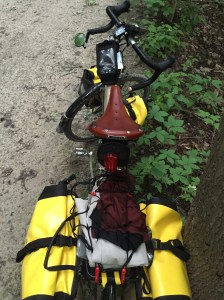
Surlys also are everything everyone says about them. I love my LHT and it does not disappoint. It is a tank, plain and simple. My load was not that heavy, but the bike never flinched, and more over, when I was coming down the hill in Harpers Ferry at 35 mph, the bike felt as calm and steady as it ever does—no wobble or shimmy at all to suggest the load it carried. These are amazing bikes and I loved having it as a partner. I am looking forward to trying out a Cross Check on this same path later in the year, but the LHT is indeed just what it is known for. I saw lots of bikes and curious configurations—from brakeless fixies to heavily shocked leisure bikes. Each one worked, but had a weakness. No one could say that about an LHT—it was made for this and was a dream to ride.

I rode the Continentals for the weight and the price—about 20 bucks less per tire than Schwalbes. I wore out this type of tire once commuting and was disappointed whereas a Schwalbe would not have worn out in the same time and under the same conditions. But the Schwalbes are heavier and even though I am assured they live up to the reputation, I was not compelled to buy in. In the end, that was a wise call. The reason why is that when all was said and done, I regretted going with the 37mms. That is the most recommended tire size on forums and discussions boards, so I went with it. What I found though was that in the mud (of which there was much) 37mm was not wide enough to make a real difference—I skidded where I skidded and it was more skill and luck than equipment that kept me upright.

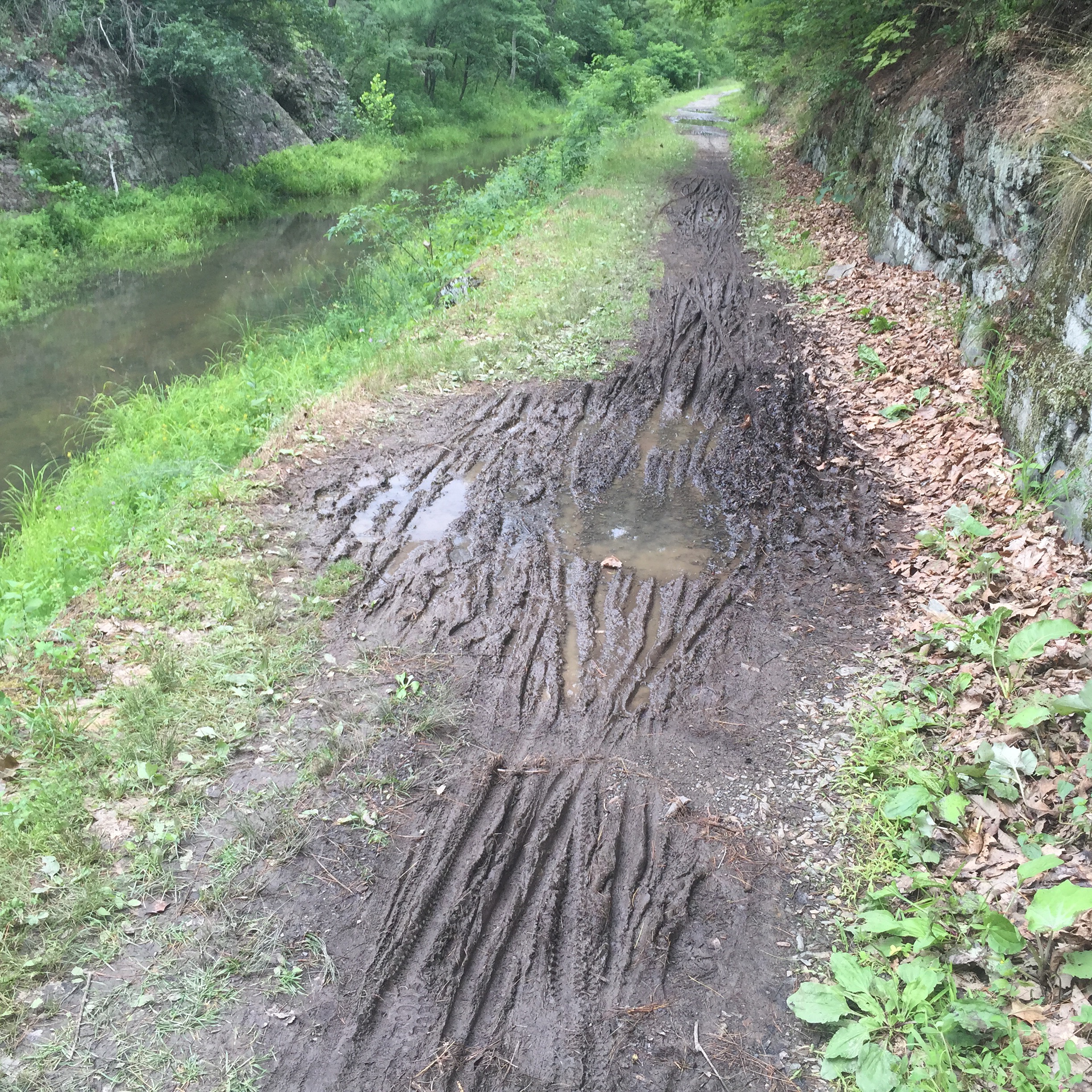
This is the crazy mud puddle south of the Pawpaw Tunnel. Make sure to walk through this stuff.

This is the crazy mud puddle south of the Pawpaw Tunnel. Make sure to walk through this stuff.

But on the dry and hardpack paths, 37mm was big enough for me to feel that is was holding my speed back. I am used to 23mm for long rides and 25mm for street commuting (both smooth surface tires) so I am happiest on a thinner tire. While the 37mms looked less like mountain bike tires than I thought they would when mounted, they were not really a huge help when things were slippery. My next trip in this trail will feature 32mms which I think will be a better splitting of the difference since the two trails (C&O and GAP) present really different dynamics. I suppose one could change tires along the way in Cumberland, but…yeah. If someone really want to do that, I would suggest using proper cyclocross tires for the C&O and something smoother for the GAP. The riders that are doing the whole C&O all in one day are on good cyclocross bikes and it makes sense. Had I sprung for the comparable Schwalbes I might feel a bit more bothered—or someone would be getting a good deal on ebay.

2015-07-08 13.18.51

The obligatory gear photo. I used a very light sleeping bag on the lower right. I was very glad I brought my Darn Tough short socks on the lower left.
2015-06-25 09.12.13-1

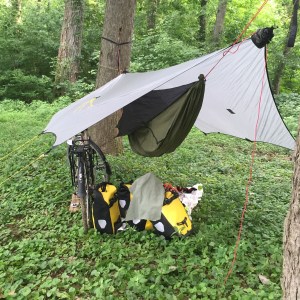
One of my camps. That is a Warbonnet Blackbird hammock under a Mac Cat tarp with Hennesy snake skins. The hammock is hanging on whoopee slings and tree straps. The guides are all shock cord or Zingit line.

I will skip over sharing too much detail about camping and camping gear. I have been hiking for ever and do long hikes every year. My pack is pretty light and all the gear well-used and tested. All I did was took the same kit I would take on the Appalachian Trail and put it in panniers—with some bike clothes, gear, and tools. I like camping and liked the campsites I stayed at, but it is worth nothing that it is really easy to stay in a hostel, hotel, or B&B every night of the trip if camping was not your thing or you wanted to travel light. Indeed, even though I was fully self-supported, I still found the lure of hotels sitting so close to the path too hard to ignore on a few nights. They really are everywhere and usually costing only between $50 and $75 (less for the hostels like the Teahorse in Harpers Ferry). I waited out one day-long rainstorm in one hotel and was very glad of it. As another trip review said, credit cards are lighter than camping gear. I am pretty confident that a rider could do this same trip with only a good bike, a water bottle, a few Hammer gels, a phone, and a wallet, and have a great time while eating and sleeping well all along the way. Also, there are tour companies out there that have organized trips for people, meeting them along the way at road crossings and parks and there providing them will full meals, any repairs needed, and even lifts to local attractions. I saw a few of these groups, and even though this is not my style, they did seem to be very happy campers. Their bikes were light and they wanted for nothing along the way. If you had the money to spare and did not feel great about self-support or winging it, this could be a great option. Or, just email me and I will just carry your crap in my half-empty panniers!

C&O and GAP Profile Map

C&O (right) and GAP (left) Profile Map.

For logistical reasons I chose to do the trip south to north (S2N). To date, Amtrak has been slow in figuring out that most railroad coaches are larger than bicycles and therefore can fit a few on board. Word is that that lesson may have been learned and that bike-friendly service is coming, but even so, the logistics of which trains can take bikes, which ones cannot, which ones want them in boxes, and so on are daunting—not to say maddening for their short sighted foolishness (that’s what happens when you put funding and overseeing a rail service in the hands of people whose real interest is helping cars and gas producers). Thus, for me, it was easier to start in the DC area and meet up with family in Pittsburgh. That turned out to be a very smart call and the others I met going the same way all arrived at the same sorts of conclusions as I had. In fact, there is a pretty healthy minority who prefer the S2N path—and I am in that camp. My pre-trip research showed me although that N2S (Pittsburgh to DC) is the more commonly taken path. I am pretty sure that the uphill path of the GAP between Cumberland, Maryland and the Continental Divide tunnel near Meyersdale, Pa is pretty big part of reason people prefer to go southbound. The standard profile map makes the incline look pretty daunting—even though your better angels are reminding you that this is rail line and therefore pretty level. It is certainly true that going southward gives you more miles that are technically heading downhill. But consider this. The C&O going S2N gains just under 500 feet in elevation over 185 miles. That makes for a grade so level that you really cannot feel if you are either going up hill or down. Most of the C&O elevation changes happen at the lock sites (no real surprise, right?) and they are very short. Also, about a third of the locks (and all the aqueducts) are made so that riders go though the dry canal bed—meaning that your passage begins with a drop and ends with an incline no matter which direction you are headed. All of this means that the C&O is, in a word, flat—in places, very flat. There may be a psychological benefit to knowing that you are going downhill if you ride southward, but there is no real physical benefit.

The GAP just south of Connellsville, Pa.

The GAP just south of Connellsville, Pa.

On the other hand, the elevation changes on the GAP are indeed noticeable. Again, keep in mind that the whole GAP is railroad grade. Even though a car can scoot up a 9% or 10% grade, a big ol’ freight or coal train would be slipping its steel wheels pretty badly even at a 3% grade. The Pittsburgh side of the Continental Divide is about a 1.3% grade and the Divide to Cumberland side is closer to 2%.
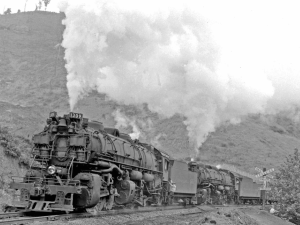
The B&O railroad back in the last days of steam. Engines like this were made specifically to haul cars up grades.

The B&O railroad back in the last days of steam. Engines like this were made specifically to haul cars up grades.

Both are steep enough to be felt in the legs (but I do most of my riding on a vast flat sandy pancake and consider myself a certified hill wimp). So, (and I suspect you can see where I am headed here) I would rather do 20 miles uphill on the slightly steeper grade and be rewarded with 125 of 1.3% downhill miles than do it the other way. Going up from Cumberland I had no real trouble maintaining about 8 or 9 mph fully loaded with a break now and then. That means that the hardest part of the trip took less that 3.5 hours (breaks included) and all the rest was either flat or a noticeable downhill and in my favor. There also was a psychological benefit. The trail conditions of the C&O are considerably poorer than those on the GAP—the former being early nineteenth-century mounded clay and earth with some gravel here and there, and the later being more recently-made packed limestone gravel atop water-draining stone. The C&O was a far harder ride than the GAP and I knew it would be. So, it helped to know that all the hard work up front would eventually be rewarded with a nice 125 mile ride at the far end. Indeed, once I crested the divide and got up to speeds of 17mph and above, I was very happy—not to say self-satisfied.

One counter argument to my S2N thinking though is that once passing Boston, Pa. going S2N, the GAP really changes. Outside of town it has its only stretch where it shares the space with cars—about a half a mile of very poorly marked path that leads to a challenging bridge over the Youghiogheny River (which has the GAP has been following for some time), and then on to the both confusing and powerfully unscenic path through and out of McKeesport, Pa (some nice steep bridge ramps along the way, but even I overtook casual unloaded riders on them). From there it feeds onto urban bike paths or city streets all the way to the fountain at Point State Park in Pittsburgh. The paths are paved and fun, but, after a few days peddling alone in the woods, suddenly being dumped out amid cars, commuters, and the sights and sounds of the city was a bit disorienting. I can see how some riders may want to put all of that behind them as soon as possible. For me, it was fine, and it made for a dramatic end to a long quiet ride. The last mile or so on Pittsburgh streets in rush hour traffic was quite dramatic—a bit a slowed down Lucas Brunelle filmScreen Shot 2015-08-06 at 12.26.21 AM

So for reasons of logistics and strategy, I went S2N. I will be doing the same direction next year as well—although the next plan is to rest a bit in Pittsburgh, strip the bike down, and then turn around and do the GAP N2S in one long day. I began this year’s ride at Mount Vernon (imagine that!) and rode the length of the Mount Vernon Trail (MVT) into DC to scope it out for future reference. The MVT is a nice paved commuter and leisure trail with some short but steep hills and one or two rather sudden turns. I got a bit lost at the edges of Alexandria (where a Starbucks is right on the trail) and making sense of DC signage looking for the crossing to Georgetown and the C&O trail head was no small matter. There is a nice well-stocked bike shop right at the base of the bridge before the steep stairs to the trailhead. I stopped for a sit down and took a pic of my bike at the Ukrainian consulate,
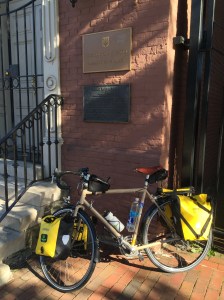
My bike tried to visit Ukraine.

My bike tried to visit Ukraine.

then down the steps by foot and off on the muddy C&O. Once I was on the trails—both trails—I never was lost in the slightest way. The only confusion was at the city ends. I think you would have to work hard to get lost on these paths. One place that was a bit confusing—and that even was just a tiny bit—was just north of the Big Slackwater Causeway near MacMahon’s Mill. Some background (despite the fact that I said I wouldn’t do history herein). When in use, the canal depended on water let in from the Potomac. In a few places you will cross the locks designed to let water in from the river. One stretch of the path though had the boats leave the canal proper and just ride along on a specially dammed section of the Potomac itself. Floods have long since knocked out the narrow towpath that ran along the river, but wise use of Federal funds have replaced those frail paths with more durable concrete causeways. These are a fun treat too after dozens of miles of mud pits. But, they end, and the path in a few places gets a bit funky. I may have been tired or a road zoned, but at one point I rode back to a clear spot to just make sure I had not missed a turn. I had not, the path was just chewed up a bit. That was the closest I came to getting lost on the paths.

Rain. It rained a lot. A lot. Just my luck. I took a day off in Williamsport Maryland partly to hide from a day of downpours. Some people like rain, other do not (I am in the later category). But like it or hate it, rain does some simple empirical things to the ground. On the C&O it made for many many puddles. Closer to DC the path is a dirt and gravel track, but as you get deeper into Maryland, large sections of it become a double track with a grass strip down the middle. These areas in particular seem very susceptible to puddling and pot holes. As always the best thing to do is just hold on and ride right through—trying to swerve to avoid will only lead to trouble. The catch of course is that under that brown water surface may or may not be a big pothole waiting for you. My tires were pumped high—90 psi generally.
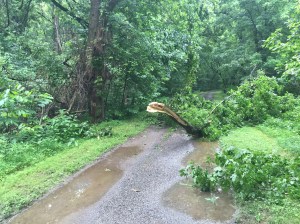
There were a few downed trees. This one and I particularly did not get along well.

There were a few downed trees. This one and I particularly did not get along well. Note the puddles though: that is what most of the C&O looked like after rain.

That made a harder ride, yes, but it eliminated the worry about pinch flats as I went in and out of thumping puddles. The storms downed trees and my only real mishap came in try to ride past one and getting bogged down in the muddy grass on the border. There were a few downed trees. This one and I particularly did not get along well. The resulting scrapes from the resulting fall were pretty minor, and since no one was there to see it, it never happened….right? In some places the mud puddles were pretty heavily rutted to the point of trouble. The south side of the Pawpaw Tunnel for example is one hairy spot. The path is a bit narrower there and with a sheer wall on one side and an 8 foot drop into the canal on the other, it pays to walk through ruts. Much of the path was so flooded even before a big rain that I felt it best to just sit out what promised to be a big ugly day. I know others went ahead, but I have no idea how happy they were about that choice.

Just outside of the town of Big Pool, MD is the 20-some-odd miles of the Western Maryland Rail Trail—a paved former rail line that hugs the course of the C&O very closely. Trail wetness made it too tempting to pass up, and so I had a nice ride with paving under my tires for a short while. Rain on the GAP was just as wet, but it did far less damage to the path itself. Rain will dramatically slow you down on the C&O and make the ride harder: on the GAP it was cold and wet, but had little effect on the ride.

One of the working water pumps. Look for water at the base to set your expectations before pumping.

And speaking of water let me say a bit about supplies of it along the way. The C&O is dotted with campsites—the NPS map shows them all. These are usually equipped with a hand pumped well that produced drinkable, if a little bit iodine flavored water. The catch of course is that not every pump works and there so far no regime for marking the ones that are not operational. The whole trail is owned and maintained by the NPS and they do an excellent job. But, the NPS is woefully underfunded and one result is sluggish maintenance on things like Maryland campsite pumps. The fun of course is figuring out if this pump or that one would work! I only found three that were useless. Sadly for me, one was at Pigman’s Ferry where I spent a night. I had sort of counted on that water for the morning (but ignored the pump until then), so instead I had to refill at Spring Gap a few miles along. But therein lies the point—it was very easy to get drinking water on the C&O.

My camp at Pigman's Ferry.

My camp at Pigman’s Ferry.

The GAP was somewhat different. First off, the trail lacks the regular campgrounds like on the C&O. There were small cleared areas at intervals (benches too, many of which bear the names of people to whom they are dedicated). There are also a few covered picnic tables, often near road crossings. But there were not really campgrounds. Mostly the camping sites were in the form of small sidings popping up here and there. I am a hammock camper, and while there were good trees at most (but not all) of the Maryland campsites, the GAP siding campsites were less than ideal for hammocks. The GAP also lacked the regularity of water supplies. There were streams and falls all over—particularly on the more northerly side. I use Aquamira (a bleach additive) to sanitize my water in the woods since it is very light and that was fine. It also was a rainy week and all streams and falls were quite lively. Some of the trailside towns have provided water supplies right on the path. The ones I recall most clearly are (links below) Meyersdale, Ohiopyle, Connellsville, and West Newton. Frostburg Maryland, has a nice little trail side rest area—but sadly no water as of yet. There also are some formal free campgrounds with shelters and water, but there are mostly north of Connellsville. Recently that town has doubled the number of shelters they graciously provide right next to the path. There are essentially AT-style raised leantos and are wonderful. The pump is north of lean-tos. All told though, between public water supplies, streams, and the occasional store close to the trail, it was easy enough to find water even though it came in a less uniform way than on the C&O.

Speaking of towns, they seem to have two different kinds of relationships with the trails and its many cyclists. One is the “pretend none of this is happening” reaction. The town of Boston, Pa is one of these. There are two or three very nice old homes converted into restaurants and pubs right along the trail on the north end. These cater to cyclists and are worth the visit. But if you make the mistake to turn into town itself as I did, the best you will find is some orange juice in a gas station. Other towns like Deal or Fort Hill are just communities with the trail running through—no supplies no lodging, no interest in being more. Other towns have adopted a completely different attitude and see in the trails and the many credit cards riding along them as antidotes the loss of industrial jobs. The Queen City of this renaissance is Ohiopyle, Pa. The trail runs right along it and that fact, plus a good whitewater site has made the town a seasonal outdoor haven.
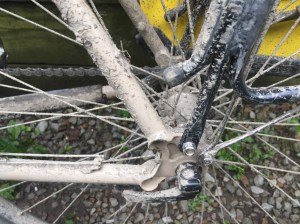
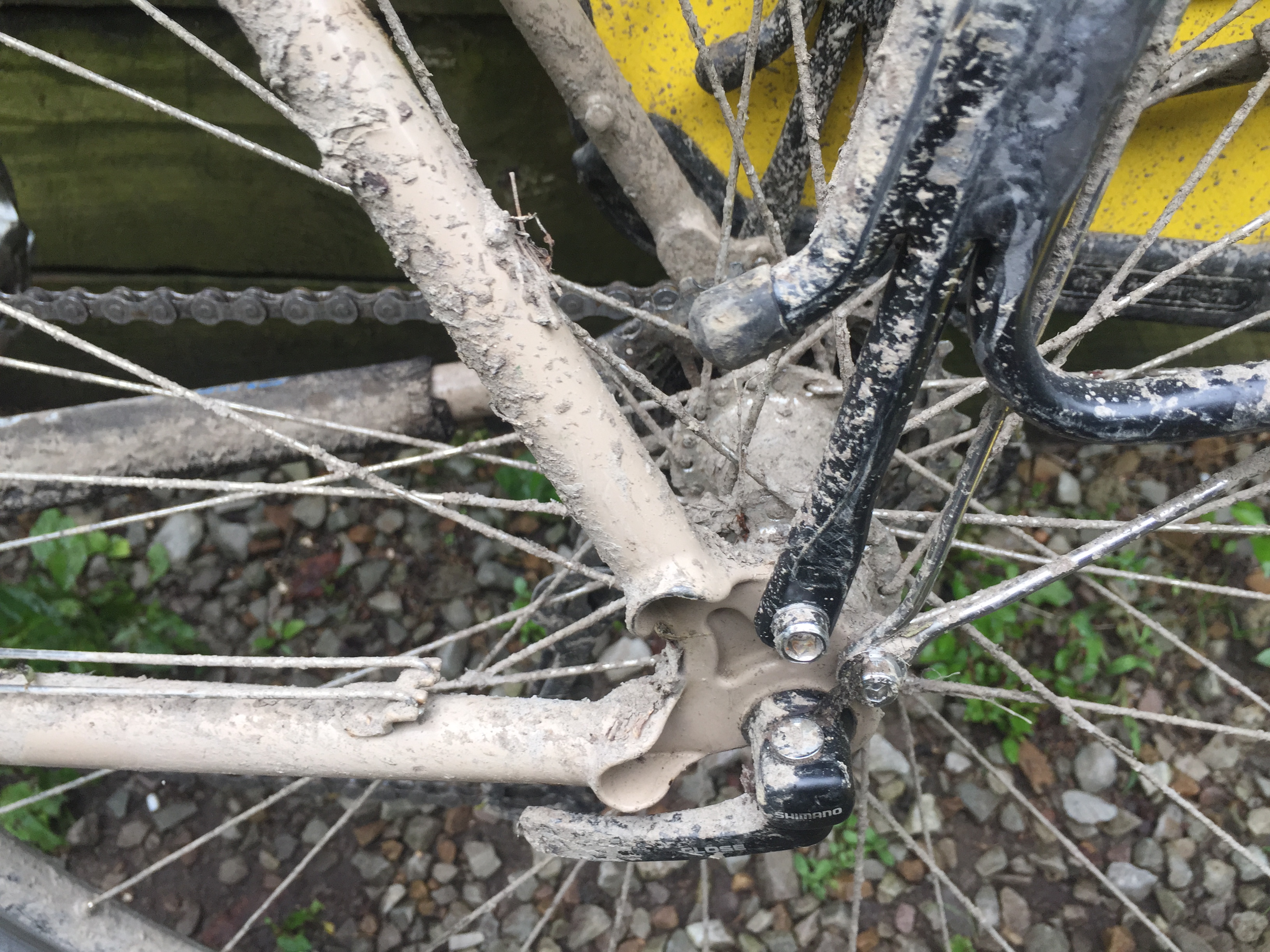
What my bike looked like most of the time.

What my bike looked like most of the time.

Food, lodging, supplies, bike shops and so on all focus on the path. Cumberland Maryland is in the process of reimagining itself as cyclist town and it was a worthwhile stop. Connellsville, Pa has bed and breakfasts about and of course has built a special free campsite. Meyersville, Pa also is turning its eyes towards the trail and has food, supplies, and lodging. West Newton, Pa has set up a welcome center housed in its old rail station. There is water there, info, souvenirs as well. Sadly no supplies, but that is because they do not want to compete with merchants in town. Those merchants are mostly over a bridge off the trail and I am not one for diversions except when really needed. So I did not see West Newton even though it is clearly working to make itself a trail town. I did pull off into Confluence, Pa for groceries and a stop at the bike shop there. Confluence also is remolding itself to be a trail town and the politics of this is visible in the fact that on at least one dead end street some grouch hung a sign saying “No Bicyclists.” That curmudgeon though is losing the battle as the folks in Confluence are friendly and helpful and the town has a lot to help people on the trail.

The Allegheny Trail Alliance and The Laurel Highlands Visitors’ Bureau have pulled together and printed up a uniform set of brochures featuring maps and info for the towns working hardest to make your GAP trip more pleasant. I found copies of these everywhere—from the Visitor Center in Cumberland Md, to the public notice boards near many road crossings.

This what the brochures were like. They were everywhere and were really helpful.

This what the brochures were like. They were everywhere and were really helpful.

There were great and really helped plan things. I wish I had them before hand, so here are the links to the various town brochures in PDF form: MeyersdaleWest Newton; Confluence; Ohiopyle; Rockwood; Connellsville. The C&O passes through fewer towns than the GAP. Brunswick Md is very close to the trail, but I suspect it gets passed over usually in favor of Harpers Ferry, WVa a few miles along. Getting to Harpers Ferry means crossing the rail bridge over the Potomac, and that means hauling your bike up a twisting set of stairs. But Harpers Ferry is an Appalachian Trail town and has the AT headquarters there. Food, supplies, lodging are all there and it is great town to visit. Williamsport, Hancock, and Cumberland Md. are all easier to reach and both have the expected amenities. The celebrated C&O Bicycle shop is in Hancock and has its large bunkhouse out back for cyclist lodging.

The prized C&O souvenir.

The prized C&O souvenir.

It is worth stopping at all the bike shops you can make since that is where you will meet other riders and get info and needed supplies. And repairs of course! I had chain troubles and got some help at the C&O Bicycle Shop and again at the CTC Bike Shop in Cumberland (thanks Wayne once again for the perfectly timed lift and the chat!).

The bike shops are all ready to help and understand the fact that you are rushing along—so service is fast and efficient. I ran into two women heading south who had blown out a tire just outside of Confluence. We managed to get in a new inner tube and they set off to make it to the next road crossing and once there figure out how and where to get a new tire. By the time I reached the Confluence Cyclery a local trail angel had already arrived there having met the women at their road crossing. He was picking up a new tire to run back to the riders so they could get back on their way. When my chain popped on an uphill (the quick lock link gave out!), I was lucky enough to find Wayne right there starting their own ride who graciously postponed it to load my bike on his rack and drive me into town to get a repair. The point is that there are plenty of wonderful and generous local folks who are happy to help riders out when trouble hits. The network is informal, but the pros at the shops all understand the drill and there are people all over who are on your side. Each year more and more people fall into this camp as the trails become more and more central to local economies.

The lock house at Oldtown, Maryland.

The lock house at Oldtown, Maryland.

Charging my devices was not that difficult. Between hotels and towns with places to sit and have coffee, it was easy to recharge. There were outlets in the mens’ room (and presumably the womens’ as well) at the rest area at the Great Falls Tavern Visitor Center. There also is a very nice little museum set up (the only of its kind) on the lock house at Lock 71 near Oldtown.
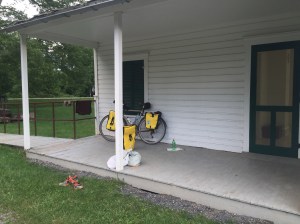
Lock 71 at Oldtown Md was a nice place to rest and tidy up while charging devices.

Lock 71 at Oldtown Md was a nice place to rest and tidy up while charging devices.

As long as it is open there is a fine outlet in there. I sat and dried out a bit on the porch there while the devices recharged. There was nothing quite like this on the GAP, but there more towns as I said before. All in all, the lights and phone were never really low during the trip.

For the most part the ride was fairly easy. My short days were due more to being lazy in town and my longest day—about 75 miles—was pretty easy. In the mud I had no trouble maintaining between 10 ad 12 mph and was faster where it was dry. There is technically a speed limit of 15 mph on the GAP at least, but little enforcement. It was a good ride, but never really that strenuous and as I said before, there were all sorts of riders on all sorts of bikes. It is manageable and a great time.

I hope that this helps you as you plan out your own C&O GAP trip and let me know if I can answer any questions.
 

Painting Perspective / Teaching Paintings

Travels happened me by two major Civil War sites this summer. Of course I had visited both Gettysburg and Antietam many times before, but I thought that the detours were well worth the extra miles and gas so that I could see these places in the midst of the 150th celebration. I am working up a week’s readings on the 150th for my seminar this fall and was also fishing for assignable tidbits. I wanted to see both of these sites because of the special role they have played in Civil War landscape memory. Both are gems—beautifully maintained acres, shaped vistas, and of course amazing collections of monuments. Proximity to Northern railheads made these places the most commemorated battle sites and that century-old legacy has made Gettysburg, at least, a massive tourist site.

Both sites have well placed museums that work well with the site’s story and the flow of visitation.

Antietam on a perhaps digitally enhanced beautiful day.

Antietam’s museum is the older of the two, although it is very proud of its new introductory film—a reenactor-heavy narrative of the campaign peppered with talking heads like James McPherson. Gettysburg has a newly-built state of the art visitor center reflecting current museum trends and is a magnificent shrine to all things Civil War. Its equally new film, though, is a Gilder Lehrman Center product, and as a consequence is very current and comfortable with the political context of the battle and the war—something usually less evident in this genre. Visitors receive a sophisticated lesson in the politics of slavery and the war itself.

Both museums, much to their credit, devoted space to discussing landscape memory and the creation of these places as battlefield parks. Unsurprisingly, though, most visitors passed through these areas somewhat quickly—perhaps too quickly. But in both museums what caught my eye was a lamentable example of Civil War myopia—that familiar inability of some enthusiasts to imagine a past outside of 1861 (or maybe 1859), to 1865. In this case, it was connected to paintings both museums display.

Both Gettysburg and Antietam display breathtaking works of nineteenth-century art even though neither treats them as the masterpieces they manifestly are. These are paintings of battles scenes, Gettysburg’s is the work of a master and his crew, while Antietam’s are more vernacular in approach. Both sets of canvases are well known—so I am making no claim to a discovery here.

A small section of the Cyclorama.

The Gettysburg “Cyclorama” was the core of its own much-visited auditorium long before it was incorporated into the new NPS visitors’ center. The five Antietam battle scenes may be a bit more obscure, but they were included in Time Life’s much-read Civil War series, giving them a wide audience. My point, or rather what struck me on seeing them on this visit, was not their well known existence, but rather, the way their “artness” is all but ignored—subordinated—to the battle narrative at the center of the museums’ battle stories.

In both cases there is good and compelling reason to talk about these paintings as art, and not just as simple imaginary windows into the battle as they are currently viewed. At Gettysburg, visitors see an admirable Gilder Lehrman film and then walk upstairs to have a guide use lights and recordings to awaken the climactic moment of Pickett’s Charge on the third day of the battle. The vehicle for that experience is a vast painting (or set of paintings, really) that make up a huge 360 degree panorama augmented by wonderfully evocative landscaping that begins where the canvas ends at the floor. As lights come on and off , recorded explosions and dramatic “glinting bayonets” language create a “you are there” feel, and people love it. But what they are loving is a late nineteenth-century form of popular entertainment. Indeed, there were several of these immersive environments that patrons could see from Coney Island to the various expositions as well as all over Western Europe. This is the same art form that one can still enjoy in a more “naturalistic” setting in cases at the Smithsonian Museum of Natural history or at New York’s version, to name just two. Realistic, grand, and employing a brilliant level of craftsmanship, what makes the Gettysburg Cyclorama so gripping is all—all—the brushwork of master craftsmen.

In this case the artist was Frenchman Paul Philippoteaux and a team of selected workmen.

Philippoteaux at work

Nearly 20 years after the battle, he studied the area, commissioned detailed photographs, and spoke with survivors and then set in to create a true masterwork. But despite his research, the painting is oddly French. The soldiers wear uniforms that are clearly French in cut and markings–well beyond the French influence common in American uniforms of the time–and much of the equipment is French in form as well. The main house in the image is not made of the stone it was in real life, but is instead plastered brick in a French style, and most tellingly, large conical French haystacks dot the Pennsylvania fields. The result is an American moment filtered through French artistic eyes—one wonders if what we are seeing is Gettysburg, or some sort of Franco-Prussian War parable. These are wonderful jumping-off points for discussion. Yet, during our visit, the guide never even mentioned Philippoteaux (even though the paintings’ first showings boasted the painter’s name as loudly as the word “Gettysburg”).

The old Cyclorama

Visitors’ questions afterwards focused only on “who was where,” and no one felt any need to inquire about the art they were loving so—and no official papers or voices on hand even suggested that they might want to. Julia King has written about how museums’ uses of seventeenth-century Dutch paintings to describe uses of found artifacts work to superimpose antique discussions of class and gentility, and naturalize the effects of those hundreds-of-years-old texts.[1] We see the same thing here. These paintings were meant to teach, commemorate, and entertain—with an emphasis on the latter two, especially considering that still-living veterans were a major visitor constituency. Indeed, the paintings still serve these goals, except in that now the notion of teaching seems to have outstripped the other two missions—this art is a surrogate vantage point, a means of time travel, and an unquestioned authority for visitors. All of this grants a unique validity to a very singular artistic vision while rendering invisible the artist(s) and the process and logic of the paintings’ creation. That is a shame really.

A similar thing happens at Antietam. There, five huge battle scene canvases portray crucial moments of that messy and poorly executed fight.

James Hope’s painting entitled “Artillery Hell.”

The paintings were the work of James Hope—a painter and Union veteran who painted these remarkable canvases in his Watkins Glen, New York workshop around 1892. In time the paintings ended up in a church and in 1979 became NPS property. The NPS does a good job of telling a small version of their story online, and the exhibit gives a wonderful description of the effort to save one of the damaged canvases. But, there is almost no effort in the display to talk about Hope, how and why he made these masterpieces, or even the larger context of survivor art. Again, the result is that the paintings are simply teaching aids—a role that misses an huge opportunity and sells these works short.

Both settings have the physical space to discuss these paintings as art. I suppose what is missing is the interpretive space. I hope that  can change and that visitors can see this moving remarkable art as art.


[1] Julia King, “Still Life with Tobacco,” Historical Archaeology 41:1 (2007), 6-22.

Nat Turner’s Long Silence

Several years ago I began visiting the sites of the Nat Turner slave revolt in Southampton County, Virginia. My interest began after teaching an early American slavery class and spending some time with the work the revolt, particularly Steven Oates’s The Fires of Jubilee: Nat Turner’s Fierce Rebellion and Kenneth

southampton

Greenburg’s Nat Turner: A Slave Rebellion in History and Memory.[1] I was particularly spurred on by Irving Tragle’s older but still quite useful source book The Southampton Slave Revolt of 1831: A Compilation of Source Material, Including the Full Text of The Confessions of Nat Turner.[2] My goal was to locate what I could find of what survived of the old landscape and see what there was to see.

I brought a team of archaeology students there for the first time in 2003 (as memory serves) and we drove around guided by Tragle’s 1960s photos of then-still-surviving homes as well as some of his hand-drawn maps. I matched those up as best as possible with a county map and off we set to see what we could see. My reasoning was simple. If a building was still standing in the 1960s, there was at least a chance that it was still standing in 2003. We whirled up and down the region’s dusty roads stopping here and there and looking over the land.  We even knocked on doors to see what local people knew. It was fascinating to hear how they spoke of the events and their landscape. This was particularly valuable to me as I had made a conscious choice to avoid the official arbiters of the landscape and its stories—a strategy I always employ and highly recommend. Learn a place first using your own resources and then only later turn to the “officials.”

After much valuable trial and error I was able to locate four buildings still on their sites—including the ruined Whitehead, Porter, and Edwards houses.

The Peter Edwards House in 2006. Now gone having been dismantled the following year by salvagers for its framing members sold to developers in northern Virginia.

The Peter Edwards House in 2006. Now gone having been dismantled the following year by salvagers for its framing members sold to developers in northern Virginia.

Since then, subsequent annual trips have allowed me to see the loss of the Edward’s house and watch the ongoing decay of the Whitehead house. One benefit has been getting to know one local farmer and his wife. The family owns much of the land and some of the most important sites, but, as is so often the case, is not on good terms with the local official history folks. But, my farmer friend has been more than willing to grant me access to the site, share his collection of found objects and his and his family’s own life stories. He showed me the site where the former owner disposed of the old Whitehead family grave stones to gain more plowing space and is even willing to allow me to excavate some day perhaps. He invited Colonial Williamsburg architectural historian Matt Webster and I to do a sustained “crawl through” of the Whitehead House ruins–a considerable risk since the ruin could collapse at any moment. I also located the cellar hole of the Francis House, and a trip into the woods on the advice of another aged neighbor showed me the plywood-covered remains of the home which had been moved in the 1980s. Two other buildings survive, one restored and occupied by a Norfolk lawyer and the other, the Rebecca Vaughn House, was long ago moved to a park in Courtland and all but abandoned.

Over the years I have brought a few dozen students around the land, toured friends and professional colleagues, and even drove the Smithsonian’s Museum of African

The decaying remains of the Whitehead House. Hidden away far from the modern road system and on private land.

The decaying remains of the Whitehead House. Hidden away far from the modern road system and on private land.

American history’s director Lonnie Bunch over hill and dale to see what might fit the museum’s needs (as far as I know, nothing much came of that adventure) But, I have not written about it. Why have I not done that? Like the nation, I have helped Turner continue his long imposed silence.

That question bugs me. The easy reason is that Ferry Farm and George Washington have kept me pretty busy. Another problem is that this might need to be a first person essay and that is a tricky thing. Mostly though it has been hard to see the hook, but I am getting close though, and this entry is part of getting those ducks in a row. Here is what I learned in preliminary form. For one thing, I am pretty sure that the ruins of the Porter House and the now lost Edwards House probably post-dated the revolt even though local stories set events there. For another thing, there is no real possibility of doing any meaningful historical preservation on this landscape. It is in fact virtually forgotten and entirely un-commemorated. Race and divisive local politics play a huge role in this fact, but there is as many have noted, a larger national lack of willingness to come to terms with Turner. Local memory is a carefully guarded commodity making treacherous political shoals. What it comes down to is that no one really wants to talk about Turner, and thus no one does, or at least when they do it all within a carefully constructed framework.

Nevertheless, what matters about this landscape still is its emotional power. I have seen people’s reactions and there are something. There is something amazing about standing by the ruins of the Whitehead House. Although it underwent some changes, study of its collapsing subfloor framing showed that at least that part dated to the late eighteenth century—this was indeed the house that Turner and his men visited. With some work and careful crawling I have made my way to the spot where Turner’s ally Hark cut off Katherine Whitehead’s head at her doorstep. We have seen what is said to be the chimney corner where Margaret Whitehead hid before Turner caught her and killed her a short ways away (this was the relationship William Styron’s novel made so problematic). If we believe the Thomas Gray account (which we currently do) then this is the only killing by the most famous slave rebel in American history. I have brought students to a very good guess about where that place is based on old road cuts and fence lines.

The front door of the Whitehead house. If a few good suppositions line up, this was a killing spot--perhaps the only one of which we can be sure.

The front door of the Whitehead house. If a few good suppositions line up, this was a killing spot–perhaps the only one we can be sure of.

There is a rise just before the old house and it was on this hump that locals laid out the bloody remains of the Whitehead family after the revolt so that arriving militia men from other counties could get fired up before going off to exact revenge on what survived of the enslaved and free black population. A meaningful place, and people can still feel something there.

This sort of connection is the essence of historical landscapes. Feeling the past is what motivates most people to visit sites all over the nation. But not all sites are the same. Some are too troublesome (to borrow the word) to warrant attention. A century of neglect has done a good job in erasing what survived of an event most wanted to forget. For a while the Navy considered moving its airfields away from Norfolk to the more in-land Southampton. The move would have enclosed much of the Turner lands and made them unapproachable to the public. The plan was sidelined, for now. Gradually though, the last vestiges of this event are fading away.

Turner spoke so loudly that permanent silencing was his punishment.

[1] Steven Oates, The Fires of Jubilee: Nat Turner’s Fierce Rebellion (New York: Harper Perennial, 1990); Kenneth Greenburg, ed., Nat Turner: A Slave Rebellion in History and Memory (New York: Oxford University Press, 2008).

[2] Irving Tragle, ed.,The Southampton Slave Revolt of 1831: A Compilation of Source Material, Including the Full Text of The Confessions of Nat Turner (New York: Vintage Books 1973).

Photographic Now-and-Thens

Over the past few months a new manner of photographic art form has come to my attention. It involves taking old photographs and merging them with new ones. I have loved this sort of game for ages, but digital photography now brings it to our fingertips. Who cannot love the work of William Frassanito who made it his métier to locate the sites and angles of noted Civil War photographs and set “then and now” images side by side?

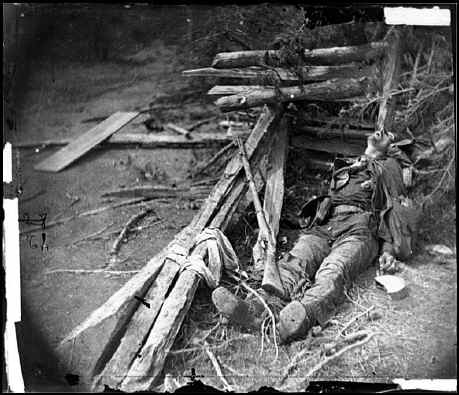
No one could not claim that Frassanito invented the approach, but few before him had used it to such great effect and historical value. His careful work charted out how photographic teams lugged corpses around battlefields from place to place to get just the right shot. That may not have changed the way military historians understood a fight, but it certainly added a deeply valuable and unique level of humanity to the aftermath of the battles. No small feat. I was one of the almost innumerable kids who grew staring in fascination and horror at the often quite beautiful images of the war’s dead. Frassanito deepened and reanimated these images for me. For example, it was moving to learn that that gaunt, prone, but yet so life-like blood-soaked Confederate boy (as he indeed was) whose life ended with a checked cloth near his hand as he hid in a small pile of fence rails near Spotsylvania Courthouse was also the dead man second from the left in another photo from the same sequence.[1] Frassanito’s work showed us that many of these men in these seemingly separate images were in fact comrades, and in all probability knew each other by name given how close to one another they died. Likewise, Frassanito’s Gettysburg work showed that the much-beloved and ballyhooed photograph of the Confederate prisoners by the fence rails shows men who in fact were not defiant heroes nor exemplars of the “elan” that Shelby Foote effused about, but were instead deserters who hid out in barns near Carlisle and thus missed the battle.[2]

Three "Johnnie Reb" Prisoners, captu...

Three “Johnnie Reb” Prisoners, captured at Gettysburg, 1863 (LOC) (Photo credit: The Library of Congress)

This Frassanito gleaned from photographer’s notes, landscape triangulation, and army records. Wonderful work.

James Deetz too used photographic “then and now” in Flowerdew Hundred when he matched up views of the James River.[3] I am not sure that he really did much more than offer a contrast, but he did use the process in aid of identifying sites—perhaps the approach’s most valuable use. I played at this game early on in the Ferry Farm work, although not with an eye toward finding sites.

But these new Photoshop matchups (although it would be Gimp in my case) are something very different. More art than research. They have enormous capacity to invoke if nothing else–but that capacity is remarkable. The first I saw of these were mashups from Russian cities during The Great Patriotic War. They wonderfully set school children against T-34 tanks and blown out buildings and thus created deeply haunting beautiful  images.

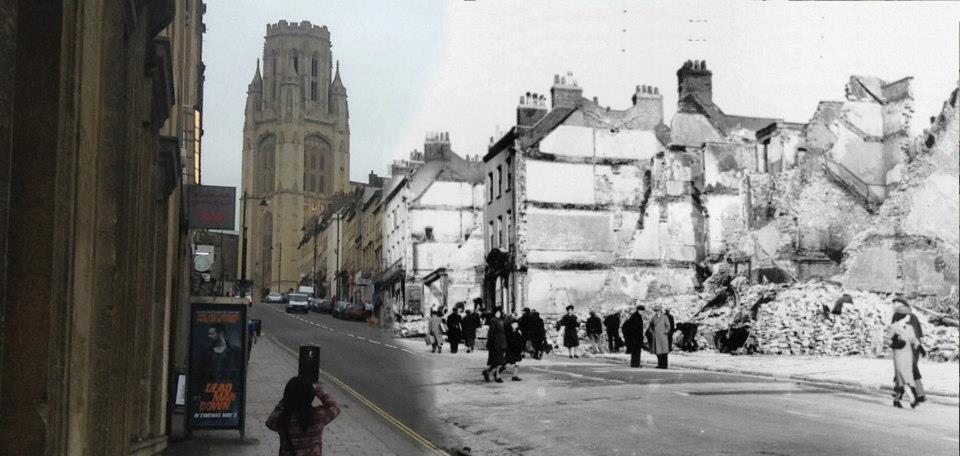
I took my first stab at this in Bristol in the UK—a city that was extensively bombed by the Germans during WWII. I used an image of the lovely Park St. and did my best matching up.

park st

What I had not noticed at first was the contrast of the devastated buildings on the right of the image, and the fashionable cartoon violence referenced in the movie poster on the left. On Park St., one generation knew these horror all to well, whereas a later generation has turned horror into a fun afternoon. I had created art and did not even know it.

Now that I am back in Fredericksburg, I am in a setting filled with great historical images. Years of time here have let me know most of the locations for many of the best shots. So I have set in to do a few of these over the next few weeks.

PrincessAnne

I do have a question though. In a city struggling with issues of preservation I find myself wondering if this sort of imaging highlights that which is lost, or does it create the impression that more has survived? Of course that depends on the individual image to a large degree. But, I find myself wondering if this helps or hurts the larger cause of preserving past views.


[1], William Frassanito, Grant and Lee: The Virginia Campaigns, 1864-1865 (New York: Thomas Publishing, 1996).

[2] William Frassanito, Gettysburg: A Journey in Time (New York: Thomas Publishing, 1996).

[3] James Deetz, Flowerdew Hundred: The Archaeology of Virginia Plantation (Charlottesville: University of Virginia Press, 1996).