Remnantology

Dedicated to the examination of the remnants. Phil Levy's words in reference to history, archaeology, Judaism, academe, music, outdoorsing…

Category Archives: Virginia History

Fredericksburg’s Farmers’ Bank: History vs the Tarmac Desert.

In the summer of 1862 President Lincoln visited the city of Fredericksburg. Soldiers of the United States had recently captured this hub of rail, road, and river virtually without incident and the President was in town to meet with his theatre commanders and to see the prize. Halfway between Washington and the Confederate capital of Richmond, Fredericksburg’s capture was one of the last moments when rational people could imagine that the war would be short and relatively painless.

Lincoln held meetings and visited local sites—including George Washington’s childhood home. In town, he met with General Marsena Patrick in the two-story neo-classically inflected Federal style Farmers’ Bank. The bank sat on the corner of Princess Anne and George Streets right across from St George’s Episcopal Church on its front and the town’s Presbyterian Church on its eastern side.
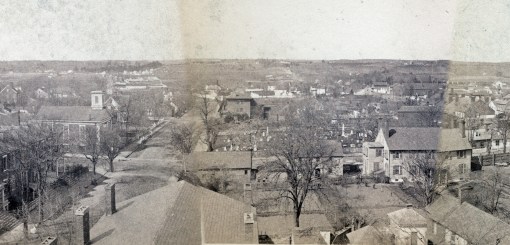
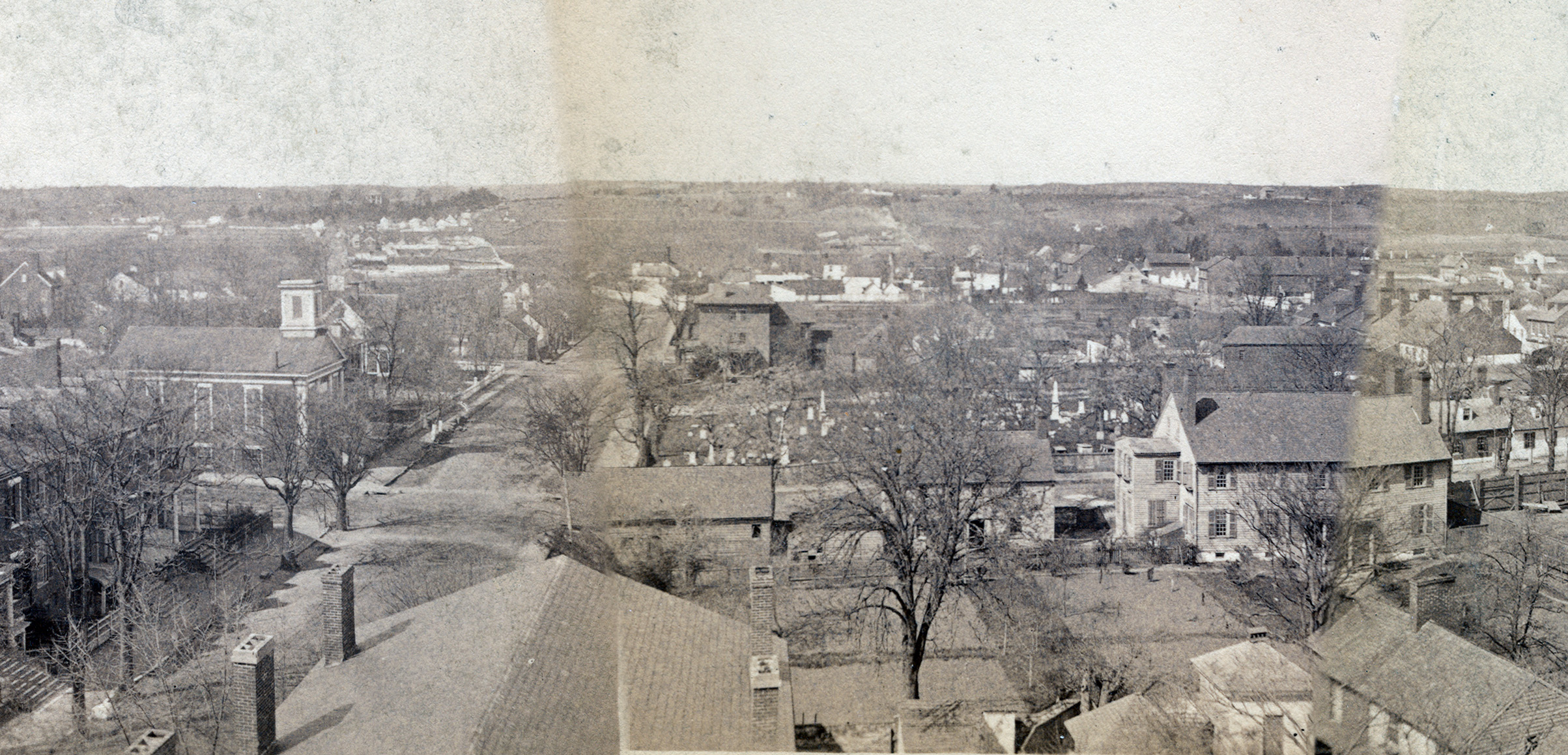
This section of the much-discussed 1888 St George Church panorama of Fredericksburg shows the roof and chimneys of the Farmers' Bank on the left foreground. Note the use of the lots that are now mostly tarmac deserts. This section of the panorama came from Fredericksburg Remembered. http://cdn.loc.gov/service/pnp/cph/3c00000/3c00000/3c00600/3c00623v.jpg

This section of the much-discussed 1888 St George Church panorama of Fredericksburg shows the roof and chimneys of the Farmers’ Bank on the left foreground. Note the use of the lots that are now mostly tarmac deserts. This section of the panorama came from Fredericksburg Remembered. http://cdn.loc.gov/service/pnp/cph/3c00000/3c00000/3c00600/3c00623v.jpg

Though lacking the adornments of ecclesiastical architecture, the Farmers’ Bank’s facade, style, and placement was nevertheless itself a statement of faith, solidity, and the American way. General Patrick’s selection of the bank as his own office—and a nerve center of the city’s occupation—enlisted the existing architecture of trust, power, and commerce for the for the cause of the Union.

The Farmers’ Bank has survived to today.

The Farmers’ Bank as it looks today. Image from Mysteries and Conundrums https://npsfrsp.wordpress.com/2011/01/17/slaves-at-fall-hill-abraham-and-hester-tuckson/

It has been a bank and office suites most of this time and is now one of Fredericksburg’s best historical buildings. Indeed, Fredericksburg NPS Battlefield Park Historian John Hennessy recently highlighted this fact for his blog readers reminding all that the bank is the only existing building we are certain Lincoln entered, walking over the bank’s worn Aquia sandstone steps and entering through the elaborate alcove entrance. The bank’s northeastern corner is especially notable for the large amount of Civil War graffiti resulting from bored soldiers carving their names and regiments into the brick (Other Civil War graffiti). In the 1930s, Historic American Building Survey architects studied the bank (then called the National Bank) and added it the list of the town’s charms. A 1990s drive through window and cash machine addition south of the bank are the only externally visible changes to the building which otherwise has maintained its historical feel capped off by a wooden Civil War era style sign.

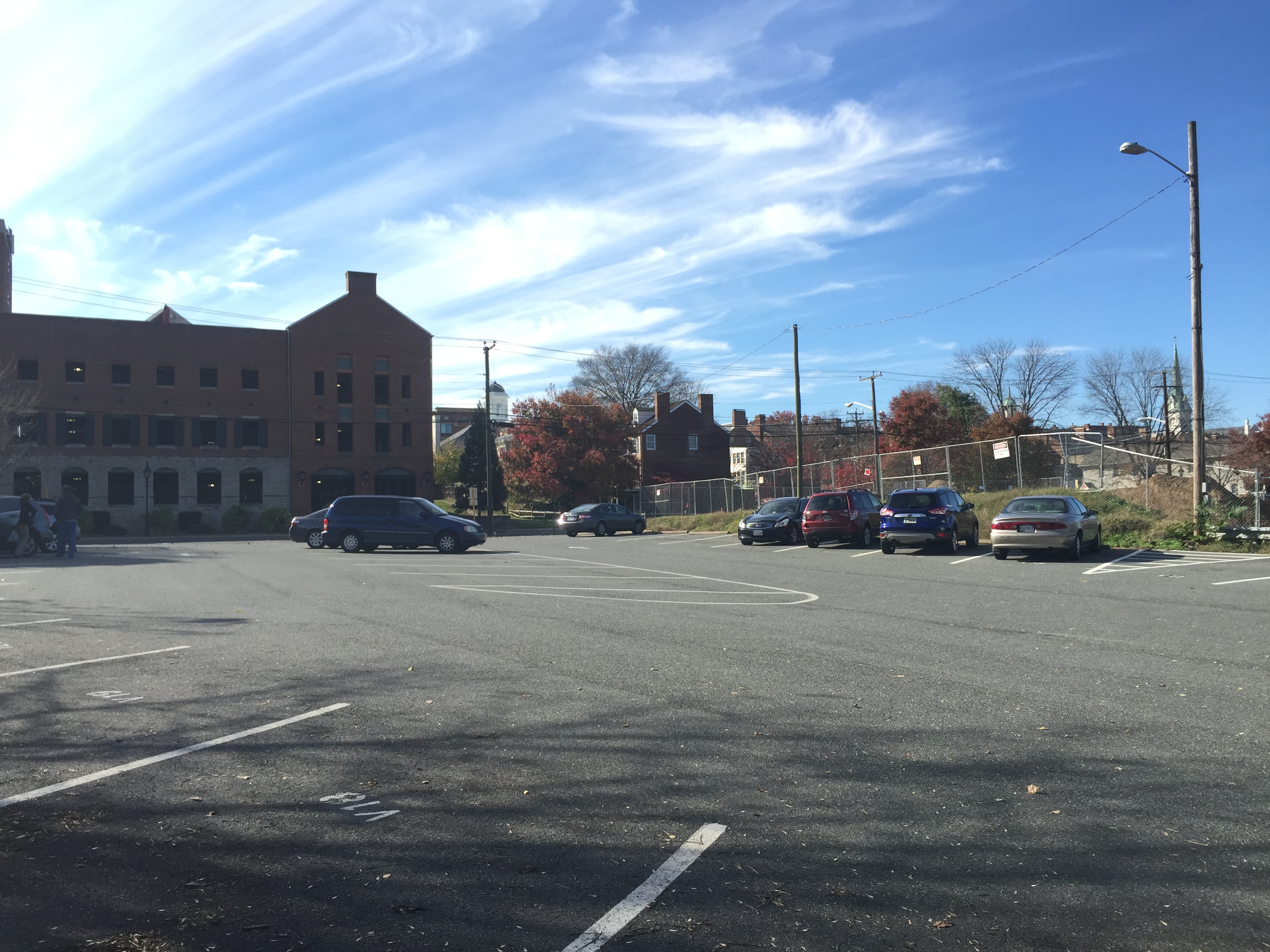
But changes in the larger lot have left the Farmers’ Bank an isolated historical Island in a tarmac desert. Beginning at least as early as the 1950s, Fredericksburgers transformed open in-town spaces into parking lots.

Seen in order on the right, the 1990s drive through bank addition, the south wall of the Farmers' Bank, and the steeple of St George Episcopal Church.

Seen in order on the right, the 1990s drive through bank addition, the south wall of the Farmers’ Bank, and the steeple of St George Episcopal Church.

In the nineteenth century, open lots were needed as work yards, kitchen gardens, and animal residences. But in the automobile era—and particularly after the 1960s when I-95 passed just west of town—the storage of temporarily dis-used cars became a primary concern. Property owners paved open lots and, as older buildings came down, their empty lots also joined the ranks of parking lots often in the shadow of roughly constructed side walls of remaining buildings meant to be seen only from the front. The result of this was to leave town feeling cold and gap toothed and filled with unplanned areas of undesirable, mostly unused, open spaces.

A Tarmac Desert on Sophia Street.

A Tarmac Desert on Sophia Street.

Once a lot is paved, the city or the owner are now committed to a never-ending maintenance regime as cracks have to be filled and holes patched. Paved lots also force collected rainwater to funnel into streets thus stressing removal systems, increasing flooding, and accelerating the erosion of older cobbles. The answer to this is of course more paving, so that over time, more and more of the cityscape became a tarmac desert. Whereas earthen lots absorb rainwater and produce greenery even when left alone and require no maintenance other than occasional mowing (or goat keeping), tarmac deserts produce nothing other than that distinctive smell in the heat and make corners for the collection of wind-borne trash. On top of that, the in and out flow of cars provide visible markers of when people are in a building and when they are not. The absence of cars signals a building’s emptiness to burglars while a dark lake of tar is itself an inviting terrain for all sorts of mischief. Nothing feels emptier than an vacant parking lot—and in Fredericksburg, most parking lots are empty most of the time and, being paved, can do nothing other than wait for the next car to park there. Paving a cityscape makes it an uninviting alienating tarmac desert that seems dark and dangerous most of the time.

The Farmers’ Bank sits now at the corner of just such an in-town desert. That makes the bank feel isolated and even irrelevant. This is just one of many ways whereby reliance on automobiles and that dependency has remade the landscape in ways that challenge preservation and a place’s historical feel.
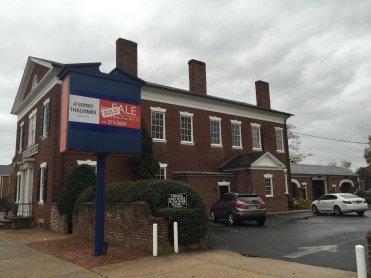
The west wall of the Farmers' Bank with the drive through on the right. Note the sale sign.

The west wall of the Farmers’ Bank with the drive through on the right. Note the sale sign.

But now the bank faces a new threat—one worse perhaps than the shells and pocket knives it endured during the Civil War. When the economy bottomed out in 2008 most of Fredericksburg’s development project ground to a halt New condos near the rail tracks which once boasted signs claiming “Starting at $400,000!” soon boasted starting prices of $150,000 before being cut up into apartments. Subdivisions simply stopped with streets half fleshed out and stripped fields were left alone to regrow what grasses they could. Businesses failed and storefronts replaced displays with For Rent signs and papered-over windows. But all of that is over, and the development economy is once again booming. In a very short period of time the city saw a massive new courthouse constructed, a new downtown hotel right across the street, and many new homes fitting in between older ones. In just this last year new in-town projects have piled high-end housing into town and added eateries and even a glittering south-western styled brew pub.

Postmodern newly built townhouse filling in open spaces on the left and the stunningly out of place brew pub sitting on the corner of William and Winchester streets.

Postmodern newly built townhouse filling in open spaces on the left and the stunningly out of place brew pub sitting on the corner of William and Winchester streets.

The good news (perhaps) is that much of this new development is taking place in lots that were previously tarred over. That addresses some of the aesthetical problems posed by tarmac deserts, but none of the environmental or historical preservation ones. The bad news is that all of this is happening so quickly that thorough archaeological is very challenging—and it seems in many cases that significant finds would not be enough to slow down the pace of building or even redirect it. Speed also leaves preservation–of buildings as well as less tangible but nevertheless important things like view sheds and historical feel– left in the dust and crushed by the bulldozer’s treads. Right now the future of the Farmers’ Bank is in question. A developer had bought the lot and received initial approval to fill the desert with condos. But the plan bogged down in levels of city government and all is on hold for now.
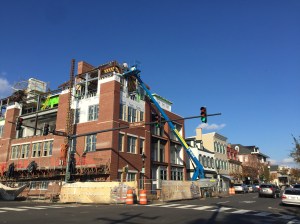
New construction on William Street right next to 19th century rows

New construction on William Street right next to 19th century rows

At this year’s Council for North Eastern Historical Archeology conference in Fredericksburg, there was discussion about how the city, still lacking a protective archaeological ordinance, may be turning a blind eye to the destruction of the town’s material patrimony–a patrimony daily stewarded by Fredericksburg, but in reality owned by the nation. Again, the good news is that the city is on the way to hiring a preservation specialist to monitor work. Again, the bad news is that no one knows just how influential that person will be once hired and how much we may lose in the meantime.

Meanwhile though, decades’ old bad car-driven choices are still felt in a town walking the line between protecting its past and building for its future.
“Ask A Slave” and Unintended Meanings

http://www.gofundme.com/AskASlave

http://www.gofundme.com/AskASlave

These videos have been making the rounds and I wanted to comment on this all. Yes, they are clever — even very clever. Yes, Dungey is talented and this is an imaginative way to promote herself as an actress and hit some social consciousness bells along the way. I respect her and her project and look forward to seeing how students react. But at the same time, it made me squirm on so many levels and raised some red flags.

The Stupid-Visitor-Question-Story genre is a staple of museum culture– and as Handler and Gable amongst others have pointed out, that is not always a good thing for either visitors or museum staff. Interpreter-visitor encounters are usually imagined as being a charming educational moment. But often these are in realty tense tug-o-wars with smugness on both sides and a high degree of trying to embarrass as well. At least visitors have the option to ask intentionally stupid questions to make their friends laugh–I suspect that that is in fact what is behind many if not most of these stories–visitors intentionally screwing around with staff. In that way, visitors get a double bang: make friends laugh in the moment and have the more incredulous repeat the feat over and over. Hey presto, a manner of immortality.

On the other hand, for interpreters, encounters are full of risk. Staff may suspect that they are being screwed with, but face employer retaliation if they get too snarky. Interpreters have to treat every question as real and have to be engaging in responding – their continued employment depends on it. Thus, the Stupid-Visitor-Question-Story genre becomes a sort of spiritual haven for people who are paid poorly, work their asses off in often harsh conditions (being in a blacksmith shop or a recreated eighteenth-century kitchen all day sucks now as it did then) and also will never be granted much intellectual respect or credibility from academe. These folks often see themselves (rightly or wrongly) as permanent second-class citizens in historyland. Most lack the kinds of schooling and publishing records academe cherishes, but do have often very detailed fine- grained knowledge of their fields. On top of that, they often have an intuitive knowledge that comes from experience—-something that is immensely valuable to museums and visitors, but always just a bit suspect to “book learning” historians. Buy an experienced interpreter a drink and they will tell you how irritating visitors are. But buy them a second drink and they will tell you what arrogant exclusive jerks historians can be.

What worries me about these film clips is the stupid visitor story being too public a performance. I see it as only encouraging visitors to play at this even more. But worse still, I worry for how museums (read employers) will see this. They are famous for retaliation and are always deeply concerned about public image. I don’t imagine that Mount Vernon is at all happy about this sort of “unmasking” and I wonder what HR policies may ensue not just there, but elsewhere as well. It is fun to laugh—and Dungey is good at making us do that. But, museums are workplaces and interpreters are staff, often very vulnerable staff at that. These clips viewed that way are so very full of issues of domination and resistance. The very title “Ask a Slave” is far more meaningful than most gleeful watchers might know.

Nat Turner’s Long Silence

Several years ago I began visiting the sites of the Nat Turner slave revolt in Southampton County, Virginia. My interest began after teaching an early American slavery class and spending some time with the work the revolt, particularly Steven Oates’s The Fires of Jubilee: Nat Turner’s Fierce Rebellion and Kenneth

southampton

Greenburg’s Nat Turner: A Slave Rebellion in History and Memory.[1] I was particularly spurred on by Irving Tragle’s older but still quite useful source book The Southampton Slave Revolt of 1831: A Compilation of Source Material, Including the Full Text of The Confessions of Nat Turner.[2] My goal was to locate what I could find of what survived of the old landscape and see what there was to see.

I brought a team of archaeology students there for the first time in 2003 (as memory serves) and we drove around guided by Tragle’s 1960s photos of then-still-surviving homes as well as some of his hand-drawn maps. I matched those up as best as possible with a county map and off we set to see what we could see. My reasoning was simple. If a building was still standing in the 1960s, there was at least a chance that it was still standing in 2003. We whirled up and down the region’s dusty roads stopping here and there and looking over the land.  We even knocked on doors to see what local people knew. It was fascinating to hear how they spoke of the events and their landscape. This was particularly valuable to me as I had made a conscious choice to avoid the official arbiters of the landscape and its stories—a strategy I always employ and highly recommend. Learn a place first using your own resources and then only later turn to the “officials.”

After much valuable trial and error I was able to locate four buildings still on their sites—including the ruined Whitehead, Porter, and Edwards houses.

The Peter Edwards House in 2006. Now gone having been dismantled the following year by salvagers for its framing members sold to developers in northern Virginia.

The Peter Edwards House in 2006. Now gone having been dismantled the following year by salvagers for its framing members sold to developers in northern Virginia.

Since then, subsequent annual trips have allowed me to see the loss of the Edward’s house and watch the ongoing decay of the Whitehead house. One benefit has been getting to know one local farmer and his wife. The family owns much of the land and some of the most important sites, but, as is so often the case, is not on good terms with the local official history folks. But, my farmer friend has been more than willing to grant me access to the site, share his collection of found objects and his and his family’s own life stories. He showed me the site where the former owner disposed of the old Whitehead family grave stones to gain more plowing space and is even willing to allow me to excavate some day perhaps. He invited Colonial Williamsburg architectural historian Matt Webster and I to do a sustained “crawl through” of the Whitehead House ruins–a considerable risk since the ruin could collapse at any moment. I also located the cellar hole of the Francis House, and a trip into the woods on the advice of another aged neighbor showed me the plywood-covered remains of the home which had been moved in the 1980s. Two other buildings survive, one restored and occupied by a Norfolk lawyer and the other, the Rebecca Vaughn House, was long ago moved to a park in Courtland and all but abandoned.

Over the years I have brought a few dozen students around the land, toured friends and professional colleagues, and even drove the Smithsonian’s Museum of African

The decaying remains of the Whitehead House. Hidden away far from the modern road system and on private land.

The decaying remains of the Whitehead House. Hidden away far from the modern road system and on private land.

American history’s director Lonnie Bunch over hill and dale to see what might fit the museum’s needs (as far as I know, nothing much came of that adventure) But, I have not written about it. Why have I not done that? Like the nation, I have helped Turner continue his long imposed silence.

That question bugs me. The easy reason is that Ferry Farm and George Washington have kept me pretty busy. Another problem is that this might need to be a first person essay and that is a tricky thing. Mostly though it has been hard to see the hook, but I am getting close though, and this entry is part of getting those ducks in a row. Here is what I learned in preliminary form. For one thing, I am pretty sure that the ruins of the Porter House and the now lost Edwards House probably post-dated the revolt even though local stories set events there. For another thing, there is no real possibility of doing any meaningful historical preservation on this landscape. It is in fact virtually forgotten and entirely un-commemorated. Race and divisive local politics play a huge role in this fact, but there is as many have noted, a larger national lack of willingness to come to terms with Turner. Local memory is a carefully guarded commodity making treacherous political shoals. What it comes down to is that no one really wants to talk about Turner, and thus no one does, or at least when they do it all within a carefully constructed framework.

Nevertheless, what matters about this landscape still is its emotional power. I have seen people’s reactions and there are something. There is something amazing about standing by the ruins of the Whitehead House. Although it underwent some changes, study of its collapsing subfloor framing showed that at least that part dated to the late eighteenth century—this was indeed the house that Turner and his men visited. With some work and careful crawling I have made my way to the spot where Turner’s ally Hark cut off Katherine Whitehead’s head at her doorstep. We have seen what is said to be the chimney corner where Margaret Whitehead hid before Turner caught her and killed her a short ways away (this was the relationship William Styron’s novel made so problematic). If we believe the Thomas Gray account (which we currently do) then this is the only killing by the most famous slave rebel in American history. I have brought students to a very good guess about where that place is based on old road cuts and fence lines.

The front door of the Whitehead house. If a few good suppositions line up, this was a killing spot--perhaps the only one of which we can be sure.

The front door of the Whitehead house. If a few good suppositions line up, this was a killing spot–perhaps the only one we can be sure of.

There is a rise just before the old house and it was on this hump that locals laid out the bloody remains of the Whitehead family after the revolt so that arriving militia men from other counties could get fired up before going off to exact revenge on what survived of the enslaved and free black population. A meaningful place, and people can still feel something there.

This sort of connection is the essence of historical landscapes. Feeling the past is what motivates most people to visit sites all over the nation. But not all sites are the same. Some are too troublesome (to borrow the word) to warrant attention. A century of neglect has done a good job in erasing what survived of an event most wanted to forget. For a while the Navy considered moving its airfields away from Norfolk to the more in-land Southampton. The move would have enclosed much of the Turner lands and made them unapproachable to the public. The plan was sidelined, for now. Gradually though, the last vestiges of this event are fading away.

Turner spoke so loudly that permanent silencing was his punishment.

[1] Steven Oates, The Fires of Jubilee: Nat Turner’s Fierce Rebellion (New York: Harper Perennial, 1990); Kenneth Greenburg, ed., Nat Turner: A Slave Rebellion in History and Memory (New York: Oxford University Press, 2008).

[2] Irving Tragle, ed.,The Southampton Slave Revolt of 1831: A Compilation of Source Material, Including the Full Text of The Confessions of Nat Turner (New York: Vintage Books 1973).