Remnantology

Dedicated to the examination of the remnants. Phil Levy's words in reference to history, archaeology, Judaism, academe, music, outdoorsing…

Category Archives: Bicycle Touring

Man Plans, God Laughs Tour, 2017. Folsom California. 

Riding the ACA Western Express Bicycle Trail.  Sunday 6-11-17

And laugh he did today! Well, maybe just a chuckle. Nothing bad happened–just low mileage let down.

As usual, Saturday was an off-the-bike day spent in this case reading, sleeping, and a short local walk. Nothing to report.

Today had a slow start from the cave in Sacramento–cozy and hard to drag out of bed at 6 am. We still had tons of yogurts to eat and orange juice left over and that was a good start. The real issue was that it is just so hard to get out of bed and onto the road. This is where tents are a huge advantage. In the woods or on tour, it is always easier to leave a tent than it is a bed. We made it out though by ten. I still wanted to hit an REI for last things before we leave civilization. Here were my genuius plans. 1: Leave Rami at a Starbucks with the bikes and get a Lyft for the 5 miles round trip to the store. Outcome: No Lyft connection available on my phone over and over–so that idea died. Lyft–if you are reading this–wtf?? B: A cab to do the same. Outcome: 10 rings and then an answering machine at the 24 hour cab co. Hey cab co., I hope Uber wipes you out–you would have been over-priced and slow to show up anyway. Plan The Thirde: Ride the 2.5 back to the REI in town. Outcome: turns out they do not open until 11am anyway and we were not going to wait a gratuitous hour. In the event, we might have been penny wise and pound foolish.

We left town again by way of the inner city bike path. Rami had found a story about a cyclist being attacked by machete wielding “stabby hoboes” not that long back and right close to where we needed to get the path. Machete Man was taking a break this morning, so we were lucky. Nevertheless, there was ample evidence again that every cranny of this city has been taken over. But as we headed north and west the path became less dicey and more like a regular path. A word about the homeless. This is always such a dilemma. We have an obligation to recognize and respect the humanity of these hard done by fellow humans. But many have made mistakes and are still living in their shadows. The tattooed tear on the face that says “I have screwed up mightily” or the premature toothlessness of meth habits are only the most visible markers of people who have lost their way or been shoved off their path. But guess what? People make mistakes. They do. So does that mean that they lose the right to humanity? It is amazing that we cannot figure out that punishments and punitive reward systems just don’t work. Too often we say to the drowning, “show me you can swim, and then I will throw you the life rope–but if you continue to drown, I will take the rope away. I don’t want to waste any rope on someone who might end up drowned anyway.” We need to change this attitude and just help people because they need help–not because they are somehow virtuous or somehow improving. And at the same time, there is no disputing the very real damage broken people do to those around them and the places they end up. Rami and I have been discussing this a lot. He has a deep romance with the edgy, the off grid, the untamed, and the seemingly free. He often talks about wanting to freight hop (bye bye leg!), or live in hobo camp–all fun and games until the fights begin. There is no point in arguing that that is not a life to romanticize–I am more in line with the butlers in Sullivan’s Travels on this one. I reminded him that many of the people we passed would happily slit his throat at night to steal all his nice bike gear. I think he gets this, and he was eager to move along when Machete Man came by on Friday. I read him as confonting ideas in words and playing out ideas in fantasy. The world is very cruel and grim right now and our sweet soft little ones are absorbing every dark and ugly iota of a culture that still thinks that it is entertaining to watch people–albeit actors–act cruelly and violently to one another. If you think about it, you’d realize how insane that can be. With that said–I still am Rik Mayall fan–so, inconsistent I guess. I think part of this ongoing discussion is because as cycle tourists, we are in some ways just like the homeless. Of course we have we some money to help us along (less and less as it happens). But we are in the elements too and looking for water and places to sleep.

Like now for example. The rest of the ride to Folsom was great. The trail is wide and lovely. Its markings are confusing though. They ask walkers to stay left while cyclists stay right, The result is that we kept having people walking towards us. That pissed me off at first–I read it as ignorance. I jumped to the left lane thinking that maybe this was a dividend path–riders on one side and walkers on the other. But an oncoming pace line quickly disabused me of this error with a classic “WTF??” hand gesture, and I appoliogize for being the momentary turd in the water pipe. The managers have painted instructional messages on the paveing, but they are worn to varying degrees making it hit or miss if your can read them. On top of that, the sentences are all pressed close together so that you can’t read them all as you fly by. American River Bike Trail Elves–try to spread those sentences out a bit more–make them more like the Burma Shave signs of old. We can only read a few words at a time as we pass–give us a fighting chance here!  

But–once we were out on the trail and knew the rules, it was great. Lovely little bends in the trail and gentle hills. It was a Sunday, so lots of riders were out. We met and chatted with many very nice super helpful people. A few wished us a safe journey as they passed and we got lots of other nice comments. These are our people and they all recognize what the fully loaded panniers mean. Many many lovely bikes too. All makes and frame designs but the guy with the titanium Seven with the Ritchie Logic stem, Chris King headset and Dura Ace mechanical was a stand out. He helped us out at a confusing fork in the trail and later I told Rami that that was like a $7000 bike. He was unimpressed. I was not though, and so, Ponytail Man in the American flag Rolling Stones Cycling Jersey–I salute you and your awesome elegant bike.  See, the issue here is that titanium is as light as carbon but can still have the classic gorgeous lines of a steel bike, whereas carbon, and even alloy, will have to be all thick and bulky in crucial places. Viva the classic lines, and double viva for a classic ride that is less that 16 pounds (this is weight and not currency–the rapidly devaluing British Pound would need to come in at about 5500 to get a bike like that). 

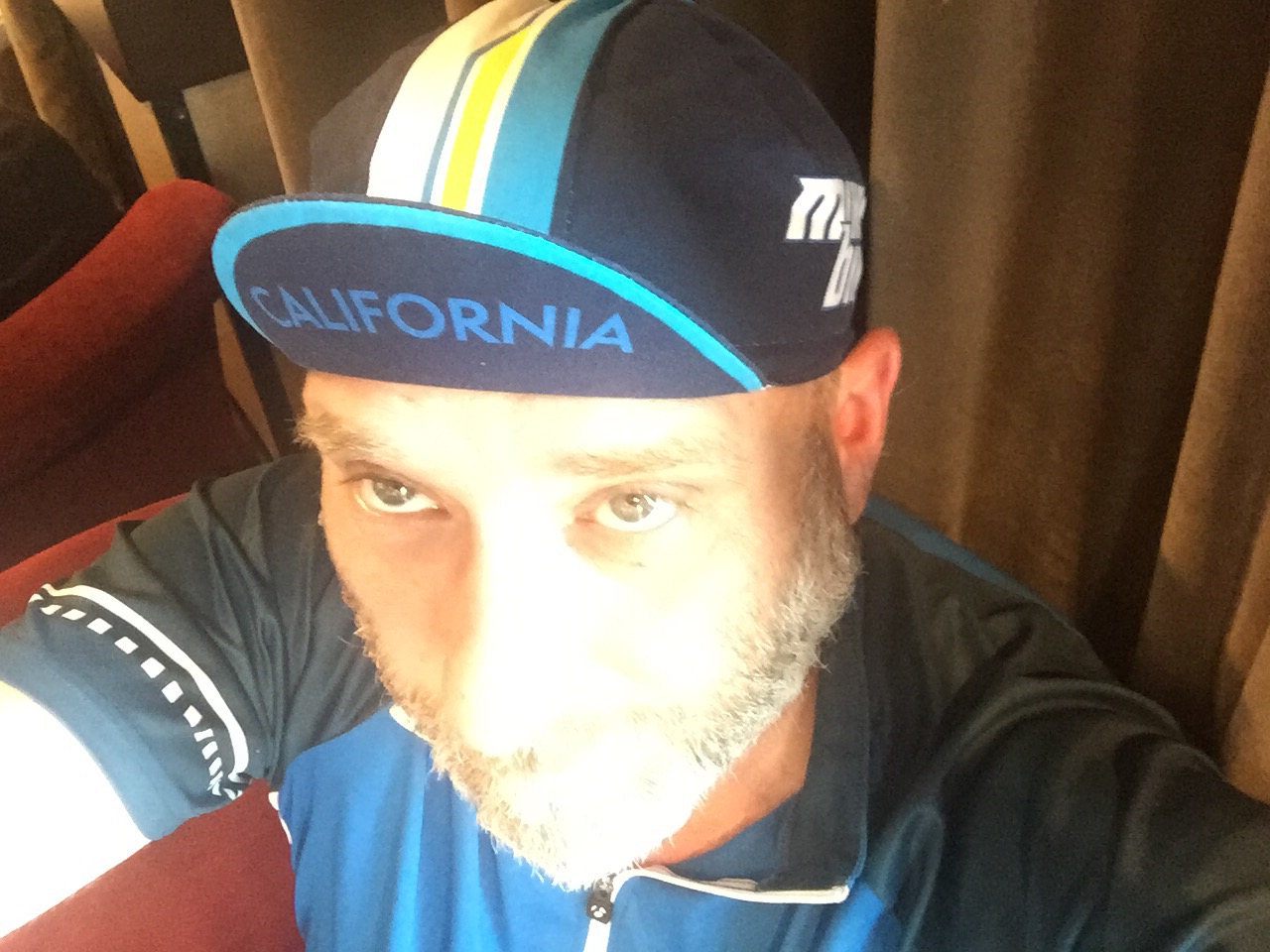
We got to Folsom and ate a bit. Then, bike stores for the last of the shakedown fixes. Mike’s provided about 50 bucks worth of gels and beans–as well as the California themed cap I was wanting since San Fran. Thanks Mike’s–trust me, the cap will look like crap soon enough. But the fiddlier stuff they had not. They told us the short cut to REI and the next shortcut back to the trail. Next stop REI where Doug fixed the broken bolt and Rami’s front rack is back to normal. Doug and the others were full of great info–including the news that the shortcut road we needed was shut down. Over a big hill and down a dirt path was the way ahead. But by the time were done at REI–the only one I have ever seen that sells shock cord too!!–it looked like the 25 to Plymouth was a bit of a challenge. On top of that, the sky hard turned black and we the wind was bringing it our way fast. We scooted off to a ritzy Starbucks 0.5 away and here I sit waiting for rain that missed us. Looks like we are camping just north of Folsom tonight as long as I can get Rami out of the Barnes and Noble close by from where he keeps texting me about the books he has found and the ones he wants to buy. He is torn between Arthurian poetry and “The State and Revolution.” Maybe he plans on creating a homeless hobo round table and initiating the Off Grid Revolution. Then again, this place is lousy with high school girls– so I may never see Rami again.

Man Plans, God Laughs Tour, 2017. Sacramento Ca.

Riding the Adventure Cycle Association’s Western Express Bike Route.

Fairfield is wine country and the hotel costs reflect that. But we had a bath tub and we took baths and fell asleep fast. Rami was captivated by the UK election and we spent a lot of time discussing how Parliament functions and which parties would be part of which possible coalitions. My prediction for a big upset by Plaid Cymru leading to a Welsh Independence majority Parliament, oddly, turned out to be off the mark. I need to rethink my confidence in the overall political influence of Welsh independence. 

We were up at 6 or so the next morning and got out soon and in good order. The mechanical cloud was not yet fully dispelled, as we would learn, but all problems are minor: the bikes are string and so are we.

It always take a bit of wandering to get out of a town. The ACA maps are good, but they can be a bit confusing near towns and towns are confusing to begin with when ridden into. In the woods, Rami and I always say we feel a bit like bears when we walk into a town–and not just because we pee on trees and rummage the trash cans. It is a headspace issue, and transitioning from just riding to suddenly considering which poorly marked street is which while cars do their car thing is never easy. Nevertheless, we found our way out and onto the roads east. We began by crossing some golden hills and skirting some others before a big right turn took us into the heart of the valley. There everything was table flat and covered in walnut orchards. The roads rolled and were lovely. There were lots of other riders out too. Cervelo seems to be the popular bike maker out here and all the riders we saw were friendly and looked skilled. It was hard to not envy getting out of the saddle and pushing hard up a hill on a 16 pound carbon racer while pushing my own 24 pounds of steel and 65 pounds of panniers. Seeing other riders on the road is great though–their being there tells you these are good riding roads, and their smiles and waves are very encouraging because they of everyone know fully well what a rider on a fully loaded bike is doing. Most of the cars are fine–although there is a pattern. Regular cars pass calmly and all have given us a wide berth. Big pickup trucks and flashy sports cars also pass us with enough room. But each of them likes to rev up and make lots of noise as they pass and then floor it after they have passed us. It is pretty routine. It conforms to the widely held view that drivers of flashy cars and overly large pickups have something they wish to prove to the world–perhaps something lacking in the trouser department. Just saying. 

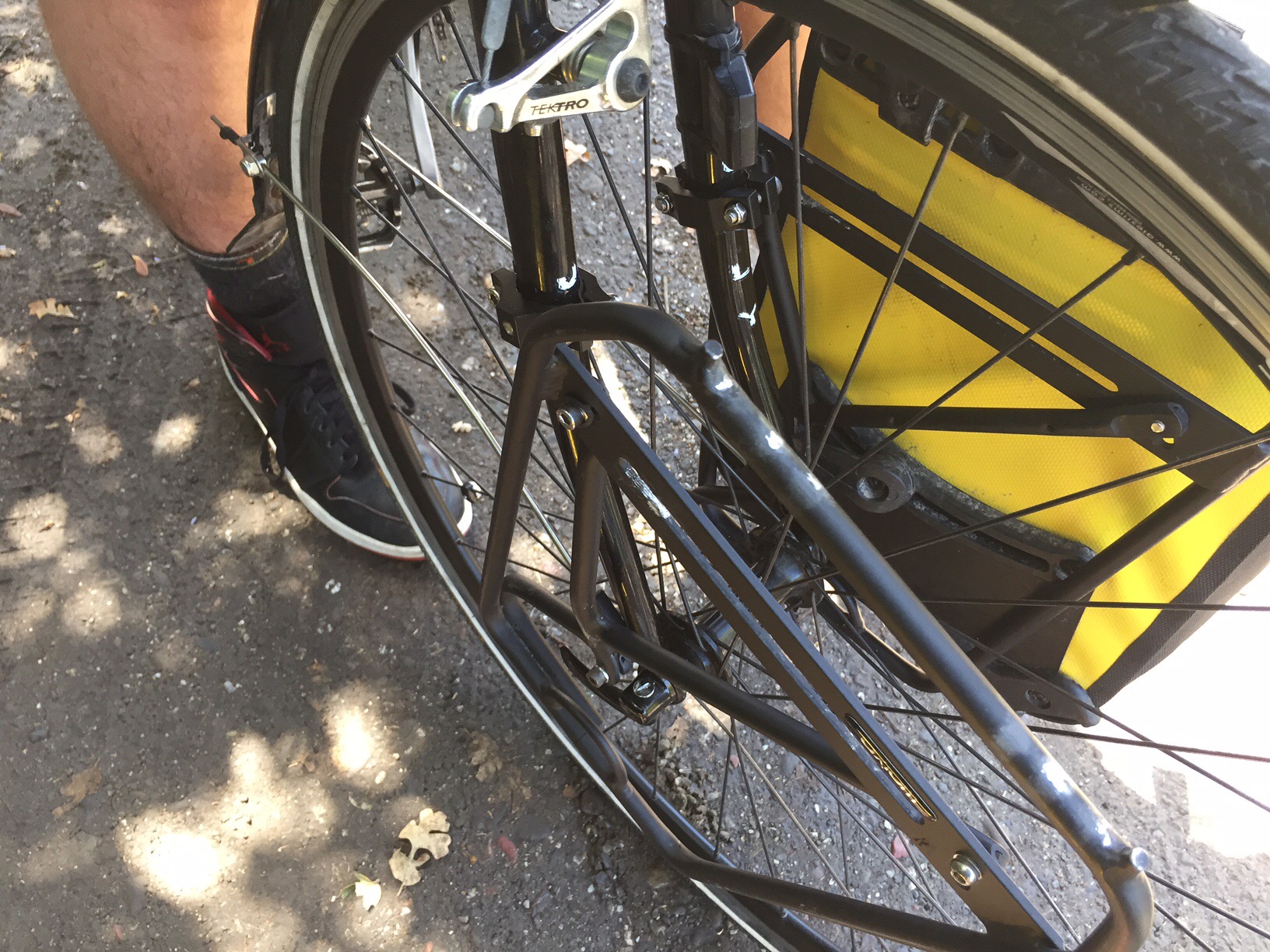
The countryside was beautiful–especially the area between Winters and Davis. The roads were dreamy and the final miles into Davis were on a great path. We crossed a great bridge over the Putah Creek. It was high and covered in great graffiti. Right around there, amidst the sun and lovely riding, the bolt holding Rami’s right pannier rack onto the fork broke gave up the ghost no doubt overcome with emotion and landscape enthusiasm. Whatever its motivation, we were suddenly roadside with a dropped pannier. The modern miracle that is the Zip Tie allowed a creative rerigging and off we went again. The surviving bolt will need to be drilled out and we did not want to wander around Davis looking for a candidate mechanic (and we were about 60 miles too far to double back to Leonardo’s). The fix will work for now, but I am not thrilled with the Axiom Lowriders. They are not really made for heavy duty. But then again I am using a Salsa add on as the top bolt holder so the problem may be there. Rami is riding my Surly Crosscheck which is my daily commuter rerigged for touring–but its fork has no brazeons. My bike–the LHT–has the Surly front rack and it is a beast. There may be change of front rack in the future, maybe in Carson City. Who knows. Nevertheless, zip ties worked for now, and so off we went. Being in Davis also made me think of my late friend and colleague Ward Stavig and I took a few moments to speak of Ward to Rami and let him know how much he would have liked him–and vice versa. 

Lovely as was the ride into Davis, the ride into Sacramento was a grim contrast. There are good wide bike lanes but they are a bit, shall we say, road-sidey. We paralleled rail tracks though and that made it fun. We got to see commuter trains fly back and forth and some huge Union Pacific engines too. We also rode on the Yolo Causeway which is essentially the shoulder of west bound Rt 80 with a waist-high concrete wall and about five feet of chain link keeping us from the on coming traffic. The noise was loud enough to make ipods useless. But–it was a great ride. Out of nowhere, Rami suddenly passed me on the left with a big smile and tried to drop me! Good luck. I leaned in and pretty soon we were heading along at 19 mph and I just drafted behind him the whole way along. I know–19 is no big deal– but with touring bikes it feels pretty good. Plus this was table land and that is where we Florida riders shine. The US needs more of these kinds of highway-side causeways. We could add one of these to interstates all over the place and it would be amazing and there would be more cycling travel and the health and financial benefits that would bring. We have the damned highways already–let’s make bike lanes next to them too! 

The Yolo dropped us off in West Sacramento which is yet another rotted urban hell. Bad roads, marginal business, hard done by people, the whole panoply of all that is wrong in this land was on display block by block. It made a shocking contrast to the natural and cultural beauty of San Francisco less than a hundred miles to the west. The money and talent that collects there and the other few blessed cities like it comes at the expenses of places like this. Inequality doing its thing. Great.

We crossed a lovely yellow bridge and went through Old Town Sacramento. We paused for only a moment, but it was a nice area. Cobbles and boards were not good for riding, but this is a hopping area that has a great feel–like Fredericksburg Va meets Tombstone Az. We passed the California Rail Road Museum and saw some engines, but we had to move on as the Friday shadows were getting long. No sooner had we left night life town then we were on a path that lead up to the bridges which we needed to cross to get up where our Airbnb was. This path was horrible. Armies of really broken homeless mean and women have made the trail, park, and riverfront their own. They were everywhere and we could see little ramshackle encampments of tents of make of blankets and tarps behind every bush. Piles of trash were everywhere since these folks still consume and defecate as others do, but no sanitation ever comes to collect the refuse. It went on for miles and we saw lots of variations of forgotten people. Most were just tanned and grimey–one though was talking to himself and walking around waving a machete. Pretty scary. Something needs to change. Shame on you Sacramento: help these people before they realize they out number the legislators and can storm the capitol. 

After about 60 miles we made our Airbnb–in this case a converted office building made into something like a hostel. We are happy though and Saturday is the weekly Off-The-Bike Day. So, rest here we come, even though neither of us are that tired. Resting up for a few hard days of climbing before us will help though.

Man Plans, God Laughs Tour 2017, Fairfield California.

Riding the Adventure Cycle Association’s Western Express bike route. 

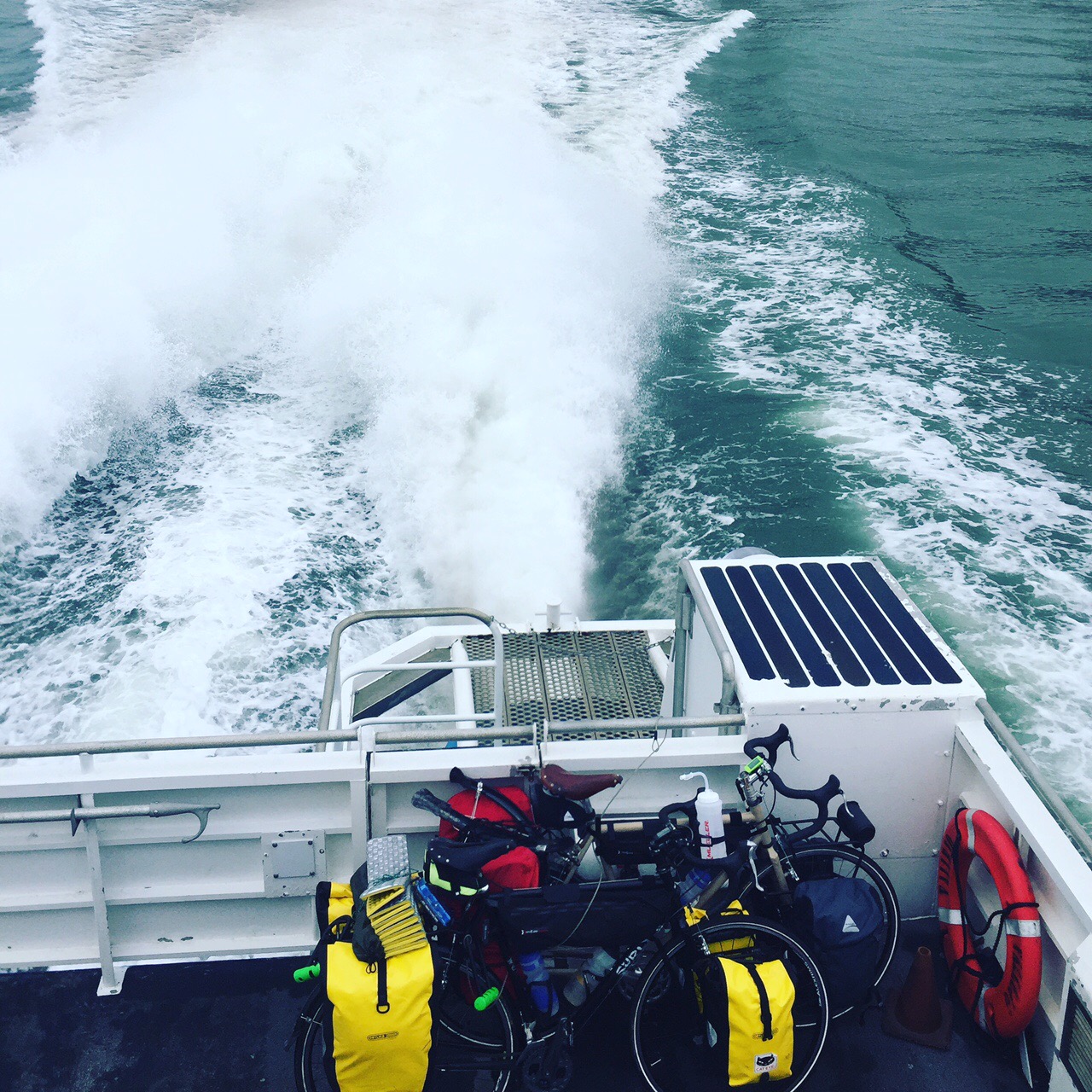
I had imagined sun, a bevy of well wishers, supportive statements from local officials, maybe even some Tour de France podium models as we set off. Instead, what we got was setting up the bikes in the rain, a dash to the Vallejo ferry, hurried ticket purchases, and a too quick goodbye. The men on the ferry suggested we tie up the bikes on the back of the boat since a bad wave could throw them overboard, Great. Then, next thing I knew, the catamaran hulls were sending up plumes of water and we were off. I sat down for a bit and watched the city slip away and considered the commitment we were making. 

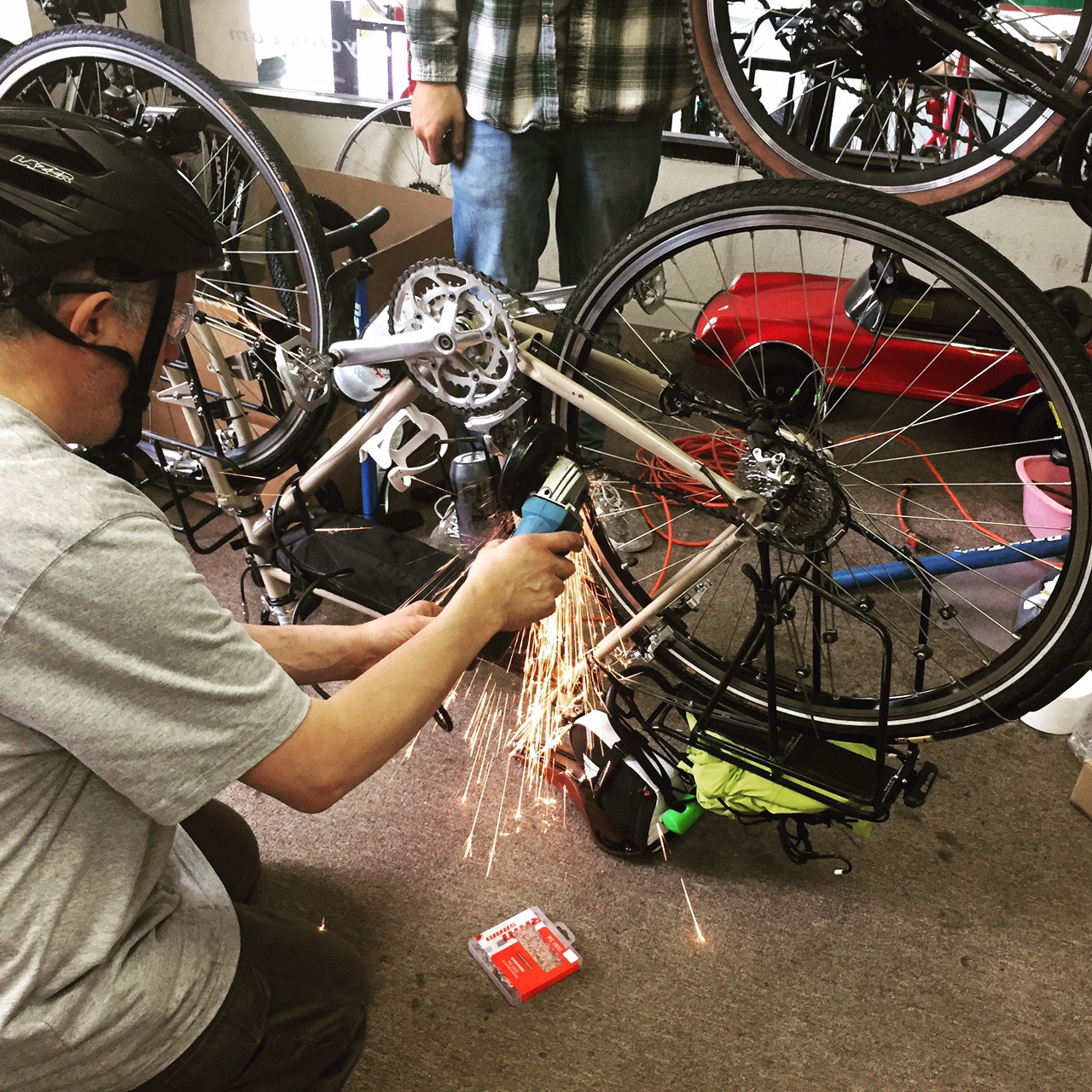
We stopped for cocoa at the Vallejo ferry cafe. It was there that I discovered that I had forgotten to bring along the specially purchased bolts and washers to attach the front fenders were still home in Florida. Great. A bit of searching showed that there was a bike shop right on our path out of town and so it was to there we headed. The bike was heavy–really heavy–overloaded as it was with desert food. Perhaps too much caution, perhaps not. After a few blocks though we made it to Vallejo’s Leonardo Cycles at 419 Georgia Ave and Leonardocycles.com. This is a small but quite busy LBS. They specialize in electric motor bikes because so many of their customers do commutes in the local hills. Later in the day we were passed by one of these bikes and I could understand why locals liked them. Leonardo Cycles’ owner Simon was more than helpful, bringing out his collection of bolts and lending me tools to set things up. We all chatted a bit while Rami searched out what antiques or army navy goods were hidden behind Vallejo windows. Once the work was done, we set off onto what was our first hill. It was not that bad although it did look a bit like a staircase before us. It is never good when you look straight out and are face to face with pavement. Worse when you have to tilt your head up to see the top. Halfway up the hill my chain seized from my having tried to run on my 32 before dropping on my chainring. My derailleur just said “no” and the peddling stopped. Great. Turn around, and head back to Simon and Leonardo Cycles. We got out the angle grinder and broke the chain. Soon all was back in order though and we were once again thanking Simon, and heading back up the hill–although now the rain from the morning had decided to make a come back. Great. 

Hills. ‘Nuff said. No wait, I take that back. Hills are damned hard when A: you ride mostly in Florida. Two: your bike weighs a US Grade A Ton. And III: it is the late afternoon of the first day out. Is keeping at 3.9 mph going up a 14 percent grade a good rate of speed? I have no idea–ask me again in a month when I know more about this. Mostly things went well for the shakedown day. Rapid shifting led to one thrown chain. Great. But it was easy to fix. By the end of the day we were riding though the Napa Valley vineyards without too much rain on us. This is a beautiful landscape an it was pleasure to ride through it. Card were ok. Most gave us a wide berth and we noted that most were Mercedeses. Finally we ended up in a hotel in Fairfield. Not exactly a bell ringer of a mileage day, but it really was only a part of day given the late start and all the fun set backs. Hopefully they are all over and tomorrow can be bigger miles.   

Riding the Erie Canal Towpath

The Erie Canal Towpath is the land’s second longest continuous bicycle path—or rather, it would be if it were considered to be a single trail, which it sort of is anyway.

2016-07-12 14.53.14

Rami and I somewhere. 

The path links Buffalo in the west to Albany in the east and comprises a network of dedicated paths, local park trails, some city streets, and under 50 miles of state road shoulders. The trail goes for about 360 miles and passes through virtually every kind of terrain Western and Upstate New York have to offer (mountains excepted). Riding the Erie is rather more of an adventure than taking on the C&O/GAP but it is by no means too much to take tackle and it really is worth it—it is a great ride.

2016-07-20 16.48.01

A typical view along the active portion of the Erie Canal–this one near Fort Plain, NY.

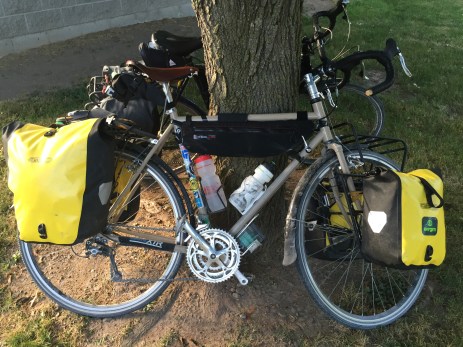
Our trip was in July and while it was warm, we never hit high heat and we avoided rain—we were lucky. We were two riders: me on my 2009 Surly LHT with a Brooks B17, Surly front rack and Topeak Tourist rear rack carrying a set of Ortlieb front and back rollers, and a Chrome roll up seat post bag for tools. My 15-year-old son Rami on a 2010 Surly Cross Check (my commuter with no front brazeons) with a Brooks B17, Bontrager rear rack carrying two Axiom Seymore Panniers, and a large Axiom seatpost bag filled with Hammer gells. We both carried Revelate Tangle top tube bags as well. These were genius—the best thing I have added to my kit in a while. They were easily accessible and super handy carryalls. They were never in the way (except maybe when it came to putting the bikes on the car) and were easy access bike handy wallets.

2016-07-17 19.01.20

My Surly LHT loaded and leaning on a tree. The shot shows the Revelate Tackle bag in its natural habitat. Great addition to the kit.

One thing to know before you get one (as well you should): the large size is deeper than the medium and small and so it intrudes more into the space one usually reserves for water bottles.

We covered the whole distance in 6 riding days (we took a 0 mile day in there) meaning an average mileage of about 63 miles per day. Our biggest day was 86 miles but I do not recall the shortest. Subtracting our biggest day creates an average mileage of 58 per day for the remaining 5 and that seems about right. I should add that no day felt really challenging—even with the hills and roads. We stopped to smell the roses and took breaks for worthwhile sites—in short, it was far from grueling, and if our mileage was low some days it was because we were pleasantly diverted. Nevertheless, I want to head back up and try it again and shoot for finishing in 4 days this next time—anyone with me?

When I was planning this trip I found less info online and in discussion forums about the Erie than other rides, and so my goal here is to fill in some holes and provide some of the info I would like to have known before I set out. The main source of information I turned to was the website run by Parks and Trails New York (PTNY) which is the body that oversees and promotes the trail. They manage that very helpful website, organize a large group ride in July, promote the trail, and are working to secure more sections.

Screen Shot 2016-08-09 at 11.53.33 PM

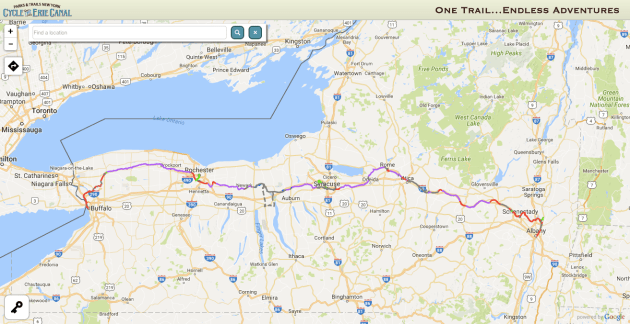
The PTNY map works well on a smart phone and they have made a little icon that links you right to it as if it were a stand alone app. The colors of the trail’s run in the map indicate road surface and were very accurate. Find the map at this link

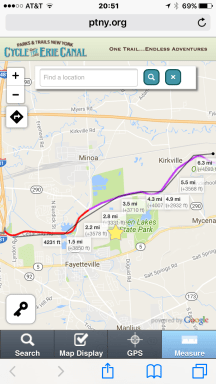
I relied on their website quite a bit during the ride—particularly the interactive map they provide. That map carries current information about closures and route changes and has a handy mileage calculator that lets you plot out a trail section’s distance with a reasonable degree of precision. The calculator though can only do straight lines, so some of the curves become a bit more square in your calculations.

IMG_5185.png

This is a section of the PTNY map on my phone showing the milage counter against the color-coded map.

Nevertheless–super helpful. There also is an independently published book or two available that has some pretty nice section maps. I did not have the PTNY book when I set out, but I grabbed a copy along the way and found it helpful but not essential.

Despite the great trail and amenities, there is not a fully developed culture of through travel on the Erie, so most of the info in books and sites is targeted at people planning short rides and looking to do their rides in maximum comfort. Much of the material out there stresses the trails’ doability and the path’s unquestionable beauty and history. It seems targeted at those considering a ride who may not have tried one yet and need some reassurances about the value of the trip and trail. No knock on any of that intended at all, but long distance riders’ questions often get deep into the weeds and I found it hard to get from the web the kind of brass tacks answers I most wanted. Where can you camp? What grades are the hills? How available is water, how far between supply points and so on—I found it hard to get these important questions answered in advance. So, here we go.

First thing to know is that there are really three Erie Canals—and the path does bits of each. The first is the original canal completed in the 1820s.

2016-07-19 16.43.31

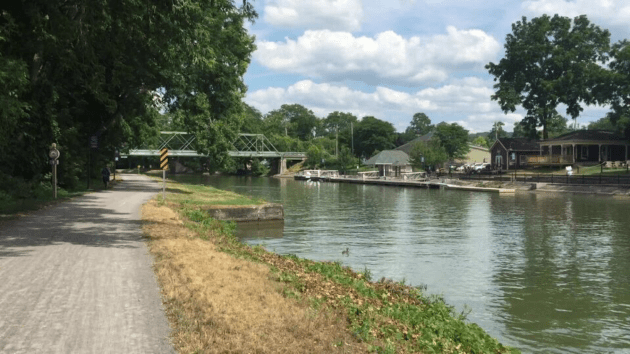
This is a typical section of the now-disused 1820s-1860s canal somewhere near Syracuse. On the left is a standard section of double track and on the right is the glint of some over grown canal ditch and water. Some of these sections had HUGE carp in them, so if you like fishing this is your place! On the whole though, you would be forgiven for thinking this was the C&O in Maryland.

The second is an expansion of that original system in the 1860s that left bits of the original rare things indeed. The third was a further expansion in the early 20th century that swallowed up the 1860s canal in some places and created a whole new route in others. You need to know this because the trail touches parts of all three and each presents different challenges and advantages.

IMG_5169

Here is a view of what much of the trail looks like between Lockport and Rochester. Fine crushed stone, wide path, and an active waterway are constant companions. It was no effort at all to stay above 15mph fully loaded on these stretches, there also were lots of towns and resources along the way.

On top of that, there are seasonal boaters using the active canal and info for them abounds. But—their route is slightly different than the one cyclists ride in some areas—so use the boat info carefully. What all of this means is that sometimes you are riding along side of a wide and usable canal and passing by modern operating locks—each of which is state owned and a legal camping spot–while other times you will be riding next to an overgrown and forgotten ditch—much like riding the C&O—with few amenities and only stealth camping if needed. Knowing that in advance makes it a lot easier to plan things out.

The operating locks are numbered and all have well manicured lawns. A few have bike lock racks and picnic tables. An even fewer have unlocked Portasans. There is very little visible notice that camping is permitted—but it is, so just set up and settle in.

2016-07-19 19.58.50

This was our camp at the lock at Marcy, NY. This was the largest and most fully equipped lock campsite we saw, but I am sure there are others. This one is right on the path (seen at left) and coming upon it at about 5pm made it just too inviting to pass up. This was still during the early Pokemon rush and poke trainers were strolling all over.

It is probably a good idea to lock up (no pun intended) since more than a few of the locks are fairly close to civilization and its occasional sticky fingers. With that said though, we had no trouble at all and in fact loved chatting with the lock master at Marcy New York and watching the boating action in the morning. The lock by Schoharie Creek near Fonda New York though was a bit off the trail and had nothing to offer other than a great lawn and a big shade tree. But—having the run of the place and a long sunset was great. One of the staff had left a nice pair of field glasses on a table next to the main building and that made for fun viewing up and down the Mohawk. On top of that, an open maintenance shed had outlets where we could recharge. We even considered sleeping in the shed, but there was no threat of rain. Lacking any way to say thanks though, I swept out the shed so at least the floor was nice and clean the next day.

Many of the towns—particularly west of Rochester and just to its east along the active canal—also allow free camping in public places for cyclists. Again, there is no public posted notice of this, so you may have to ask to make sure. The best example was Brockport where we spent a 0-mile day wandering in town and meeting people.

2016-07-15 19.38.11

Our camp at the Brockport Visitor Center. We locked the bikes to the tree over there and ate at the table on the other side. It was a wonderful comfortable camp.

As with the GAP, some towns have embraced the canal and others not so much so. Brockport is one of the best examples of a place taking the trail to heart. There is a nice visitor center right on the canal which welcomes both cyclists and boaters (smart move since both parties have wallets). The wonderful volunteers showed us where to camp right on the lawn and gave us the pass card that granted us access to a big clean bathroom with a shower and outlets.

2016-07-16 20.36.33

The bathroom at the Brockport Visitor Center

All we had to do was stop by the police and let them know we were there (they were nonplussed) and we were set for two nights at no cost. The visitor center also has a nice sitting room and we spent time there chatting with the volunteers and other guests. We were the only cyclists, but there were a few boaters tied off at the dock. It was nothing to walk over to the main strip in town where there was a bike shop, food supplies, and tons of people chasing pokemon. Oddly, few of the in-town business owners knew that cyclists were allowed to camp at the visitor center—and in fact we only ended up there because a sudden late day rain just after a coffee stop in town had us sheltering in the Brockport Fire Department. It was the firemen who directed us to the visitor center—so now I pass on their advice. Brockport is a must stay when you ride the trail.

Hotels are all over the place on the trail, but there are no real hostels we could find, so if you plan on staying under a roof each night, plan on shelling out between $75 and $100 for the privilege. PTNY’s web site has a list of hotels and other amenities which is worth the look over. It could be a bit better though if it also said just how far from the trail was each hotel. It is one thing to see that the town ahead of you has 6 hotels listed. It is quite another to discover that they are 4 miles away, uphill, and on an un-shouldered state highway. More details about the viability of hotels would have been good to know. Even so, we avoid hotels as much as possible to save money—maybe doing one hotel night to three or four tent nights ideally when touring. For that reason discovering the free camping in towns and at locks was a blessing.

2016-07-17 20.54.01

The sun going down just west of Montezuma on State Road 373. This is at the top of Cayuga Lake amidst lots of Amish farms.

We also stayed at a commercial campground at the Montezuma swamp near Clyde, NY at the top of Cayuga Lake. Although on roads, the passage on the trail here was lovely and full of fun hills and Amish farms. We cruised through this terrain as the sun was getting very low and just loved it—no cars at all, just us, the road, and the occasional Amish buggy.

The disused sections of the canal—mainly the miles east of Clyde, NY—are very different than the heavily trafficked western sections. This is where road shoulders become more a part of a cyclist’s day and the condition of the canal trail is far worse than the western miles of very solid crushed stone.

2016-07-18 14.47.52

The Erie is great for your cycling tan.

Riding here was often very much like riding the C&O in Maryland: a swampy overgrown canal trench on the right and single or double track dirt-in-grass paths to your front. Lots of road crossing here as well and towns were thick on the ground. That meant that we never worried for water even though it would have been hard to find a good camping spot if it came to it. It was no effort at all to maintain 15mph or more on the crushed stone but road speed dropped significantly on the older canal sections—13mph was good, but ruts and puddles often slowed us down to 11mph. Another irritation here was that many sections of the trail had patches of loose crushed gravel filling in potholes and water damage.

2016-07-19 11.13.31

It does not look like much, but this hill was one of two that I had to dismount for. In this case it was due to loose gravel that bogged my tires. This patch was somewhere near Jordan, NY.

These were rarely for any distance, but they came on us suddenly and sometimes threated to cause real trouble if we hit them at speed. A little bogging and fishtailing was the worst we got and neither of us went over the handlebars as I had worried. Nevertheless, I got a few good heart stops as I hit these patches. One rise to a road crossing was so loose that I could not gear down in time and was reduced to a full stop as my wheels sunk in and I had to unclip and walk a few steps (only one of two times in 400 miles, so that is not so bad).

The diversity of trail conditions makes tire choice and interesting problem. What with covering everything from to loose pack to ice-smooth tarmac, getting the right tires is as important as it is impossible. I had arranged for our support team to meet us at each crucial junction with a change of tires—road worthy 25mms for the paved sections, light tread 32mms for the hard packed crushed stone, and nubbly 40mms for the rougher areas. But back in the real world where there is no such thing as our support team, I had to make a single call at the start and trust to luck.

2016-07-17 12.50.54

Sometimes there is work going on which shuts down the trail and it makes more sense to push through rather than take a two mile on-road detour. This was outside Rochester.

Since we were doing the Erie right after covering the C&O/GAP the tires had to do multiple terrains over close to 800 miles. I went with 32mm Continental Touring Plus run up to 80-100psi. These are a bit thinner than the 38mms I used on my last tour and thought were exactly wrong. I wanted the lower rolling resistance of the thinner tire and yet still wanted some beef and tread. They worked fine, but in truth, no tire can be all things. I saw other people with a variety of choices and each had some good and bad to them. I was happy with the Contis though and would happily use them again. They were good all arounders but it all depends on what you want. Some riders clearly prefer the cushion and bite of a thicker tire with low PSI. I on the other hand hate pinch flats as much as I hate anything in life, and would rather take some knocks than replace inner tubes. I also want to be able to get up to the mid- 20mphs the second the trail lets me (pushing 40mph on some of my favorite down hills)—but obviously not everyone wants that. If you want to get speed you need to have the tires that agree with you on that project. One complaint about the Contis was that the rear tire on the Cross Check was oddly worn when we were done—more than the other tires despite not bearing a heavier load and enduring the same conditions and psi. I am not really sure what was up there and it may simply have been a bad tire. My next tour is going to be either 1000 miles or 3000 so I may move over to Schwalbes then. We’ll see.

Signage on the Erie is a mixed bag even though the trail managers have done a good job over all of getting a fairly uniform marking system in place. Admittedly, on large sections of the trail there is no need for signs: the choices are pretty simple—either I ride on this crushed stone ribbon, or I can turn left and slam into that cornfield or I can turn right and plunge into the canal.

2016-07-19 12.47.29

That circle shield is the most common trail sign. Note the color of the arrow–whether sun faded or a curious choice, the arrow can be hard to see when you are at speed, unsure where you are, and wary of cars.

No sign needed for much of the trail–especially west of Rochester. But it gets a bit trickier when passing though towns and riding state roads. Here the right and left turns are easy to miss at your cost. We were very lucky to be following the big annual July ride which left behind its spray painted marks on the pavement—little red hobo signs that helped us (and the 700 some odd riders the week before) keep on track. This is where the Erie is more like traditional bike touring and less like the C&O/GAP—you have to know where you are and are going. Even so though, clearly the goal is to increase the number of riders on the trail and some better signage would help sooth nerves. A problem though is that the many municipalities along the way will have something to say about signs and that can be just too much for advocates to take on. So for that reason, uniformity would help. There is a basic trail logo and it is on any of the signs. There are often helpfully posted at directional changes accompanied by an arrow. But in many cases the arrows were hard to read white on tan and sun faded. Since there are often cars around and signs pass by in an instant while riding, I found that we had to stop at many signs to be sure. That is not a really big deal, but I think it is a good thing to know about as you prepare a trip of your own.

Be prepared to be a bit confused in cities too while hostile cars whiz by. The issue was most pronounced passing through Syracuse and on the approach to Albany from Schenectady.

2016-07-14 13.18.23

Riding in Buffalo will take some concentration.

This section of the trail links together lots of local dedicated bike paths to mixed effect. A few turns are a bit sudden and unforeseen as you charge ahead eager to make the much-awaited destination. On top of that, this is the hilliest stretch of the trail. That is no big deal—but there are a lot of ups and downs—few being more than a 5% grade. There is one killer hill though just east of Schenectady in the Niskayuna area. That one is big enough to have its own warning signs. The worst part of the hills though was that more than a few of the down hills—especially in Colonie—end at stop signs and traffic or sudden tight right turns. That means riding your breaks hard right when you should be enjoying withdrawing your deposit in the gravity bank.

2016-07-21 17.23.26

Intersection near Albany

Beware too that things get pretty weird in Cahoes (in many ways). There is a very sudden left onto a city street that we overshot and I gather others did as well since the local bike path just carries on happy as a paved clam. Working back through hilly Cahoes was not fun to begin with, and then finding and navigating the road bridge in town was no picnic either as we were there close to 5pm and traffic was thick. I would say that this was the single most challenging urban riding we did—and that includes the whole of Syracuse (the largest urban stretch) which all in all was pretty straight forward. The long on-street ride on Broadway through Watervliet is worth careful attention too.

2016-07-21 17.10.48

The trail as it passes through Green Island. NY outside Albany

The streets here are numbered, but there is a sudden 3rd Avenue thrown in just to confuse your counting—when you see 3rd Avenue, the turn on 4th St is still a ways away. This is just the sort of place where a good sign could make a big difference—and given the traffic issues, confusion can become an issue of safety.

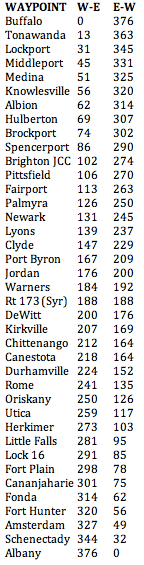
Another useful thing to have in advance are the mileages between towns, crossings, and waypoints. This bit of vital trip planning intelligence was also hard to come by—but knowing distances is essential to planning out how long you think it will take to get from point A to point B. The published guidebooks have mileage tables, but these are hidden in the back and are a bit spare anyway—and of course, are not available online. I kept a record for myself using my Cat Eye and I am sharing my results here. There is some imprecision in my miles though. I was not always so careful about clocking the mileage in the same place in each town—some I recorded at the edge of town, others right in the center. Some waypoints were little more than road crossings while others were whole cities, like Syracuse which I only clocked where the trail merges with Rt 173—but when planning your ride keep in mind that Syracuse occupies most of the 12 miles eastward until DeWitt. I also made no record of Colonie, Cahoes, Green Island, and Watervliet but just lumped them into the 32 miles between Schenectady and Albany. In a few places I also had a diversion to a campsite or a resupply a bit off the trail. Rarely were these infrequent jaunts more than a mile or two, but I did not carve those miles out of my totals. So, there is a little imprecision in my table, but it certainly will help you plan out where you might be day to day. As they say, “your mileage may vary,” but not by all that much.

Screen Shot 2016-08-09 at 11.45.47 PM

All in all, the Erie is a great bike ride and many many more people need to make it a regular part of their riding. It is a great mix of place, exertion, and adventure and I really hope a more fully developed through ride culture comes into being. It is a great resource and it is calling out for more prominence. Ride it.


The Zombies Were Out

Today was a terrible pedestrian day on the bike path. It is normal for people to be walking slowly on the Mount Vernon trail bike path–especially at the little parks along the way. It is easy to call out “on your left” and slide past. No biggie–you just unclip and slow down when you get to the traffic areas and see the crowds getting thick. There are often a few people not keeping their kids on the safe side of the path and the occasional dog on too long a leash who want to jump out under your tire. But with some care and conversation it is easy for everyone to share the space. But there are also people who are so in their own heads that they are real hazards to themselves and others. Today there were at least three people who were just walking towards the path and starting to cross without even looking up or either way–like they were just walking across their bedroom! One can spot them up ahead before it is too late and in my mind I am just thinking–he is gonna stop…isn’t he?

Mt__Vernon_Trail

It is a sort of a road–don’t you think? Pic from the Examiner.com

But they don’t. In one case it was some guy who seemed to be talking to people the other side of the path, in another it was just some older guy looking at his shoes with his wife behind him was looking at hers. There also was a guy who just wanted to walk on the path but felt no need to look to see if anyone was there already. Amazing. When that happens I  just holler “heads up” as loud as I can and hope I can scare the crap out of them so they will not get slammed into next time. You have to yell loudly because so many people have earbuds furthering their isolation and even at low speeds sudden stops can be very bad. Do these people walk onto roads that way? The Mount Vernon Trail is a paved path with a broken yellow line down the middle–it is pretty darn official looking and no one can imagine that that it is something other than what it is. But once it gets warm there are these somnambulists who just zombie their way into potential harm. Use brains, don’t eat them! Here is the thing Zombie Man–when I slam into you it is really going to hurt. Let’s work together to keep that from happening. My job is to be super alert to what walkers are doing along the path, your job is to look both ways before you cross. Ok?

Then at the end of the day, I stopped to check something on my phone. I was on the dark nighttime street next to the Starbucks in Alexandria. There was a tourist guy who wanted to ask me about my LEDs and that is fine. The problem was that he came up behind me with the five other people he was with and sort tapped my shoulder from behind. Jeepers! I told him in no uncertain terms that approaching people from behind on dark streets is not a good idea at all. Spring is in the air and people are being weird.

The C and O Canal and the Great Allegheny Passage

I want to share a report of my June 2015 trip on the C&O Canal path and the Great Alleghany Passage bike trail. Together they make for the longest stretch of car-free trail in the nation and tons of people ride the path, or parts of it, every year. I took me about a year of reading, dreaming, and planning to get everything together for a trip that ended up being close to 400 miles (all told) of riding and took 6 days. My goal here is try to answer some of the questions that I was unable to resolve in my web research before my own trip. So, I am not really going to share any info about the beauty, history, or experience of the trail—that has been covered well elsewhere. I am also assuming that you dear readers have already done some of the basic research for your trip, so I am not going to offer much of a sales pitch for the trails or bicycle touring in general. Instead, I want to focus on the sort of questions I had before I left but for which I could not really find answers, and to share useful information I learned along the way that I had not seen posted elsewhere. I hope what follows helps, and please use comments to ask any arising questions and I will try to answer them.

2015-06-24 15.55.08

My Surly LHT in happy times before the mud set in.

The first thing to cover is gear and condition. I am a daily rider doing about 10 to 15 miles a day with longer rides of up to 40 miles interspersed throughout the week. So any sense of what was physically hard or easy comes from that base vantage point. The bike was my 2009 Surly 700c wheeled, rim brake Long Haul Trucker (LHT) which I use for daily commuting (my Cannondale does the faster stuff). The LHT is more or less stock with two major changes. One was replacing the crankset with a Campignolo Veloce 52/42/30 so I could use the bike for more speed when not loaded up. The other is my fully broken in honey-colored Brooks B17. Bottoms vary, but to me, you are nuts if you try to do distances with anything other than a Brooks or a Selle Anatomica. I had troubles on the path, but not a single one of them were in anyway posterior-related.
2015-06-27 17.38.52

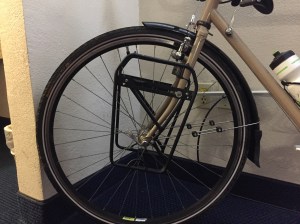
This is the angle of the Axiom Lowrider front pannier rack on the standard LHT front fork.

The rest of the bike gear was:

Continental Touring Plus Tires 700×37

2 yellow Ortlieb Back Rollers

2 yellow Ortlieb Front Rollers

1 Timbuk2 Bike Box

1 Medium Bontrager seat bag

1 set of Bontrager 35mm plastic fenders (their adjustability was a big plus)

1 Topeak Super Tourist rear rack

1 set of Axiom Lowrider front racks

The rest of the gear were things like my regular bike lights and all. Nothing really worth noting. The Topeak rack is great and the Ortiebs hung on the sides with no issues. They bounced a bit on the bumps, but nothing that was worth worrying about. I was a bit less thrilled with the Axiom front racks. The main issue was that they were not level to the ground. I mounted them on to the in-built Surly brazes (after a brief attempt at the provided U bracket harnesses) but no matter how I pushed and pulled, they had to sit so that the rearward edge was lower than the forward edge. It is just an issue of mismatched fittings and makes for a poor match between bike and rack. Some people might not care about this issue, but it bugged me. It just looked off to me (you can tell from the pics whether than would gnaw at you or not) More importantly though, it meant that on the bumpy parts of the trail the panniers wanted to bounce loose, and gravity meant that they wanted to jump over the posts that Axiom placed on the top to hold the pannier in place. No matter what I did they slipped around a lot. It was not a huge issue—I never lost a pannier for example–but it did get to me after a while. And since so much of riding entails staring down at the front end of the bike, I was a bit obsessive about where my panniers were sitting and even reached down a few times to shove them back into place. The movement was never more than an inch, but there it is. I will probably try another make for the next big trip. Apart from that, the racks did their job very well and were problem free.

I was happy with my box and bag, but next time I am planning on putting a larger seat bag on board. I found that I would have benefited more and opened my panniers a bit less with a larger seat post bag. I have never warmed to handlebar bags, but I can see why people like them—map access especially.

I am sensitive to gear hype, so let me be really clear about this. What is said about Ortlieb panniers and Brooks saddles is 100% true–none of it is hype. It was a wet trip and the Ortliebs were everything I could have wanted them to be. Easy to use, easy on and off, and bone dry no matter how wet and muddy they got on the outside. 2015-06-30 19.06.35Other brands are also great, but I am glad I went with the Ortliebs and never gave a worry to my gear in them.
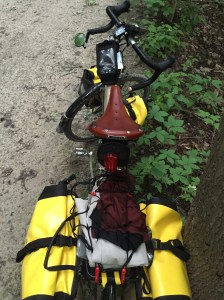
Surlys also are everything everyone says about them. I love my LHT and it does not disappoint. It is a tank, plain and simple. My load was not that heavy, but the bike never flinched, and more over, when I was coming down the hill in Harpers Ferry at 35 mph, the bike felt as calm and steady as it ever does—no wobble or shimmy at all to suggest the load it carried. These are amazing bikes and I loved having it as a partner. I am looking forward to trying out a Cross Check on this same path later in the year, but the LHT is indeed just what it is known for. I saw lots of bikes and curious configurations—from brakeless fixies to heavily shocked leisure bikes. Each one worked, but had a weakness. No one could say that about an LHT—it was made for this and was a dream to ride.

I rode the Continentals for the weight and the price—about 20 bucks less per tire than Schwalbes. I wore out this type of tire once commuting and was disappointed whereas a Schwalbe would not have worn out in the same time and under the same conditions. But the Schwalbes are heavier and even though I am assured they live up to the reputation, I was not compelled to buy in. In the end, that was a wise call. The reason why is that when all was said and done, I regretted going with the 37mms. That is the most recommended tire size on forums and discussions boards, so I went with it. What I found though was that in the mud (of which there was much) 37mm was not wide enough to make a real difference—I skidded where I skidded and it was more skill and luck than equipment that kept me upright.

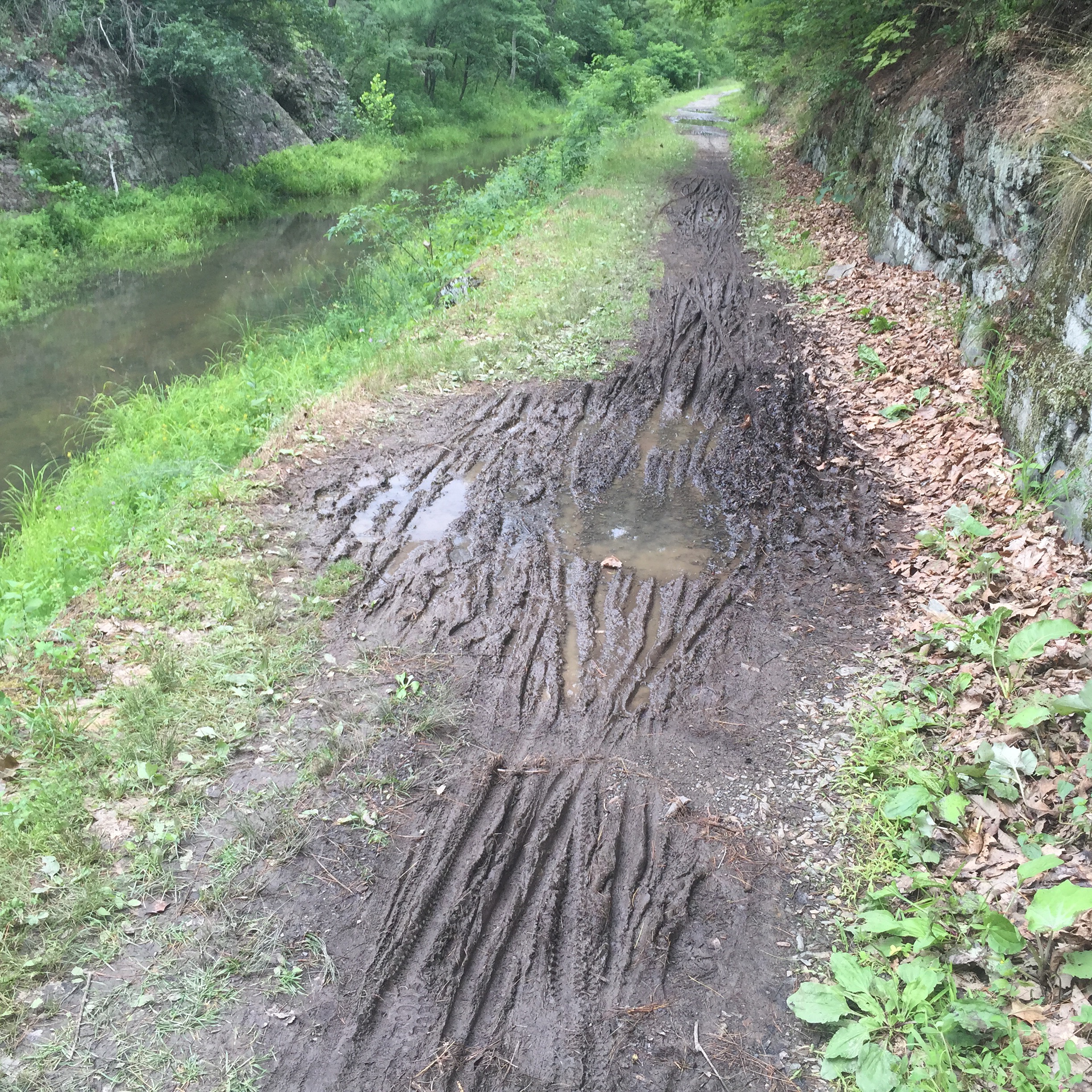
This is the crazy mud puddle south of the Pawpaw Tunnel. Make sure to walk through this stuff.

This is the crazy mud puddle south of the Pawpaw Tunnel. Make sure to walk through this stuff.

But on the dry and hardpack paths, 37mm was big enough for me to feel that is was holding my speed back. I am used to 23mm for long rides and 25mm for street commuting (both smooth surface tires) so I am happiest on a thinner tire. While the 37mms looked less like mountain bike tires than I thought they would when mounted, they were not really a huge help when things were slippery. My next trip in this trail will feature 32mms which I think will be a better splitting of the difference since the two trails (C&O and GAP) present really different dynamics. I suppose one could change tires along the way in Cumberland, but…yeah. If someone really want to do that, I would suggest using proper cyclocross tires for the C&O and something smoother for the GAP. The riders that are doing the whole C&O all in one day are on good cyclocross bikes and it makes sense. Had I sprung for the comparable Schwalbes I might feel a bit more bothered—or someone would be getting a good deal on ebay.

2015-07-08 13.18.51

The obligatory gear photo. I used a very light sleeping bag on the lower right. I was very glad I brought my Darn Tough short socks on the lower left.
2015-06-25 09.12.13-1

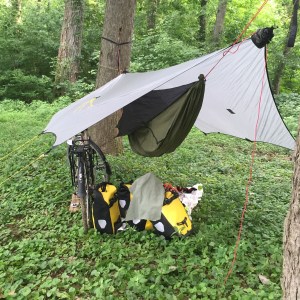
One of my camps. That is a Warbonnet Blackbird hammock under a Mac Cat tarp with Hennesy snake skins. The hammock is hanging on whoopee slings and tree straps. The guides are all shock cord or Zingit line.

I will skip over sharing too much detail about camping and camping gear. I have been hiking for ever and do long hikes every year. My pack is pretty light and all the gear well-used and tested. All I did was took the same kit I would take on the Appalachian Trail and put it in panniers—with some bike clothes, gear, and tools. I like camping and liked the campsites I stayed at, but it is worth nothing that it is really easy to stay in a hostel, hotel, or B&B every night of the trip if camping was not your thing or you wanted to travel light. Indeed, even though I was fully self-supported, I still found the lure of hotels sitting so close to the path too hard to ignore on a few nights. They really are everywhere and usually costing only between $50 and $75 (less for the hostels like the Teahorse in Harpers Ferry). I waited out one day-long rainstorm in one hotel and was very glad of it. As another trip review said, credit cards are lighter than camping gear. I am pretty confident that a rider could do this same trip with only a good bike, a water bottle, a few Hammer gels, a phone, and a wallet, and have a great time while eating and sleeping well all along the way. Also, there are tour companies out there that have organized trips for people, meeting them along the way at road crossings and parks and there providing them will full meals, any repairs needed, and even lifts to local attractions. I saw a few of these groups, and even though this is not my style, they did seem to be very happy campers. Their bikes were light and they wanted for nothing along the way. If you had the money to spare and did not feel great about self-support or winging it, this could be a great option. Or, just email me and I will just carry your crap in my half-empty panniers!

C&O and GAP Profile Map

C&O (right) and GAP (left) Profile Map.

For logistical reasons I chose to do the trip south to north (S2N). To date, Amtrak has been slow in figuring out that most railroad coaches are larger than bicycles and therefore can fit a few on board. Word is that that lesson may have been learned and that bike-friendly service is coming, but even so, the logistics of which trains can take bikes, which ones cannot, which ones want them in boxes, and so on are daunting—not to say maddening for their short sighted foolishness (that’s what happens when you put funding and overseeing a rail service in the hands of people whose real interest is helping cars and gas producers). Thus, for me, it was easier to start in the DC area and meet up with family in Pittsburgh. That turned out to be a very smart call and the others I met going the same way all arrived at the same sorts of conclusions as I had. In fact, there is a pretty healthy minority who prefer the S2N path—and I am in that camp. My pre-trip research showed me although that N2S (Pittsburgh to DC) is the more commonly taken path. I am pretty sure that the uphill path of the GAP between Cumberland, Maryland and the Continental Divide tunnel near Meyersdale, Pa is pretty big part of reason people prefer to go southbound. The standard profile map makes the incline look pretty daunting—even though your better angels are reminding you that this is rail line and therefore pretty level. It is certainly true that going southward gives you more miles that are technically heading downhill. But consider this. The C&O going S2N gains just under 500 feet in elevation over 185 miles. That makes for a grade so level that you really cannot feel if you are either going up hill or down. Most of the C&O elevation changes happen at the lock sites (no real surprise, right?) and they are very short. Also, about a third of the locks (and all the aqueducts) are made so that riders go though the dry canal bed—meaning that your passage begins with a drop and ends with an incline no matter which direction you are headed. All of this means that the C&O is, in a word, flat—in places, very flat. There may be a psychological benefit to knowing that you are going downhill if you ride southward, but there is no real physical benefit.

The GAP just south of Connellsville, Pa.

The GAP just south of Connellsville, Pa.

On the other hand, the elevation changes on the GAP are indeed noticeable. Again, keep in mind that the whole GAP is railroad grade. Even though a car can scoot up a 9% or 10% grade, a big ol’ freight or coal train would be slipping its steel wheels pretty badly even at a 3% grade. The Pittsburgh side of the Continental Divide is about a 1.3% grade and the Divide to Cumberland side is closer to 2%.
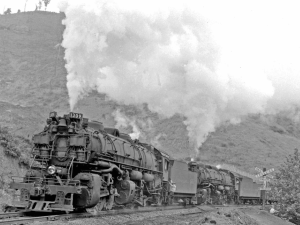
The B&O railroad back in the last days of steam. Engines like this were made specifically to haul cars up grades.

The B&O railroad back in the last days of steam. Engines like this were made specifically to haul cars up grades.

Both are steep enough to be felt in the legs (but I do most of my riding on a vast flat sandy pancake and consider myself a certified hill wimp). So, (and I suspect you can see where I am headed here) I would rather do 20 miles uphill on the slightly steeper grade and be rewarded with 125 of 1.3% downhill miles than do it the other way. Going up from Cumberland I had no real trouble maintaining about 8 or 9 mph fully loaded with a break now and then. That means that the hardest part of the trip took less that 3.5 hours (breaks included) and all the rest was either flat or a noticeable downhill and in my favor. There also was a psychological benefit. The trail conditions of the C&O are considerably poorer than those on the GAP—the former being early nineteenth-century mounded clay and earth with some gravel here and there, and the later being more recently-made packed limestone gravel atop water-draining stone. The C&O was a far harder ride than the GAP and I knew it would be. So, it helped to know that all the hard work up front would eventually be rewarded with a nice 125 mile ride at the far end. Indeed, once I crested the divide and got up to speeds of 17mph and above, I was very happy—not to say self-satisfied.

One counter argument to my S2N thinking though is that once passing Boston, Pa. going S2N, the GAP really changes. Outside of town it has its only stretch where it shares the space with cars—about a half a mile of very poorly marked path that leads to a challenging bridge over the Youghiogheny River (which has the GAP has been following for some time), and then on to the both confusing and powerfully unscenic path through and out of McKeesport, Pa (some nice steep bridge ramps along the way, but even I overtook casual unloaded riders on them). From there it feeds onto urban bike paths or city streets all the way to the fountain at Point State Park in Pittsburgh. The paths are paved and fun, but, after a few days peddling alone in the woods, suddenly being dumped out amid cars, commuters, and the sights and sounds of the city was a bit disorienting. I can see how some riders may want to put all of that behind them as soon as possible. For me, it was fine, and it made for a dramatic end to a long quiet ride. The last mile or so on Pittsburgh streets in rush hour traffic was quite dramatic—a bit a slowed down Lucas Brunelle filmScreen Shot 2015-08-06 at 12.26.21 AM

So for reasons of logistics and strategy, I went S2N. I will be doing the same direction next year as well—although the next plan is to rest a bit in Pittsburgh, strip the bike down, and then turn around and do the GAP N2S in one long day. I began this year’s ride at Mount Vernon (imagine that!) and rode the length of the Mount Vernon Trail (MVT) into DC to scope it out for future reference. The MVT is a nice paved commuter and leisure trail with some short but steep hills and one or two rather sudden turns. I got a bit lost at the edges of Alexandria (where a Starbucks is right on the trail) and making sense of DC signage looking for the crossing to Georgetown and the C&O trail head was no small matter. There is a nice well-stocked bike shop right at the base of the bridge before the steep stairs to the trailhead. I stopped for a sit down and took a pic of my bike at the Ukrainian consulate,
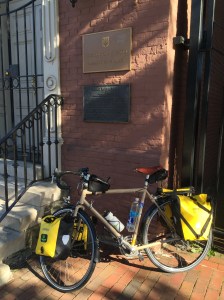
My bike tried to visit Ukraine.

My bike tried to visit Ukraine.

then down the steps by foot and off on the muddy C&O. Once I was on the trails—both trails—I never was lost in the slightest way. The only confusion was at the city ends. I think you would have to work hard to get lost on these paths. One place that was a bit confusing—and that even was just a tiny bit—was just north of the Big Slackwater Causeway near MacMahon’s Mill. Some background (despite the fact that I said I wouldn’t do history herein). When in use, the canal depended on water let in from the Potomac. In a few places you will cross the locks designed to let water in from the river. One stretch of the path though had the boats leave the canal proper and just ride along on a specially dammed section of the Potomac itself. Floods have long since knocked out the narrow towpath that ran along the river, but wise use of Federal funds have replaced those frail paths with more durable concrete causeways. These are a fun treat too after dozens of miles of mud pits. But, they end, and the path in a few places gets a bit funky. I may have been tired or a road zoned, but at one point I rode back to a clear spot to just make sure I had not missed a turn. I had not, the path was just chewed up a bit. That was the closest I came to getting lost on the paths.

Rain. It rained a lot. A lot. Just my luck. I took a day off in Williamsport Maryland partly to hide from a day of downpours. Some people like rain, other do not (I am in the later category). But like it or hate it, rain does some simple empirical things to the ground. On the C&O it made for many many puddles. Closer to DC the path is a dirt and gravel track, but as you get deeper into Maryland, large sections of it become a double track with a grass strip down the middle. These areas in particular seem very susceptible to puddling and pot holes. As always the best thing to do is just hold on and ride right through—trying to swerve to avoid will only lead to trouble. The catch of course is that under that brown water surface may or may not be a big pothole waiting for you. My tires were pumped high—90 psi generally.
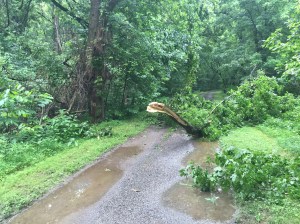
There were a few downed trees. This one and I particularly did not get along well.

There were a few downed trees. This one and I particularly did not get along well. Note the puddles though: that is what most of the C&O looked like after rain.

That made a harder ride, yes, but it eliminated the worry about pinch flats as I went in and out of thumping puddles. The storms downed trees and my only real mishap came in try to ride past one and getting bogged down in the muddy grass on the border. There were a few downed trees. This one and I particularly did not get along well. The resulting scrapes from the resulting fall were pretty minor, and since no one was there to see it, it never happened….right? In some places the mud puddles were pretty heavily rutted to the point of trouble. The south side of the Pawpaw Tunnel for example is one hairy spot. The path is a bit narrower there and with a sheer wall on one side and an 8 foot drop into the canal on the other, it pays to walk through ruts. Much of the path was so flooded even before a big rain that I felt it best to just sit out what promised to be a big ugly day. I know others went ahead, but I have no idea how happy they were about that choice.

Just outside of the town of Big Pool, MD is the 20-some-odd miles of the Western Maryland Rail Trail—a paved former rail line that hugs the course of the C&O very closely. Trail wetness made it too tempting to pass up, and so I had a nice ride with paving under my tires for a short while. Rain on the GAP was just as wet, but it did far less damage to the path itself. Rain will dramatically slow you down on the C&O and make the ride harder: on the GAP it was cold and wet, but had little effect on the ride.

One of the working water pumps. Look for water at the base to set your expectations before pumping.

And speaking of water let me say a bit about supplies of it along the way. The C&O is dotted with campsites—the NPS map shows them all. These are usually equipped with a hand pumped well that produced drinkable, if a little bit iodine flavored water. The catch of course is that not every pump works and there so far no regime for marking the ones that are not operational. The whole trail is owned and maintained by the NPS and they do an excellent job. But, the NPS is woefully underfunded and one result is sluggish maintenance on things like Maryland campsite pumps. The fun of course is figuring out if this pump or that one would work! I only found three that were useless. Sadly for me, one was at Pigman’s Ferry where I spent a night. I had sort of counted on that water for the morning (but ignored the pump until then), so instead I had to refill at Spring Gap a few miles along. But therein lies the point—it was very easy to get drinking water on the C&O.

My camp at Pigman's Ferry.

My camp at Pigman’s Ferry.

The GAP was somewhat different. First off, the trail lacks the regular campgrounds like on the C&O. There were small cleared areas at intervals (benches too, many of which bear the names of people to whom they are dedicated). There are also a few covered picnic tables, often near road crossings. But there were not really campgrounds. Mostly the camping sites were in the form of small sidings popping up here and there. I am a hammock camper, and while there were good trees at most (but not all) of the Maryland campsites, the GAP siding campsites were less than ideal for hammocks. The GAP also lacked the regularity of water supplies. There were streams and falls all over—particularly on the more northerly side. I use Aquamira (a bleach additive) to sanitize my water in the woods since it is very light and that was fine. It also was a rainy week and all streams and falls were quite lively. Some of the trailside towns have provided water supplies right on the path. The ones I recall most clearly are (links below) Meyersdale, Ohiopyle, Connellsville, and West Newton. Frostburg Maryland, has a nice little trail side rest area—but sadly no water as of yet. There also are some formal free campgrounds with shelters and water, but there are mostly north of Connellsville. Recently that town has doubled the number of shelters they graciously provide right next to the path. There are essentially AT-style raised leantos and are wonderful. The pump is north of lean-tos. All told though, between public water supplies, streams, and the occasional store close to the trail, it was easy enough to find water even though it came in a less uniform way than on the C&O.

Speaking of towns, they seem to have two different kinds of relationships with the trails and its many cyclists. One is the “pretend none of this is happening” reaction. The town of Boston, Pa is one of these. There are two or three very nice old homes converted into restaurants and pubs right along the trail on the north end. These cater to cyclists and are worth the visit. But if you make the mistake to turn into town itself as I did, the best you will find is some orange juice in a gas station. Other towns like Deal or Fort Hill are just communities with the trail running through—no supplies no lodging, no interest in being more. Other towns have adopted a completely different attitude and see in the trails and the many credit cards riding along them as antidotes the loss of industrial jobs. The Queen City of this renaissance is Ohiopyle, Pa. The trail runs right along it and that fact, plus a good whitewater site has made the town a seasonal outdoor haven.
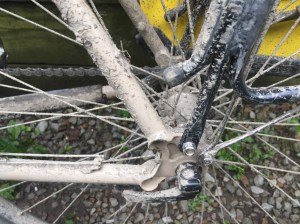
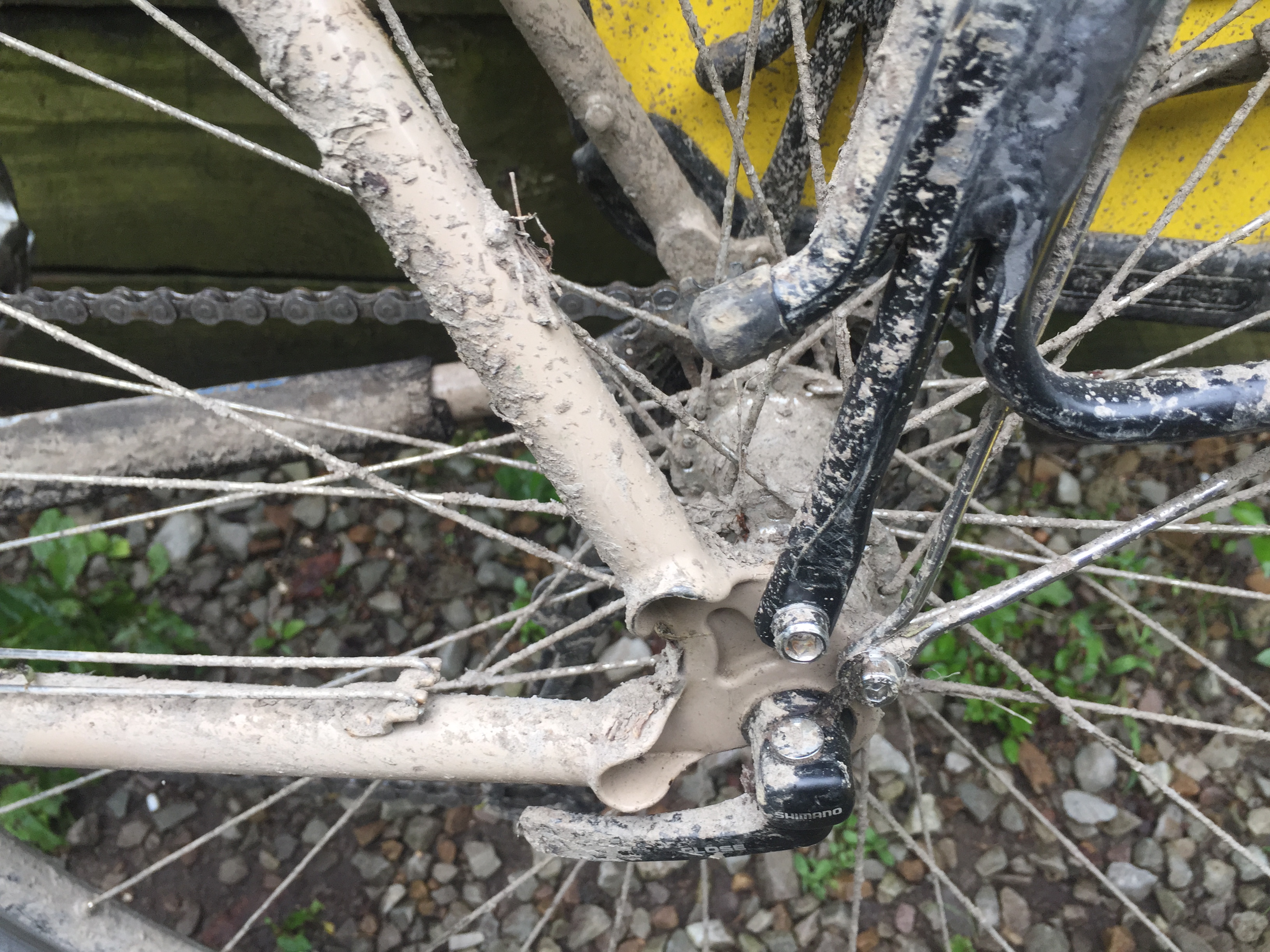
What my bike looked like most of the time.

What my bike looked like most of the time.

Food, lodging, supplies, bike shops and so on all focus on the path. Cumberland Maryland is in the process of reimagining itself as cyclist town and it was a worthwhile stop. Connellsville, Pa has bed and breakfasts about and of course has built a special free campsite. Meyersville, Pa also is turning its eyes towards the trail and has food, supplies, and lodging. West Newton, Pa has set up a welcome center housed in its old rail station. There is water there, info, souvenirs as well. Sadly no supplies, but that is because they do not want to compete with merchants in town. Those merchants are mostly over a bridge off the trail and I am not one for diversions except when really needed. So I did not see West Newton even though it is clearly working to make itself a trail town. I did pull off into Confluence, Pa for groceries and a stop at the bike shop there. Confluence also is remolding itself to be a trail town and the politics of this is visible in the fact that on at least one dead end street some grouch hung a sign saying “No Bicyclists.” That curmudgeon though is losing the battle as the folks in Confluence are friendly and helpful and the town has a lot to help people on the trail.

The Allegheny Trail Alliance and The Laurel Highlands Visitors’ Bureau have pulled together and printed up a uniform set of brochures featuring maps and info for the towns working hardest to make your GAP trip more pleasant. I found copies of these everywhere—from the Visitor Center in Cumberland Md, to the public notice boards near many road crossings.

This what the brochures were like. They were everywhere and were really helpful.

This what the brochures were like. They were everywhere and were really helpful.

There were great and really helped plan things. I wish I had them before hand, so here are the links to the various town brochures in PDF form: MeyersdaleWest Newton; Confluence; Ohiopyle; Rockwood; Connellsville. The C&O passes through fewer towns than the GAP. Brunswick Md is very close to the trail, but I suspect it gets passed over usually in favor of Harpers Ferry, WVa a few miles along. Getting to Harpers Ferry means crossing the rail bridge over the Potomac, and that means hauling your bike up a twisting set of stairs. But Harpers Ferry is an Appalachian Trail town and has the AT headquarters there. Food, supplies, lodging are all there and it is great town to visit. Williamsport, Hancock, and Cumberland Md. are all easier to reach and both have the expected amenities. The celebrated C&O Bicycle shop is in Hancock and has its large bunkhouse out back for cyclist lodging.

The prized C&O souvenir.

The prized C&O souvenir.

It is worth stopping at all the bike shops you can make since that is where you will meet other riders and get info and needed supplies. And repairs of course! I had chain troubles and got some help at the C&O Bicycle Shop and again at the CTC Bike Shop in Cumberland (thanks Wayne once again for the perfectly timed lift and the chat!).

The bike shops are all ready to help and understand the fact that you are rushing along—so service is fast and efficient. I ran into two women heading south who had blown out a tire just outside of Confluence. We managed to get in a new inner tube and they set off to make it to the next road crossing and once there figure out how and where to get a new tire. By the time I reached the Confluence Cyclery a local trail angel had already arrived there having met the women at their road crossing. He was picking up a new tire to run back to the riders so they could get back on their way. When my chain popped on an uphill (the quick lock link gave out!), I was lucky enough to find Wayne right there starting their own ride who graciously postponed it to load my bike on his rack and drive me into town to get a repair. The point is that there are plenty of wonderful and generous local folks who are happy to help riders out when trouble hits. The network is informal, but the pros at the shops all understand the drill and there are people all over who are on your side. Each year more and more people fall into this camp as the trails become more and more central to local economies.

The lock house at Oldtown, Maryland.

The lock house at Oldtown, Maryland.

Charging my devices was not that difficult. Between hotels and towns with places to sit and have coffee, it was easy to recharge. There were outlets in the mens’ room (and presumably the womens’ as well) at the rest area at the Great Falls Tavern Visitor Center. There also is a very nice little museum set up (the only of its kind) on the lock house at Lock 71 near Oldtown.
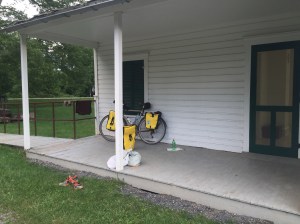
Lock 71 at Oldtown Md was a nice place to rest and tidy up while charging devices.

Lock 71 at Oldtown Md was a nice place to rest and tidy up while charging devices.

As long as it is open there is a fine outlet in there. I sat and dried out a bit on the porch there while the devices recharged. There was nothing quite like this on the GAP, but there more towns as I said before. All in all, the lights and phone were never really low during the trip.

For the most part the ride was fairly easy. My short days were due more to being lazy in town and my longest day—about 75 miles—was pretty easy. In the mud I had no trouble maintaining between 10 ad 12 mph and was faster where it was dry. There is technically a speed limit of 15 mph on the GAP at least, but little enforcement. It was a good ride, but never really that strenuous and as I said before, there were all sorts of riders on all sorts of bikes. It is manageable and a great time.

I hope that this helps you as you plan out your own C&O GAP trip and let me know if I can answer any questions.